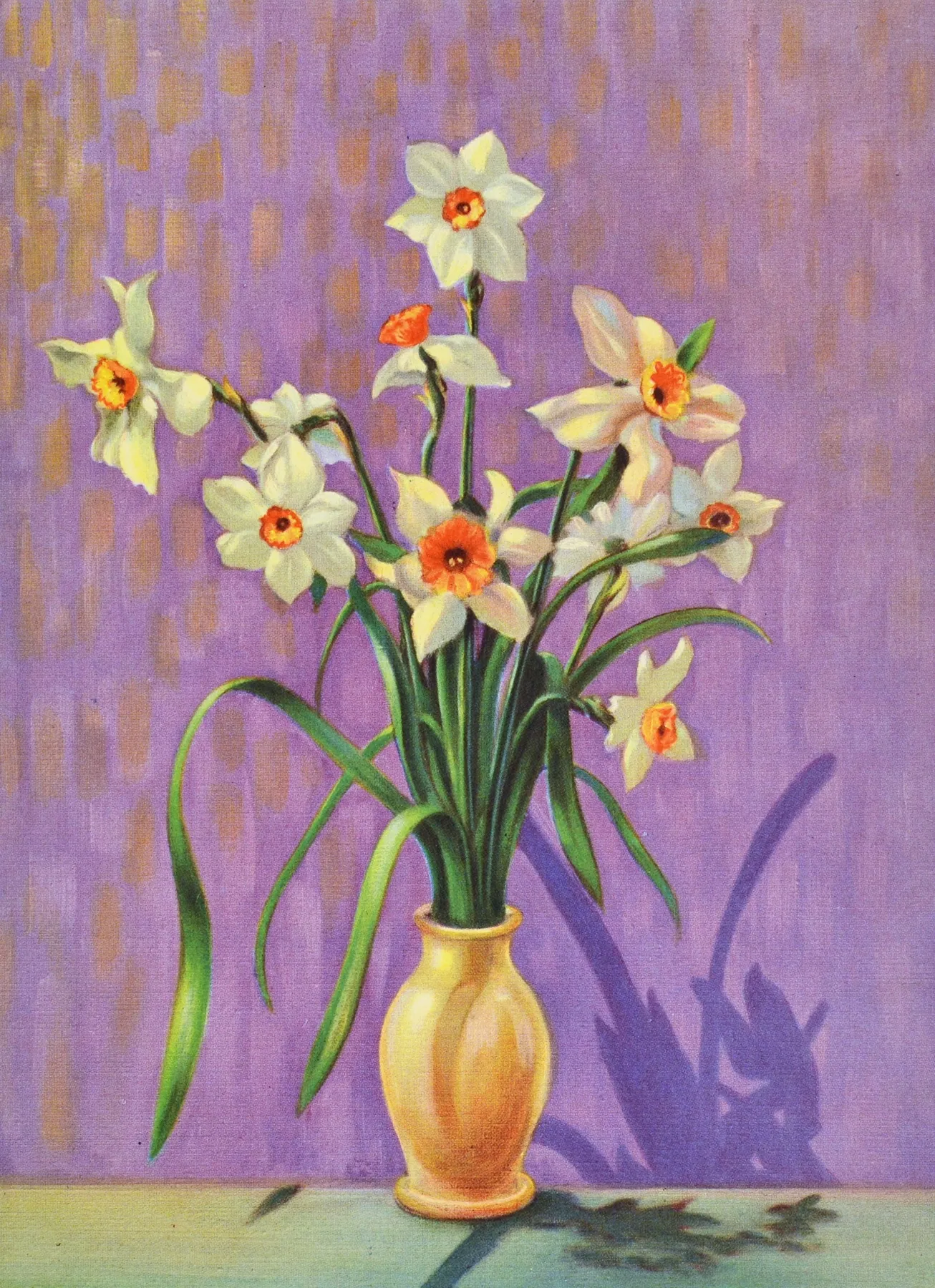
Narcissus (1937)
Ten ways of seeing
- upright 1.38 : 1
First Look
论画以形似,见与儿童邻。
—— 宋·苏轼《书鄢陵王主簿所画折枝》
To judge painting by likeness alone is the view of a child.
The sheet is vertical: the eye climbs and settles in the upper half. Let the plant stand before you look for detail. Then step in close: watch where colour meets line, and whether the line ever breaks. Third, find the darkest small patch: the whole tonal order is measured from there.
Name and Thing
Only the genus Narcissus is given; species-level names came later. No established Chinese name exists, so it is cited by its binomial alone.
Form and Colour
A layered bulb, upright strap leaves, six white tepals and a small golden cup — the Chinese name is 'silver terrace with a golden cup'.No colour group is recorded. A single plant, laid out with nothing hidden.
Composition
Tall and narrow, the plant rising in one movement with generous margins — the upright format of most floras. No details are appended: a plate for looking, not for keying out. Old plates set the plant slightly off centre, with unequal margins — that small imbalance is what keeps it alive.
Line and Colour
After 1900 photography and colour reproduction ran alongside watercolour: accuracy rose, the cut of the burin disappeared. Craft leaves franker evidence than inscriptions. If you mean to copy it: this is a photomechanical record — match the colours directly, do not imitate the printing grain.
Poetic Resonance
疑水仙游泳,向别浦相逢。
—— 《临江仙引·画舸》
The poem gives the mood first and the picture supplies the form; set the line beside the plate and the corolla becomes its resting point.
Symbolism
In China it is the New Year's offering — clear, fragrant, a little otherworldly; in Europe, because of Narcissus, it means self-love and the gaze turned inward. Meanings change their tune: the same flower can say opposite things within a century.
Season and Place
Late winter into early spring: forced in water in the twelfth month, blooming at the New Year. Zhangzhou in Fujian has grown it since Ming times. The year 1937 on the plate is that of publication, not of flowering — the gathering came a year or two earlier. The bud and the ripe fruit on one branch tell the season; the name in the title often tells the journey.
The Book and the Hand
“The language of flowers” carries only Lafayette F. Cargill's name. From drawing to plate the sheet passed through several hands — the engraver aimed at accuracy, the colourist at speed, and between them lies each plate's unevenness.
What to Take Away
Carry three rules away: whole before detail; line before colour; picture before book. The flower of that year is dust, yet its image on paper has outlived every living cousin.