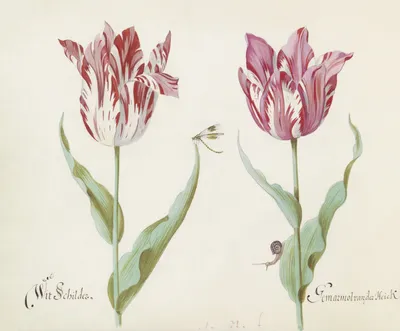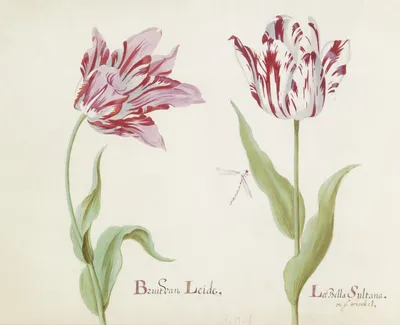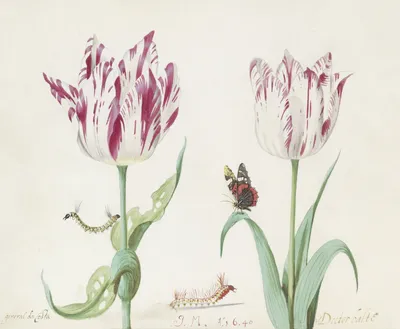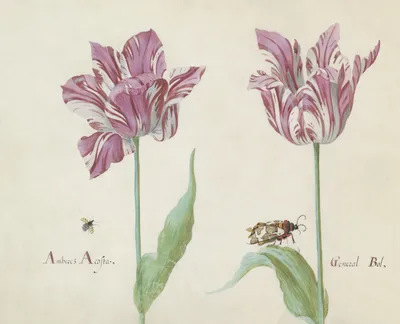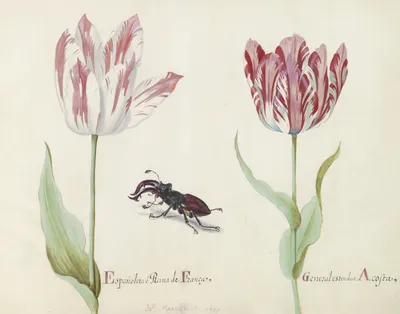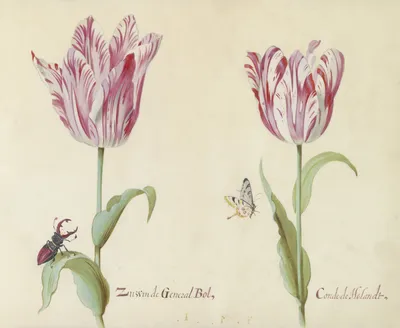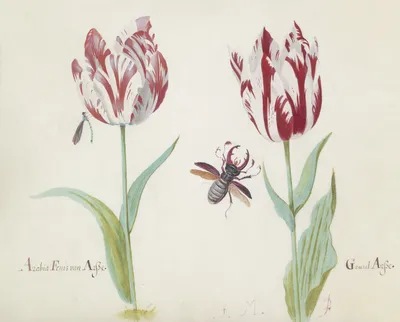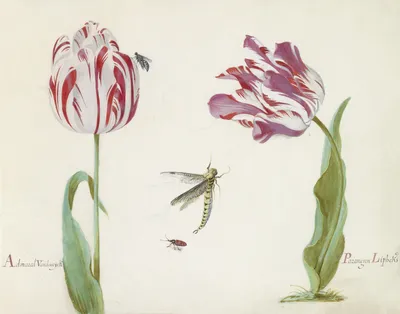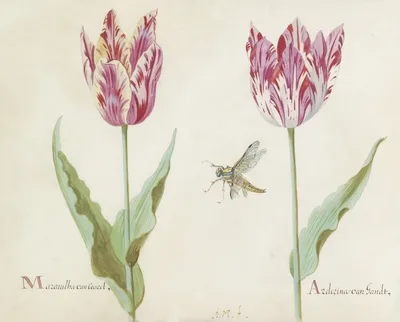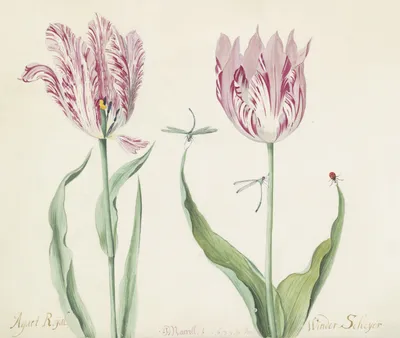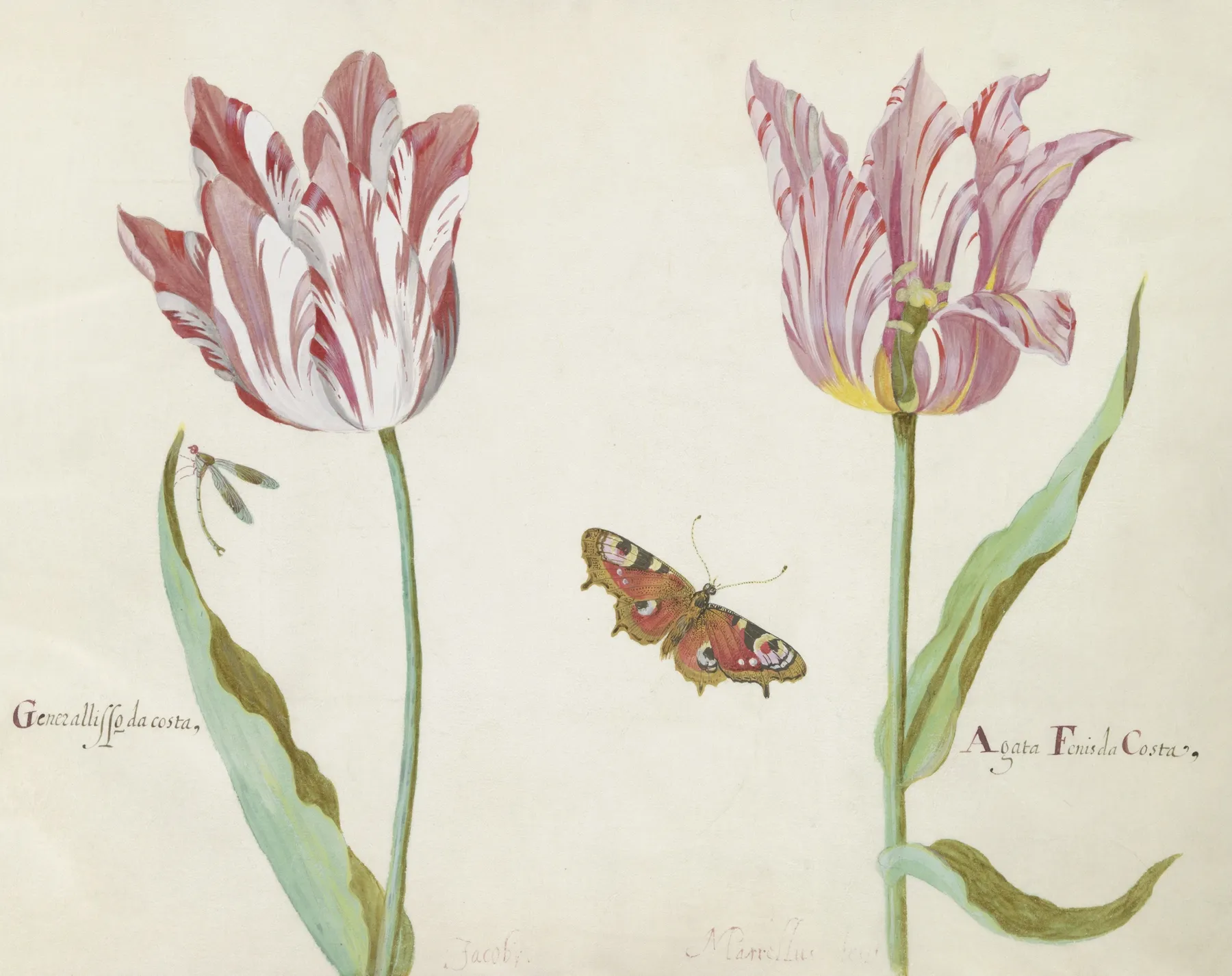
Twee tulpen met waterjuffer en dagpauwoog Generallisso da costa Agata Fenis da Costa (1637)
Ten ways of seeing
- square 0.79 : 1
First Look
搜尽奇峰打草稿。
—— 清·石涛《苦瓜和尚画语录》
Exhaust the strange peaks, and then make the sketch.
Nearly square, plant and detail each holding a corner. Then step in close: watch where colour meets line, and whether the line ever breaks. Third, find the darkest small patch: the whole tonal order is measured from there.
Name and Thing
No reliable binomial survives, so the printed title must serve. Neither name nor binomial survives: the printed title must do.
Form and Colour
A bulb of overlapping fleshy scales gives the lily its Chinese name, 'hundred-fold'; six tepals reflex as the flower opens, around six stamens with long, T-shaped anthers.No colour group is recorded. Read the outline, then the colour layers, then the brush.
Composition
Nearly square, plant and details sharing the corners. No details are appended: a plate for looking, not for keying out. Old plates set the plant slightly off centre, with unequal margins — that small imbalance is what keeps it alive.
Line and Colour
Before 1700 most botanical figures came from woodcut: thick, hard lines in relief, colour brushed on afterwards. Decide first whether it was printed or painted; only then discuss whether it is beautiful. If you mean to copy it: take its skeleton, its margins and the order of its colours; the burin's hatching is the language of copper — suggest it with pencil density, do not imitate it stroke for stroke.
Poetic Resonance
梨花淡白柳深青,柳絮飞时花满城。
—— 宋·苏轼《东栏梨花》
Pear blossoms pale white, willows deep green; when the catkins fly, flowers fill the town.
The poem gives the mood first and the picture supplies the form; set the line beside the plate and the corolla becomes its resting point.
Symbolism
In the West the white lily is Marian purity, held by the angel of the Annunciation; in China the name sounds like 'a hundred years in harmony', a wedding wish. Meanings change their tune: the same flower can say opposite things within a century.
Season and Place
Early to high summer, June and July. Temperate north — China, Japan, Europe. Long used in Chinese medicine, lilies were hunted in East Asia by nineteenth-century collectors and transformed European gardens. The year 1637 on the plate is that of publication, not of flowering — the gathering came a year or two earlier. See this kind of plate in the flowering season if you can: once you have met the living flower, you stop reading only colour.
The Book and the Hand
“The Tulip Book” carries only Jacob Marrel's name. A plate is collective work: drawer, engraver and colourist were different hands, and the unnamed ones decided how good it looks.
What to Take Away
If you keep one line, keep Guo Xi's: from afar its momentum, up close its texture. The flower of that year is dust, yet its image on paper has outlived every living cousin.