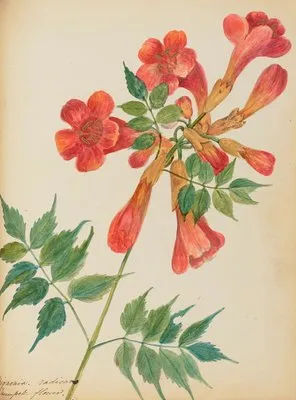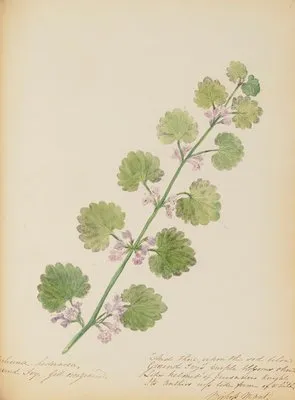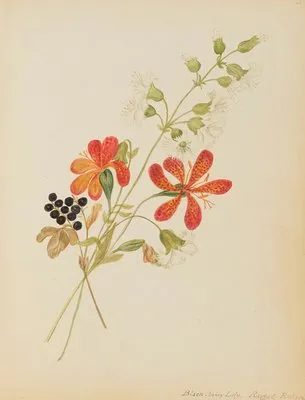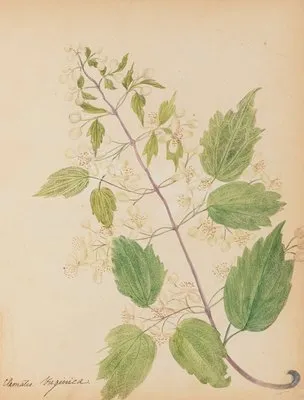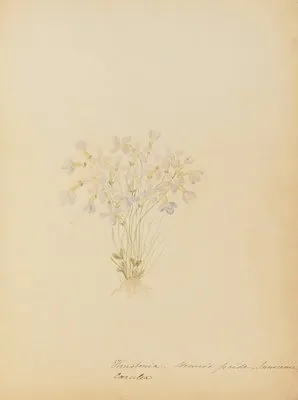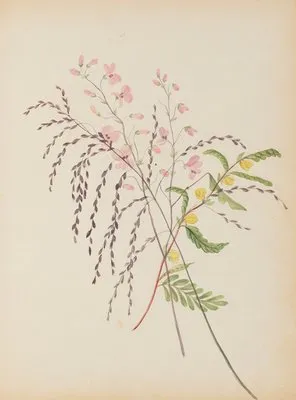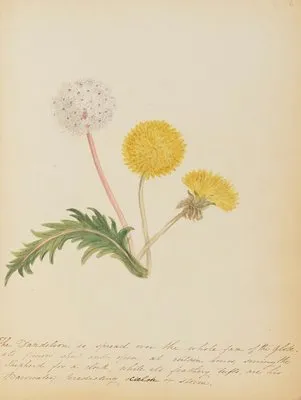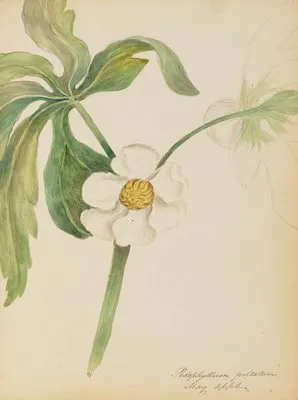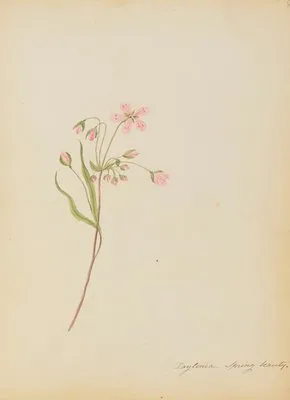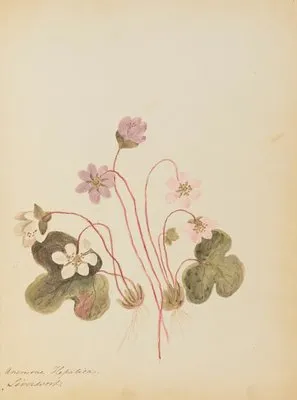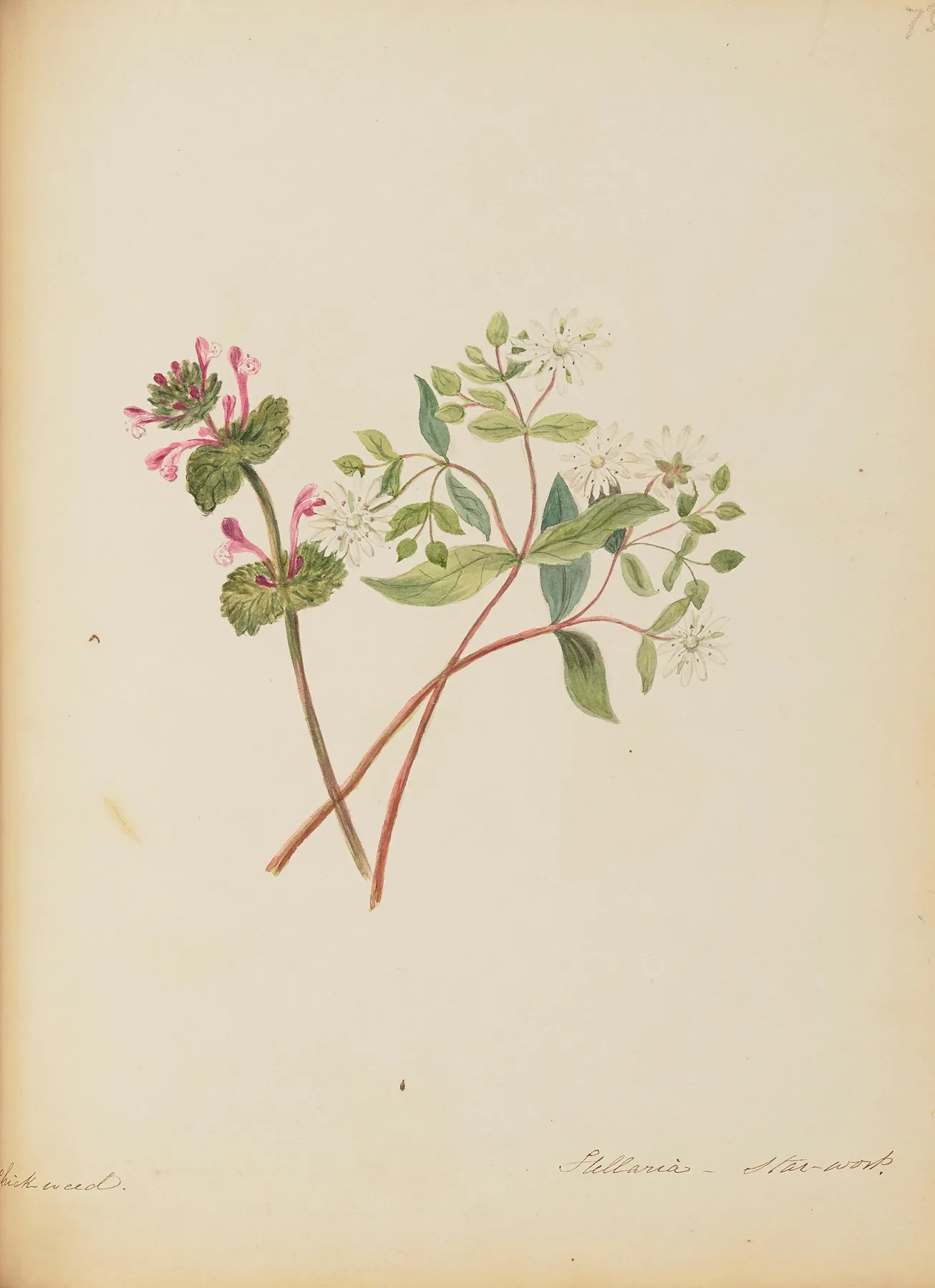
Chick weed. Stellaria- Star-wort (1856)
山雀科
Chick weed. Stellaria- Star-wort (1856)
Ten ways of seeing
- measured cast amber
- upright 1.38 : 1
First Look
真山水之川谷,远望之以取其势,近看之以取其质。
—— 宋·郭熙《林泉高致·山水训》
Mountains and valleys: from afar take their momentum, up close take their texture — the two distances from which any picture is read.
The sheet is vertical: the eye climbs and settles in the upper half. Let the plant stand before you look for detail. Then step in close: watch where colour meets line, and whether the line ever breaks. Third, find the darkest small patch: the whole tonal order is measured from there.
Name and Thing
No reliable binomial survives, so the printed title must serve. The Chinese name 山雀科 is a modern rendering of the Latin, not an old garden name.
Form and Colour
Measured on this plate: flower colour covers 9.4% of the sheet, foliage 0.2%, the cast amber with a second note of yellow-green. No other plate shares exactly this measure. Wildflowers are rarely tidy: small blooms, slender stems, leaves imperfect and often chewed. That untidiness is exactly what records wind, light and soil.No colour group is recorded. Three things fix the habit: leaf arrangement, tepal count, and how the flower is borne.
Composition
The sheet is tall. No details are appended: a plate for looking, not for keying out. The plant fills 94% of the sheet, centred near the centre — the herbarium way, drawn to be read whole.
Line and Colour
In the later nineteenth century chromolithography took over: colour printed rather than painted, line demoted. Take a loupe to three places: petal edge, leaf vein, caption. An unbroken line means engraving; colour crossing the outline means a hand. If you mean to copy it: block in the broad shapes and colours first, detail last; lithographic softness comes from thin washes — two or three pale layers will get you close.
Poetic Resonance
终日白云应自足,明年芳草又何如。
—— 唐·皇甫冉《酬權器》
The poem gives the mood first and the picture supplies the form; set the line beside the plate and the corolla becomes its resting point.
Symbolism
In Chinese verse wildflowers bloom unseen, owing nothing to praise; in the West they mark a place — one species, one landscape's character. Flower language was added later; the flower knows nothing of it, and that innocence is part of its power.
Season and Place
By latitude and altitude. they resent transplanting and will not mass in a border — the difference between a wildflower and a garden flower. The year 1856 on the plate is that of publication, not of flowering — the gathering came a year or two earlier. Read the locality and the flowering season both with a discount: one is hearsay, the other a ten-day peak.
The Book and the Hand
“Wild flowers of Georgetown, DC” carries only Rebecca Nourse's name. From drawing to plate the sheet passed through several hands — the engraver aimed at accuracy, the colourist at speed, and between them lies each plate's unevenness.
What to Take Away
Appreciation is not knowledge but habit — one more look each time. The flower of that year is dust, yet its image on paper has outlived every living cousin.
About this plate
Chick weed. Stellaria- Star-wort (1856) is plate 72, from Wild flowers of Georgetown, DC, drawn by Rebecca Nourse. This public-domain plate is reproduced at high resolution, free to view and download. Publication: Georgeotwn, D.C., 1856.