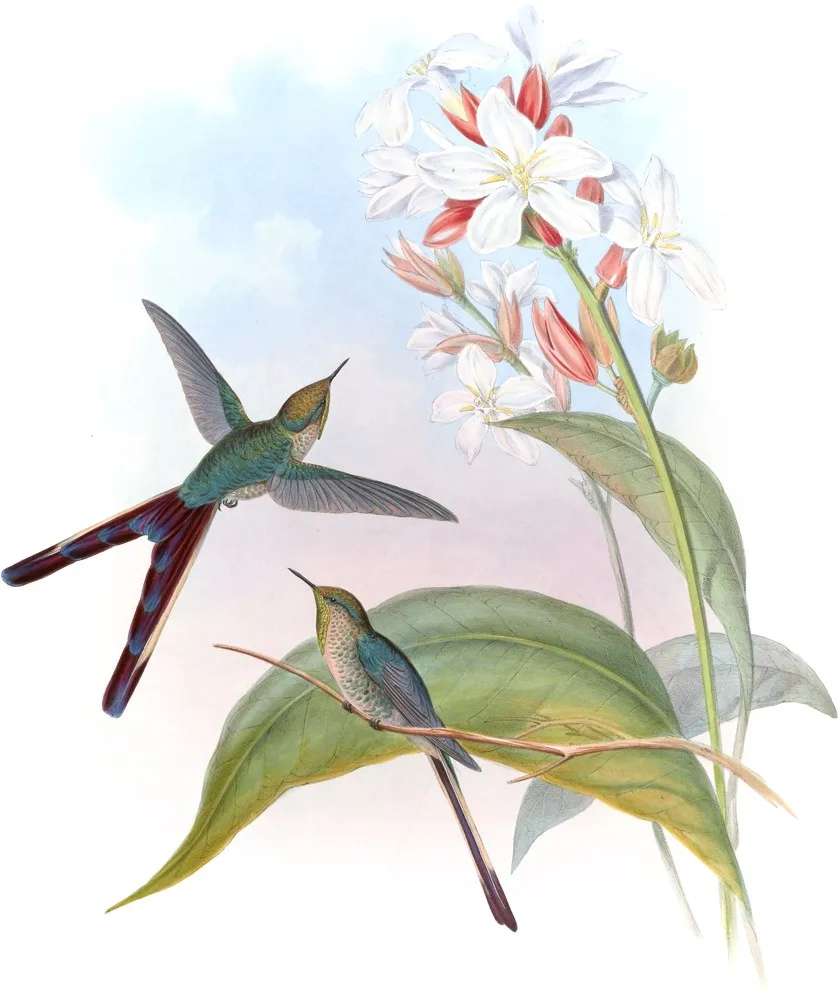
Cometes? Glyceria
Cometes? Glyceria
Purple-tailed Comet
- 学名
- Cometes? Glyceria
- 合集
- 古尔德蜂鸟图谱
- 绘者
- John Gould(约翰·古尔德)
- 年代
- 1852
- 图版号
- Pl. 176, Vol. III
- 原书页码
- p.176
- 授权
- CC0 1.0 Universal (Public domain)
关于本图版
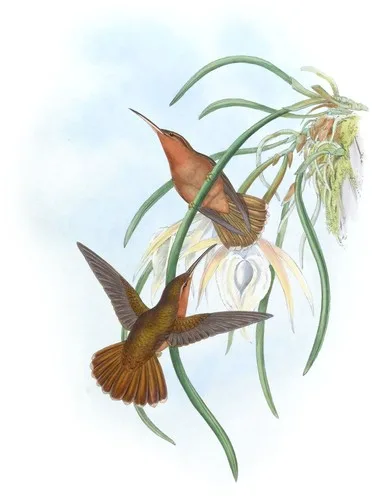
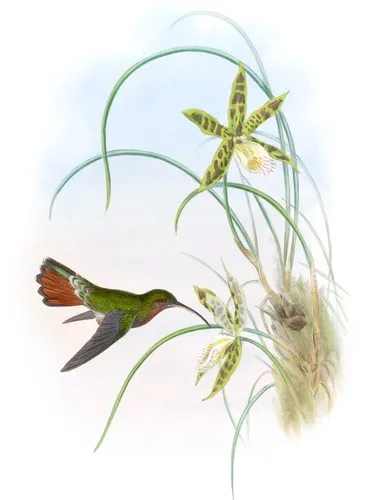
此图原刊于《古尔德蜂鸟图谱》(Gould's Hummingbirds),绘者为约翰·古尔德,成书于 1849—1887 年间。原书题作“Cometes? Glyceria”,归入蜂鸟科(Trochilidae)。
全编共收录 421 幅图版,本图是其中一幅,原书将其列为 Pl. 176, Vol. III,见第 176 页,版式为纵幅。图为公有领域原件的修复扫描,构图与设色未经改动。
原书文字(英文 / 法文)
Popayan in New Granada
During the many years that I have given attention to the Trochilidæ, I have not met with a bird which has caused me more thought, and I may say perplexity, than the one represented on the accompanying Plate.
In point of affinity it is intimately allied to the members of the genera Lesbia, Cometes and Cynanthus, partaking as it does, either in form or colouring, of characters pertaining to each of those genera. Sometimes it has occurred to me that it might be a hybrid between either two of them, but I am perfectly at a loss to say which two species would be likely to produce such a cross. Such an idea has entered my mind, but when I have again and again reconsidered the matter, it has appeared to me that it is a distinct species, and that it may ultimately prove to be the female or young male of some gorgeous bird with which we are at present unacquainted. The only example known, and which is in my own collection, was procured by M. Mossa, near Popayan in Columbia, and by him sent to M. Parzudaki of Paris, from whom I obtained it.
I regret to find that some confusion exists with regard to the specific name of this fine bird. Aware of its interest in a scientific point of view, I exhibited the specimen to the Natural History Section of the British Association for the Advancement of Science, at their meeting in Hull in 1853, and suggested the name of Mossai as its specific appellation; but in an after-conversation, my friend the late Prince Charles Lucien Bonaparte advised me to give it the name of Glyceria as being a more appropriate name for so beautiful a bird, and this name having appeared in the Prince’s and other lists of the family prior to the publication of the British Association Report, it is the one which must be adopted. M. Mossa being thus deprived of the compliment I had intended him, I beg here to testify to the value of his discovery, and to record my sense of M. Parzudaki’s kindness in giving me the first offer of so fine a bird.
On the tip of the hind-claw, I find a hard, agglutinated, wax-like mass which is irremoveable; as I have seen nothing like it in any other member of the family, I have thought it only right to mention it.
Head, back of the neck, wing-coverts, back and tail-coverts deep shining green; wings purplish brown; chin and throat metallic light olive-green; sides of neck and under surface buff, with a spot of deep shining green on the tip of each feather; tail dark reddish purple, passing into deep bluish green at the tip, except on the outer feathers, where the hue is so faint as to be scarcely perceptible; the outer feathers also have the basal three-fourths of the shafts and the outer webs buffy white, the base of the shaft paler than the web; basal three-fourths of the shaft of the next feather also buffy white; under tail-coverts buff, with a brown mark in the centre near the tip.
The figures are of the natural size. The plant is the Erythrochiton Brasiliense.
References
- Cometes Mossai, Gould, in Athenaeum, Sept. 24, 1853.—Ib. Report of Brit. Assoc. 1853, p. 68.
- Lesbia glyceria, Bonap. Rev. et Mag. de Zool. 1854, p. 252.
十二观
- 略纵 1.19∶1
- 1852 年刊
- 图版 176, Vol. III
这不是词条,是一条看画的次序:先站定看整体,再看名字与形色、构图与刀工,然后问它几时开、从哪里来、经了谁的手;最后是中国诗文——同一朵花,中国古人是怎么看的。十二观读完,这幅图就打开了。
-
第一眼
六法者何?一、气韵生动是也;二、骨法用笔是也;三、应物象形是也;四、随类赋彩是也;五、经营位置是也;六、传移模写是也。
—— 南齐·谢赫《古画品录》
一千五百年前的六条标准:气韵、用笔、形似、设色、构图、临摹。你在这幅图上一样样对过去,就是一次完整的读画。这一幅略高于宽,落点在中央偏上那只鸟的头部。第二步凑近一寸:看线与色的交界,色有没有压住线,线有没有断。第三步,把视线放到最深的那一小块:整幅的用色秩序,都是从那里排开的。
-
名与实
此幅未见可靠的学名,只能以原书题名相称——早期图谱里这种情形并不少见。此幅既无通行中文名,学名也不可靠,只能以原书题名相称——图谱里总有几幅这样的图,只能靠画面本身说话。
-
形与色
蜂鸟为美洲最小之鸟,喙细长如针,舌分叉成管,可伸入花心吸蜜;翼小而振频极高,能悬停、能倒飞。此幅未作色相归档,只能就形制论。此幅只画一个种,形制的每一处都摊在纸面上,没有遮掩。
-
构图与呼吸
画幅略高于宽,鸟身居中偏上,视线落在头部与喙。(高宽比约 1.19∶1)全幅只画一只,不作解剖附图——这类图更近于“观赏”,而非“鉴定”。试着用拇指遮住空白处——画面立刻变闷;放开,它才重新“喘上气”。留白,是给主体让出的气口。
-
一刀一色
十九世纪后半叶,石版与彩色石印渐成主流:颜色可以直接印出,不再依赖手工,线条反倒退居其次。图像的“准确”提高了,手性却淡了。先判断它是“印”的还是“画”的,再谈好不好看——这是看老版画最实用的一条规矩。
-
时序
热带美洲几乎全年可见,花期即其季节;温带种类的蜂鸟则随花北迁,一年往返数千公里。图上所记的 1852 年是刊行之年,不是采到那只鸟的年份;真正的观察记录通常比出版早一两年。看这一类图最好的时候,是它的花期:文字说不清的“开得正盛”,在树下站三分钟就懂了。
-
故土
仅产美洲,自阿拉斯加南部至火地岛,以安第斯山最为繁盛。中土无蜂鸟,汉籍不载,晚清海外游记始见其名。同一部图谱里,同类往往排在一起;把几幅并看,差别比单看一幅清楚得多。
-
书与人
《古尔德蜂鸟图谱》(Gould's Hummingbirds)由约翰·古尔德绘,成于1849-1887。此幅为其中图版 176, Vol. III,见原书第 176 页。图谱是集体工程:绘图、刻版、上色、编纂各有其人,署名的往往只有第一个。
-
诗境
夫列子御风而行,泠然善也,旬有五日而后反。
—— 《庄子·逍遥游》
蜂鸟悬停于空,不落不飞,最近于“御风”。庄子说的是一种自由的姿态,蜂鸟把它做成了生理事实。古人写到这一层,已不只是赏花,是借花说人;画面则只负责把那朵花留住。
-
文心
人无癖不可与交,以其无深情也。
—— 明·张岱《陶庵梦忆》
一个人若没有痴迷的东西,就不值得交往——因为他没有深情。看画看到入迷,本身也是一种德行。古尔德《蜂鸟图谱》(1849—1887)以石版手工上色,金箔衬底,使羽色在纸上仍有金属光;这套图册本身就是十九世纪印刷与收藏狂热合流的产物。中外的分别不在谁高明,而在问的问题不同:欧洲问它是什么,中国问它像谁。两个问题都答了,一幅图才算读完。
-
花语
阿兹特克以蜂鸟为战神与太阳的化身;欧洲维多利亚时代则以蜂鸟为收藏与装饰的极致,百万只羽毛被做成胸饰。中国旧籍无此鸟,故无象征——这空白本身,就是一部博物学交流史。花语是后人添上去的,花本身并不知道;但这层“不知道”,正是它最动人的地方。
-
带走一双眼睛
下次看鸟,别急着认名:先看它停的姿态,再看羽色在哪一段最深,最后才翻图鉴——顺序一换,看鸟就从“对答案”变成了“看画”。图谱的用意是“以备查考”,看久了却会忘记查考:1852 年的一个人,为一只鸟花了整整一天。