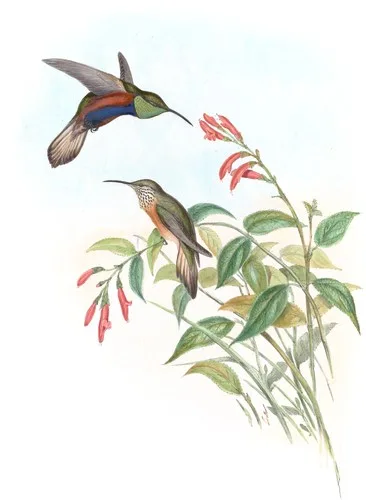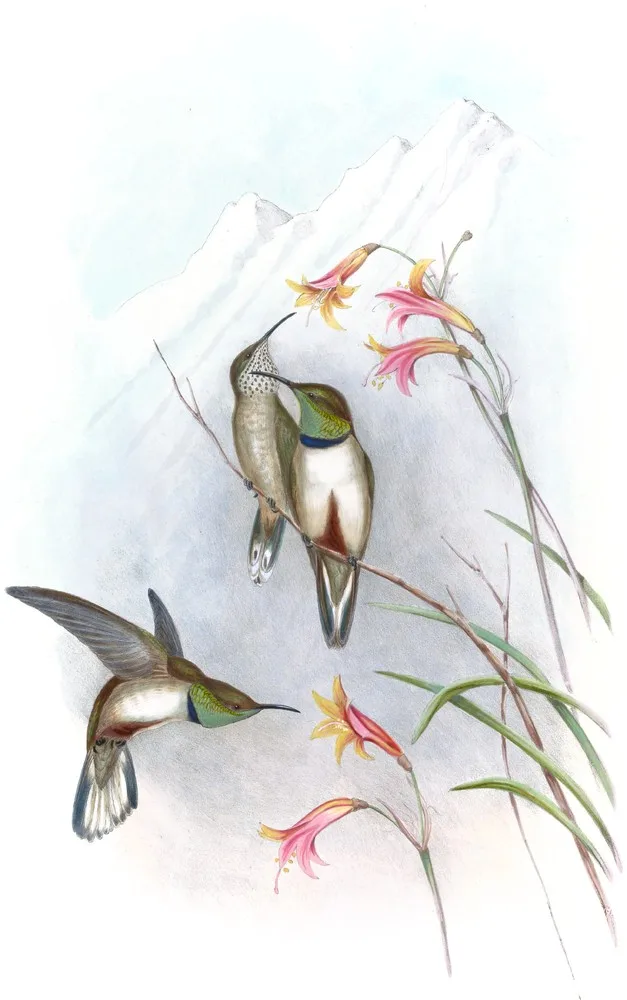
Oreotrochilus Estellæ
Oreotrochilus Estellæ
Estella’s Hill-star
- 合集
- 古尔德蜂鸟图谱
- 绘者
- John Gould(约翰·古尔德)
- 年代
- 1850
- 图版号
- Pl. 70, Vol. II
- 原书页码
- p.70
- 授权
- CC0 1.0 Universal (Public domain)
关于本图版
本图选自约翰·古尔德的《古尔德蜂鸟图谱》(Gould's Hummingbirds),原书 1849—1887 年间出版。原书题作“Oreotrochilus Estellæ”,在分类体系中列于蜂鸟科(Trochilidae)。
该合集全编共 421 幅图版,此图为其中之一,图版编号 Pl. 70, Vol. II,对应原书第 70 页,版式为纵幅。图像由公有领域原件扫描修复而来,细节在放大视图中仍清晰可辨。
原书文字(英文 / 法文)
The high lands near La Paz in Bolivi
If M. D’Orbigny was not the first who discovered, he was certainly the first who described this fine species of Humming Bird, the rarity of which in our collections may be attributed to the circumstance of its being an inhabitant of those high mountain ranges which are rarely visited by European travellers and naturalists.
“We have only met with this charming species,” says M. D’Orbigny, “in the valley in which is situated the town of La Paz, in Bolivia, at the foot of the western side of the eastern Cordilleras. It inhabits dry and elevated places, at an altitude of more than 11,000 feet above the level of the ocean. It is solitary in its habits, flits about from flower to flower, and often rests upon shrubs and trees. Its food consists of insects of various kinds,” and the pollen of flowers.
Mr. Bridges procured numerous examples during his late expedition into Bolivia, some of which were obtained at a higher elevation than that mentioned by M. D’Orbigny.
The sexes offer very considerable differences in their size and plumage, the female being by far the smaller bird, and entirely wanting the rich green of the throat which is so conspicuous in the male. The young males of the year assume an intermediate style of colouring, the green of the throat being obscurely indicated, and the mark on the centre of the abdomen being much less apparent than in the adult.
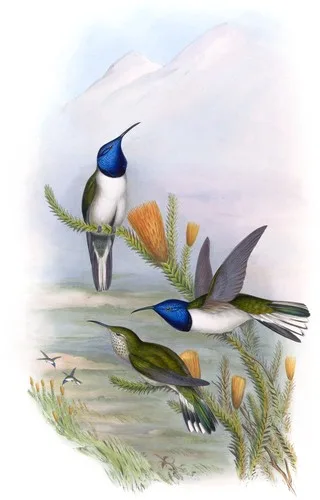
The male has the head, all the upper surface and wings greyish olive-brown, passing into dull coppery green on the upper tail-coverts; two centre tail-feathers and the outer one on each side, (which has an inward curvature,) green with bronze reflexions, the remainder narrowly edged on the external webs with brown; throat rich luminous grass-green, bounded below with a crescentic band of deep velvety black with blue reflexions; flanks olive-brown; breast and sides of the abdomen white; down the centre of the abdomen a mark of chestnut; under tail-coverts olive with green reflexions; tarsi clothed with brown feathers; bill and feet brownish black; irides blackish brown.
Total length, 5
The female has the upper surface the same as the male; the two middle tail-feathers brownish green, the remainder white with a band of green across the centre: the outer feather on each side, which is much shorter than the rest, less pointed, and less inwardly curved than in the male, is of a browner hue with bluish green reflexions; throat white, regularly spangled with brown, obscurely tinted with blue; chest and abdomen brownish white, the brown predominating on the flanks.
Total length, 4
The figures represent the two sexes of the natural size. The plant is the Phycella Herbertiana.
References
- Trochilus Estella, D’Orb. et Lafr. Syn., No. 31. p. 32.—D’Orb. Voy. dans l’Amér. Mérid., tom. iv. p. 376.
- Orthorhynchus Estella, D’Orb. Voy. dans l’Amér. Mérid., Atlas, Ois., pl. 61 fig. 1.
- Trochilus Ceciliæ, Less. Rev. Zool. 1839, p. 43.
- Oreotrochilus Estella, Gould in Proce. of Zool. Soc., Part XV. 1847, p. 10.—Gray and Mitch. Gen. of Birds, Oreotrochilus, sp. 1.