棕煌蜂鸟
Selasphorus rufus
Selasphorus rufus
Rufous Flame-bearer
- 中文名
- 棕煌蜂鸟
- 学名
- Selasphorus rufus
- 合集
- 古尔德蜂鸟图谱
- 绘者
- John Gould(约翰·古尔德)
- 年代
- 1852
- 图版号
- Pl. 137, Vol. III
- 原书页码
- p.137
- 授权
- CC0 1.0 Universal (Public domain)
关于本图版
这幅图版出自《古尔德蜂鸟图谱》(Gould's Hummingbirds),由约翰·古尔德绘制,1849—1887 年间出版。画面主体是棕煌蜂鸟(Selasphorus rufus),归入蜂鸟科(Trochilidae)。
全编共收录 421 幅图版,本图是其中一幅,原书将其列为 Pl. 137, Vol. III,见第 137 页,版式为纵幅。图为公有领域原件的修复扫描,构图与设色未经改动。
原书文字(英文 / 法文)
Mexico. In summer it also occurs in California, and even as far north as Nootka Sound, and sometimes at Sitka.
Elegant in all its proportions, refulgent in the colouring of its throat, associated with the past as one of the many interesting discoveries of our celebrated Navigator Captain Cook, and remarkable for resorting to extremely high latitudes for the purpose of breeding, this little Humming-Bird has claims to our notice exceeding those of most of its congeners; it is interesting too, on account of the vast extent of country over which it is spread, its range extending over Mexico and North America, but being, however, exclusively confined to the Western or Pacifie side of that great Continent, where it represents the well-known Trochilus colubris, the range of which appears to be as exclusively confined to the Western or Atlantic portion.
The great country of Mexico may be considered as its proper habitat during the months of winter. I have frequently received it from Guatemala, and from this its most southern limit, it is very abundant along the great chain northwards, through California and the Rocky Mountains to Sitka, and perhaps in some seasons to within the Russian territory. Captain Cook found it in abundance at Nootka Sound, and every traveller who has visited the mouth of the River Columbia, speak of it as an object the beauty of which never failed to arrest his attention while inhabiting those regions. After the summer is over and gone, and the powerful rays of the sun are deflected towards the more southern parts of the Continent, it retraces its steps towards the congenial climate of Mexico, where insect life is at this season still sufficient for its wants; this little wanderer, therefore, unlike many other species, which appear to be stationary, passes over a vast range of country, and is strictly a migrator; and, as is generally the case with birds having this habit, it is only in certain seasons that it bears the fine flame-coloured gorget as figured in the accompanying Plate. ‘The period when this part is most radiant is that immediately preceding the pairing or breeding season, and in no instance have I found specimens collected in Mexico at all equal in beauty to those obtained in more northern climes. Exposure to light, the rapidity of flight, the process of constructing their nest, and the frequent combats in which these little furies are engaged, all doubtless tend to diminish the beauty and purity of their plumage; perfect specimens, therefore, can only be obtained during their spring passage, or immediately after their arrival at their summer residence.
This species, more fortunate than most of its family, has had some interesting accounts of its habits and economy recorded by various writers, which, in the absence of any opportunities for observing them myself, I cannot perhaps do better than transcribe in their own words, as given in Audubon’s ‘Ornithological Biography,’ &c.
“We began,” says Mr. Nuttall, ‘to meet with this species near the Blue Mountains of the Columbia River, in the autumn, as we proceeded to the west. These were all young birds, and were not very easily distinguished from those of the common species of the same age. We now for the first time (April 16) saw the males in numbers, darting, burring and squeaking in the usual manner of their tribe; but when engaged in collecting its accustomed sweets in all the energy of life, it seemed like a breathing gem, or
magic carbuncle of glowing fire, stretching out its gorgeous ruff, as if to emulate the sun itself in splendour. Towards the close of May the females were sitting, at which time the males were uncommonly quarrelsome and vigilant, darting out ait me as I approached the tree, probably near the nest, looking like an angry coal of brilliant fire, passing within very little of my face, returning several times to the attack, sinking and darting with the utmost velocity, at the same time uttering a curious reverberating sharp bleat, somewhat similar to the quivering twang of a dead twig, yet also so much like the real bleat of some small quadruped, that for some time I searched the ground instead of the air, for the actor in the scene. At other times the males were seen darting up high in the air, and whirling about each other in great anger and with much velocity. After these manceuvres the aggressor returned to the same dead twig, where for days he regularly took his station, displaying the utmost courage and angry vigilance. The angry hissing or bleating note seems something like wht’ t’ t’ t’ t’ sh vee, tremulously uttered as it whirls and sweeps through the air, like a musket-ball, accompanied also by something like the whirr of the Night Hawk. On the 29th of May I found a nest in a forked branch of the Nootka Bramble, Rubus nutkanus. The female was sitting on two eggs of the same shape and colour as those of the common species, T. colubris. The next also was perfectly similar, but somewhat deeper. As I approached, the female came hovering round the nest, and soon after, when all was still, she resumed her place contentedly.”
Dr. Townsend’s note is as follows:—“Nootka Sound Humming-Bird, Trochilus rufus, Ah-puets-Rinne, of the Chinnooks. On a clear day the male may be seen to rise to a great height in the air, and descend instantly near the earth, then mount again to the same altitude as at first, performing in the evolution the half of a large circle. During the descent it emits a strange and astonishingly loud note, which can be compared to nothing but the rubbing together of the limbs of trees during a high wind. I heard this singular note repeatedly last spring and summer, but did not then discover to what it belonged. I did not suppose it to be a bird at all, and least of alla Humming-Bird. The observer thinks it almost impossible that so small a creature can be capable of producing so much sound. TI have never observed this habit upon a dull or cloudy day.”
“The nest,” says Audubon, “which measures two inches and a quarter in height, and an inch and three quarters in breadth at the upper part, is composed externally of mosses, lichens, and a few feathers, with slender fibrous roots interwoven, and lined with fine cottony seed-down.”
By many writers the Little Brown Humming-Bird of Edwards (Trochilus ruber of Linnæus) has been considered identical with the present bird, but I am at a loss to conceive how such an error could have arisen, since on examining Kdwards’s figure it will at once be seen that it represents a bird of a totally different form, probably a Phaëthornis, but what species it is almost impossible to determine.
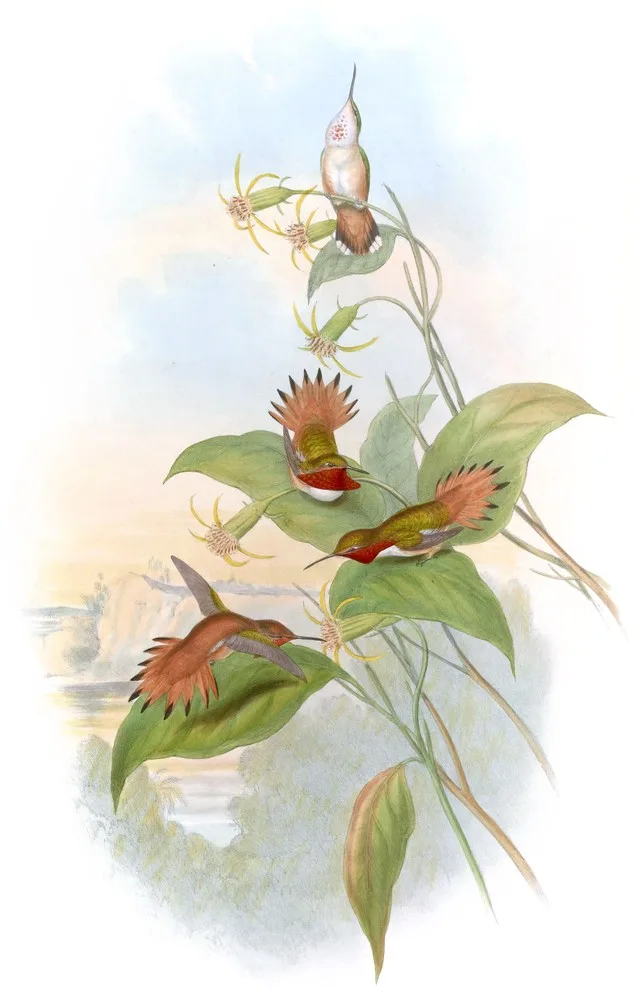
The adult male has the head brown; all the upper surface and the tail, the feathers of which are of a broad lanceolate form, cinnamon-brown, with a mark of dark brown down the tip of each of the tail: feathers; wings purple-brown; wing-coverts bronzy brown; throat luminous orange-red; breast white, tinged with red; under surface cinnamon-brown, inclining to white on the centre of the abdomen; bill brownish black; feet brown.
The above is the usual colouring, but I have occasionally seen fully adult males with the rich gorget, in which the colouring of the back was totally different, being of a golden green, and presenting so great a contrast as almost to induce a belief that they were of a different species.
The female has the upper surface golden green, the head brownish; the upper tail-coverts and the base of the tail-feathers rufous, the remaining portion of the tail-feathers being brownish black tipped with white; under surface white, tinged with rufous on the sides and under tail-coverts, the throat having a roundish spot of fiery metallic red near the tip of most of the feathers; the female also differs in having the tail-feathers short and rounded at the tip instead of the broad and lanceolate form of those of the male.
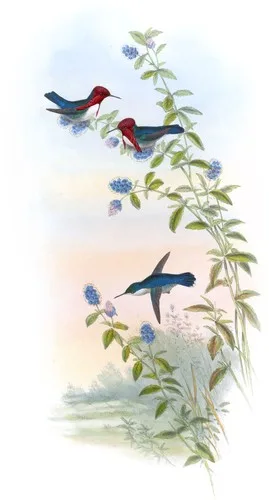
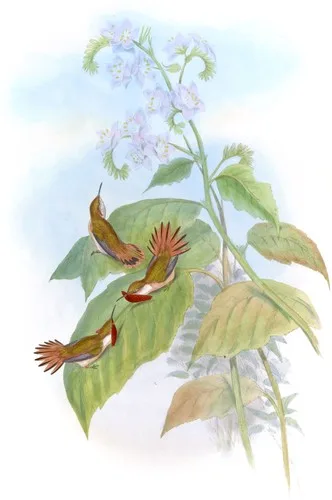
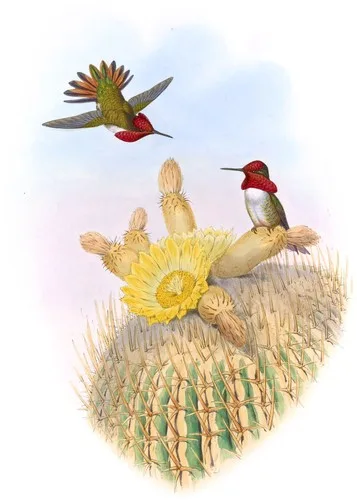
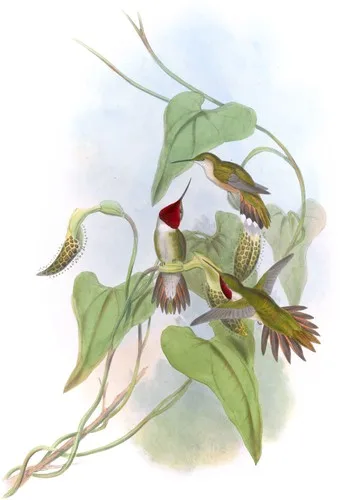
The Plate represents three males and a female on the Gynoxys fragrans; all of the natural size.
References
- Trochilus rufus, Gmel. Edit. Linn. Syst. Nat., vol. i. p. 497.—Jard. Nat. Lib. Humming-Birds, vol. u. p. 71. pl. 2.—Aud. Birds of Am., vol. iv. pl. 379.—Ib. Orn. Bio., vol. iv. p. 555.
- Trochilus collaris, Lath. Ind. Orn., vol. i. p. 318.—Vieill. Hist. Nat. des Ois. de l’Am. Sept., tom. u. p. 75.
- Trochilus Sitkensis, Rathke.
- Le Sasin, Aud. et Vieill. Ois. dor., tom. i. p. 110. pls. 61, 62.
- Ornismya Sasin, Viess. Hist. Nat. des Ois. Mou., p. 190. pls. 66, 67.—Id. Supp., p. 121. pl. 11. p. 128. pl. 12. p. 124. pl. 13.—Id. Less. Troch., p. 117. pl. 43.
- Ruff-necked Humming-Bird, Lath. Gen. Syn., vol. i. p. 785. pl. 35.—Id. Supp., p. 135.—Shaw, Gen. Zool., vol. viii. p. 343.—Lath. Gen. Hist., vol. iv. p. 350. pl. 78.
- Ruff-necked Honey-sucker, Penn. Arct. Zool., vol. ii. p. 177.
- Trochilus (Selasphorus) rufus, Swains. and Rich. Faun. Bor. Am., vol. ii. p. 324.
- Trochilus ruber, Brandt, Icon. Av. Ross., tab. 1, 2.
- Selasphorus rufus, Aud. Syn. Birds of Am., p. 171.
- Melhisuga rubra, Gray and Mitch. Gen. of Birds, vol. i. p. 113, Mellisuga, sp. 60.
- Selosphorus ruber, Bonap. Consp. Gen. Av., p. 82, Selosphorus, sp. 1.
- Calliphlox rufa, Gambel in Proc. of Acad. Sci. Philad., Oct. 1846, p. 111.