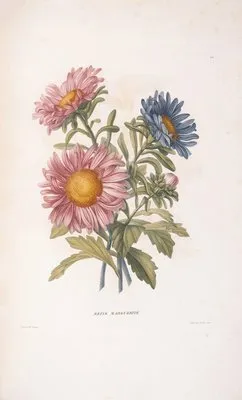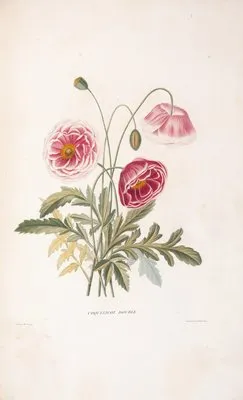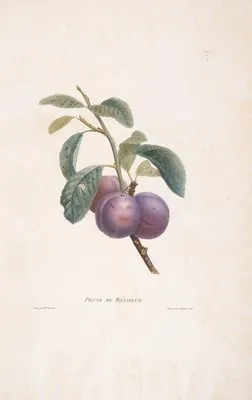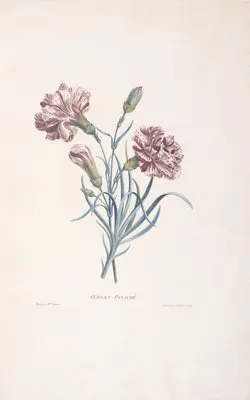
Iris Bleu (1820)
Iris Bleu (1820)
Iris Bleu (1820)
Ten ways of seeing
- measured cast blue
- upright 1.67 : 1
First Look
江馆清秋,晨起看竹,烟光日影露气,皆浮动于疏枝密叶之间。
—— 清·郑板桥《题画竹》
On an autumn morning at the river lodge I looked at the bamboo: mist, sunlight, dew, all drifting among the sparse and dense leaves.
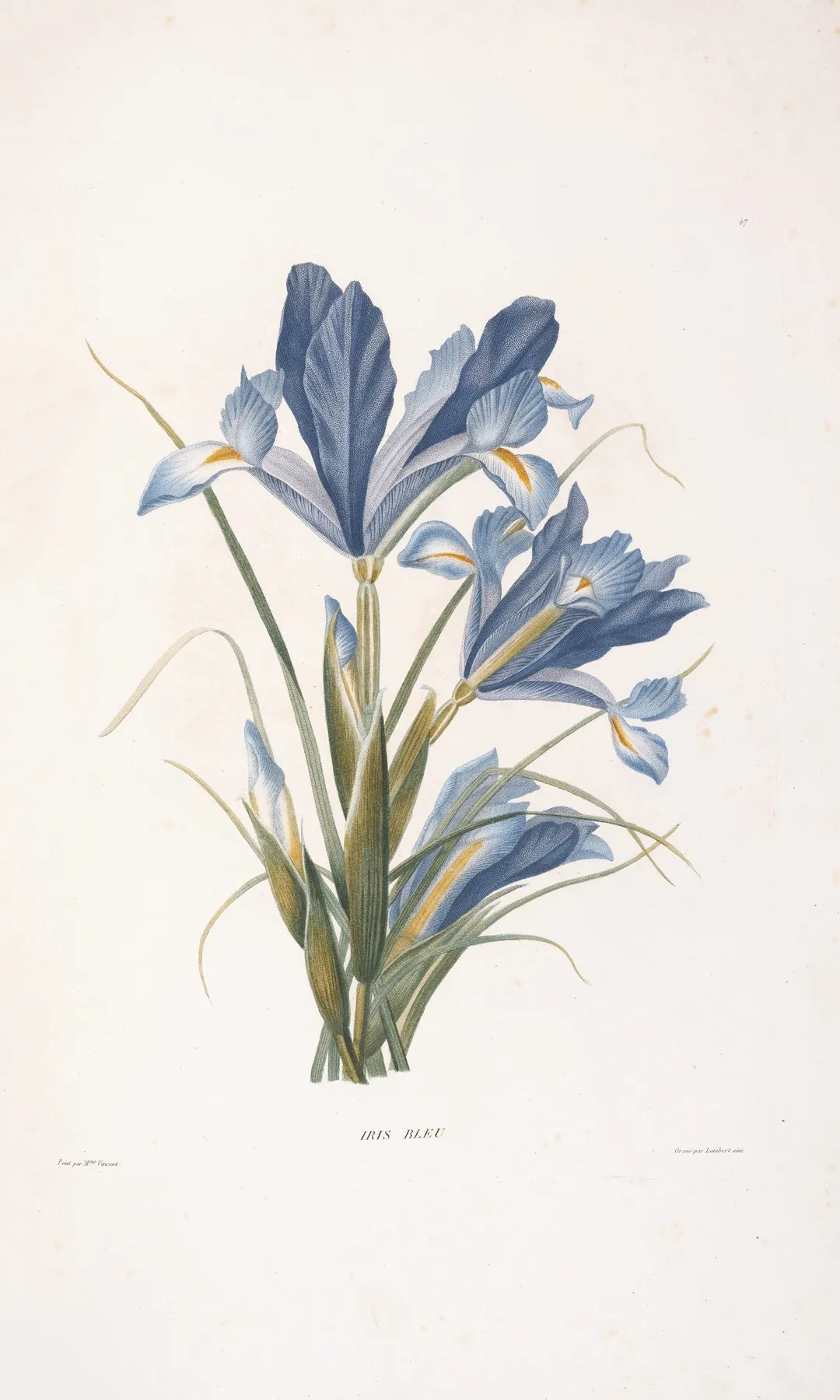
The sheet is vertical: the eye climbs and settles in the upper half. Let the plant stand before you look for detail. Then step in close: watch where colour meets line, and whether the line ever breaks. Third, find the darkest small patch: the whole tonal order is measured from there.
Name and Thing
The binomial is Iris bleu: the first word is the genus it belongs among, the second the epithet that sets it apart. The genus name Iris: Iris is the Greek goddess of the rainbow, for the many hues of the flowers. No established Chinese name exists, so it is cited by its binomial alone.
Form and Colour
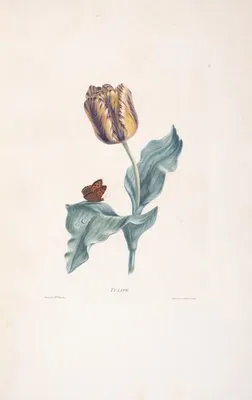
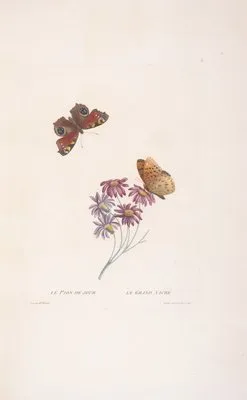
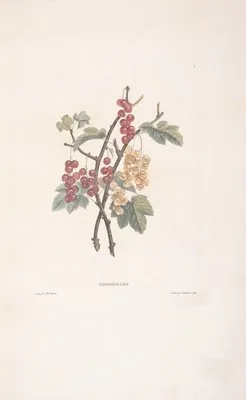
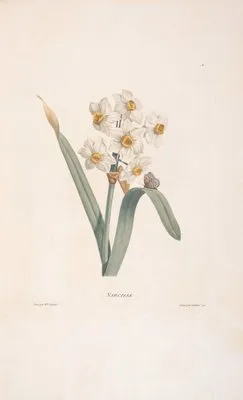
Measured on this plate: flower colour covers 6.1% of the sheet, foliage 0.3%, the cast blue with a second note of yellow-green. No other plate shares exactly this measure. Irises carry rhizomes or bulbs, sword-shaped leaves in two ranks, and six tepals — three falls drooping, often bearded or speckled, three standards erect.No colour group is recorded. A single plant, laid out with nothing hidden.
Composition
The sheet is tall. No details are appended: a plate for looking, not for keying out. The plant covers only 15% of the sheet, centred near the centre; the emptiness is where the eye rests.
Line and Colour
The first half of the nineteenth century moved from copper to steel to lithography; stipple could render the softest transition. There is evidence on the back too: the plate mark pressed into the paper, the slight relief of the pigment, lines worn shallow in a later printing. If you mean to copy it: take its skeleton, its margins and the order of its colours; the burin's hatching is the language of copper — suggest it with pencil density, do not imitate it stroke for stroke.
Poetic Resonance
别后相思隔烟水,菖蒲花发五云高。
—— 唐·元稹《寄贈薛濤》
The poem gives the mood first and the picture supplies the form; set the line beside the plate and the corolla becomes its resting point.
Symbolism
In China sweet flag hung at the door wards off evil at midsummer; in Europe the iris is the messenger, since Iris was the rainbow goddess who carried divine words. In a flora it is a species first and a symbol second; the order is worth keeping.
Season and Place
Late spring to early summer, peaking in April and May, before the summer rains. Temperate north. In China iris and sweet flag belong to the Dragon Boat festival. The year 1820 on the plate is that of publication, not of flowering — the gathering came a year or two earlier. The bud and the ripe fruit on one branch tell the season; the name in the title often tells the journey.
The Book and the Hand
“Studies of Flowers and Fruits” carries only Henriette Antoinette Vincent's name. The image is public domain; the hand-colouring is still one person's hand.
What to Take Away
Appreciation is not knowledge but habit — one more look each time. Two centuries on, the plant may still flower in some garden; the one on this sheet stopped in the season of 1820.
About this plate
Iris Bleu (1820) is plate 47, from Studies of Flowers and Fruits, drawn by Henriette Antoinette Vincent. This public-domain plate is reproduced at high resolution, free to view and download. Publication: Paris, Chez Bance aîné, 1820.