Tree Peony
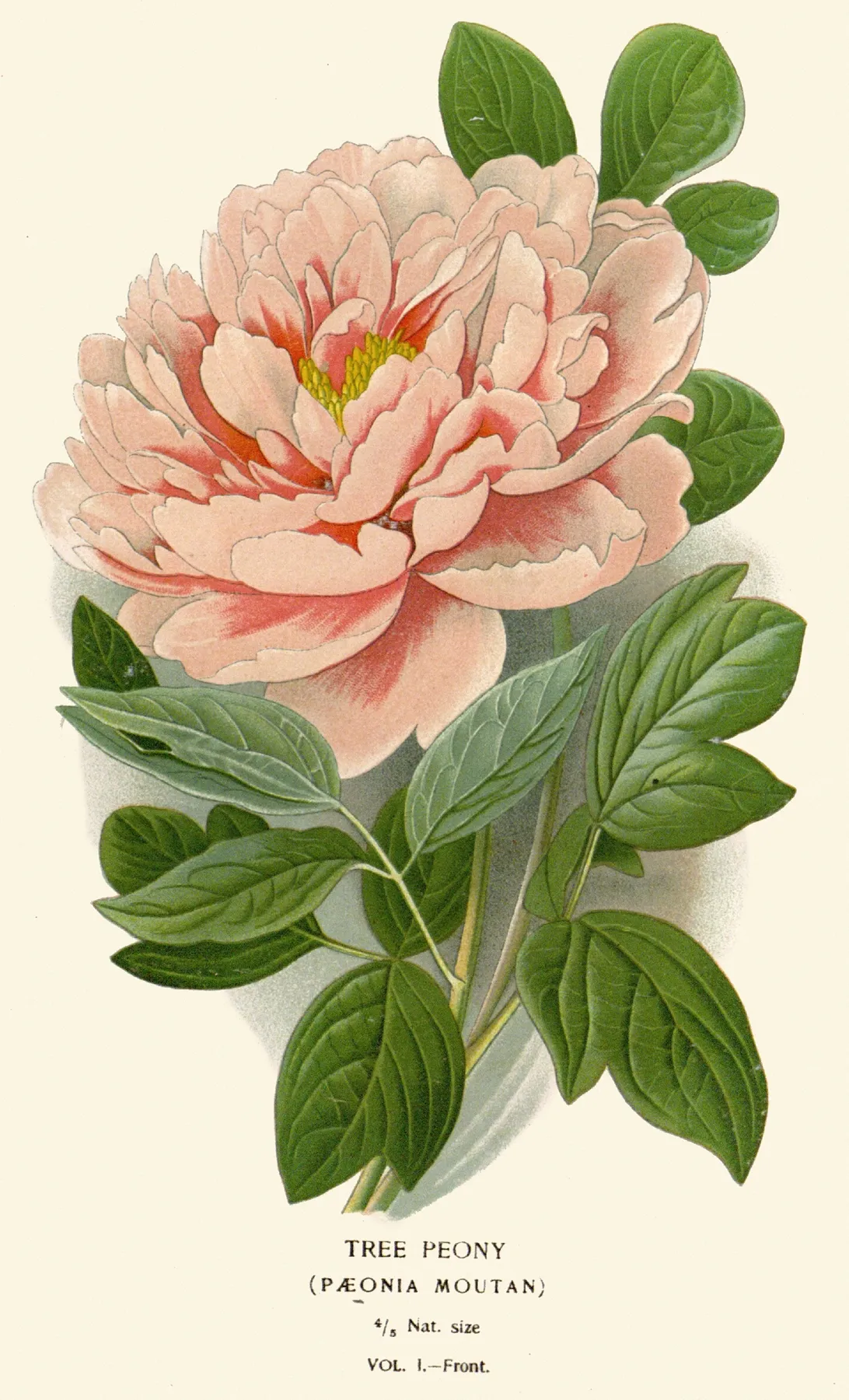
TREE PEONY (PEONIA MOUTAN) $/s Nat. size VOL. 1.—Front.
Tree Peony
Ten ways of seeing
- measured cast amber
- upright 1.65 : 1
First Look
真山水之川谷,远望之以取其势,近看之以取其质。
—— 宋·郭熙《林泉高致·山水训》
Mountains and valleys: from afar take their momentum, up close take their texture — the two distances from which any picture is read.
The sheet is vertical: the eye climbs and settles in the upper half. Let the plant stand before you look for detail. Then step in close: watch where colour meets line, and whether the line ever breaks. Third, find where the green is deepest: the whole tonal order is measured from that patch.
Name and Thing
The binomial is Tree peony: the first word is the genus it belongs among, the second the epithet that sets it apart. Two words carry a whole provenance. No established Chinese name exists, so it is cited by its binomial alone.
Form and Colour
Measured on this plate: flower colour covers 23.8% of the sheet, foliage 23.7%, the cast amber with a second note of red. No other plate shares exactly this measure. Herbaceous peonies die back each year, tree peonies keep woody stems; both have twice-trifoliate leaves and huge double blooms, often blotched at the petal base. a moss green. A single plant, laid out with nothing hidden.
Composition
The sheet is tall. No details are appended: a plate for looking, not for keying out. The plant fills 53% of the sheet, centred near the centre — the herbarium way, drawn to be read whole.
Line and Colour
In the later nineteenth century chromolithography took over: colour printed rather than painted, line demoted. Craft leaves franker evidence than inscriptions. If you mean to copy it: block in the broad shapes and colours first, detail last; lithographic softness comes from thin washes — two or three pale layers will get you close.
Poetic Resonance
重华直至牡丹芳,其来有渐非今日。
—— 唐·白居易《牡丹芳》
The poem gives the mood first and the picture supplies the form; set the line beside the plate and the green the corolla becomes its resting point.
Symbolism
The tree peony is 'national beauty and heavenly fragrance', an emblem of prosperity; the herbaceous peony is tenderness — given at parting, hence its name 'jiangli', 'about to leave'. In a flora it is a species first and a symbol second; the order is worth keeping.
Season and Place
Late April to early May, around the Grain Rain solar term. Native to China: tree peonies centred on Luoyang, herbaceous ones on Yangzhou. Most garden peonies in Europe descend from eighteenth-century Chinese imports. The year 1896 on the plate is that of publication, not of flowering — the gathering came a year or two earlier. Read the locality and the flowering season both with a discount: one is hearsay, the other a ten-day peak.
The Book and the Hand
“Favourite flowers of garden and greenhouse” carries only Edward Step's name. From drawing to plate the sheet passed through several hands — the engraver aimed at accuracy, the colourist at speed, and between them lies each plate's unevenness.
What to Take Away
If you keep one line, keep Guo Xi's: from afar its momentum, up close its texture. A flora exists to be consulted; look long enough and you forget to consult — someone in 1896 gave a whole day to a single flower.
About this plate
Tree Peony is plate 148, from Favourite flowers of garden and greenhouse, drawn by Edward Step. This public-domain plate is reproduced at high resolution, free to view and download. Publication: New York, Frederick Warne & Co, 1896-1897.