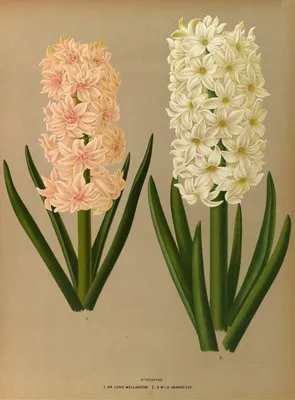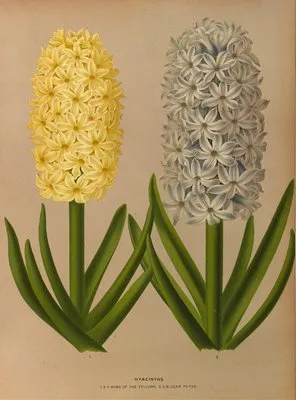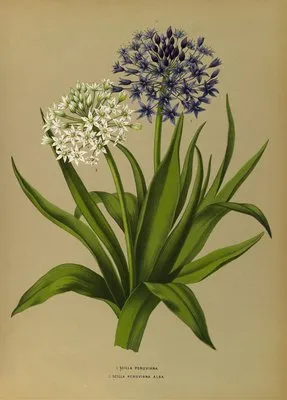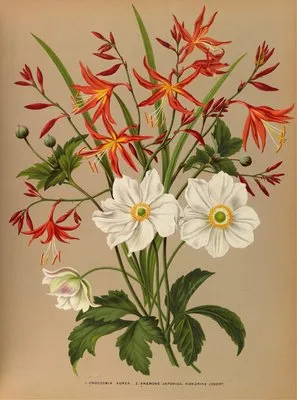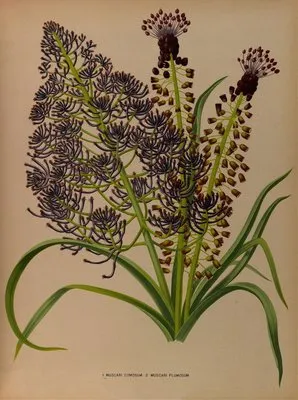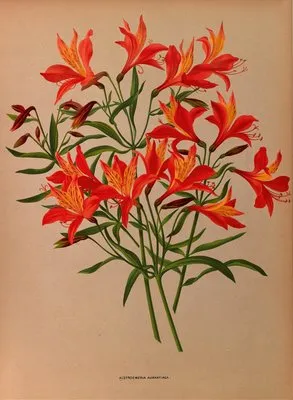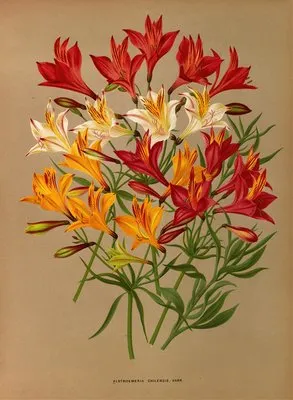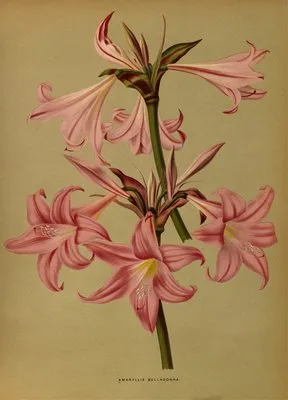
Hyacinths 8
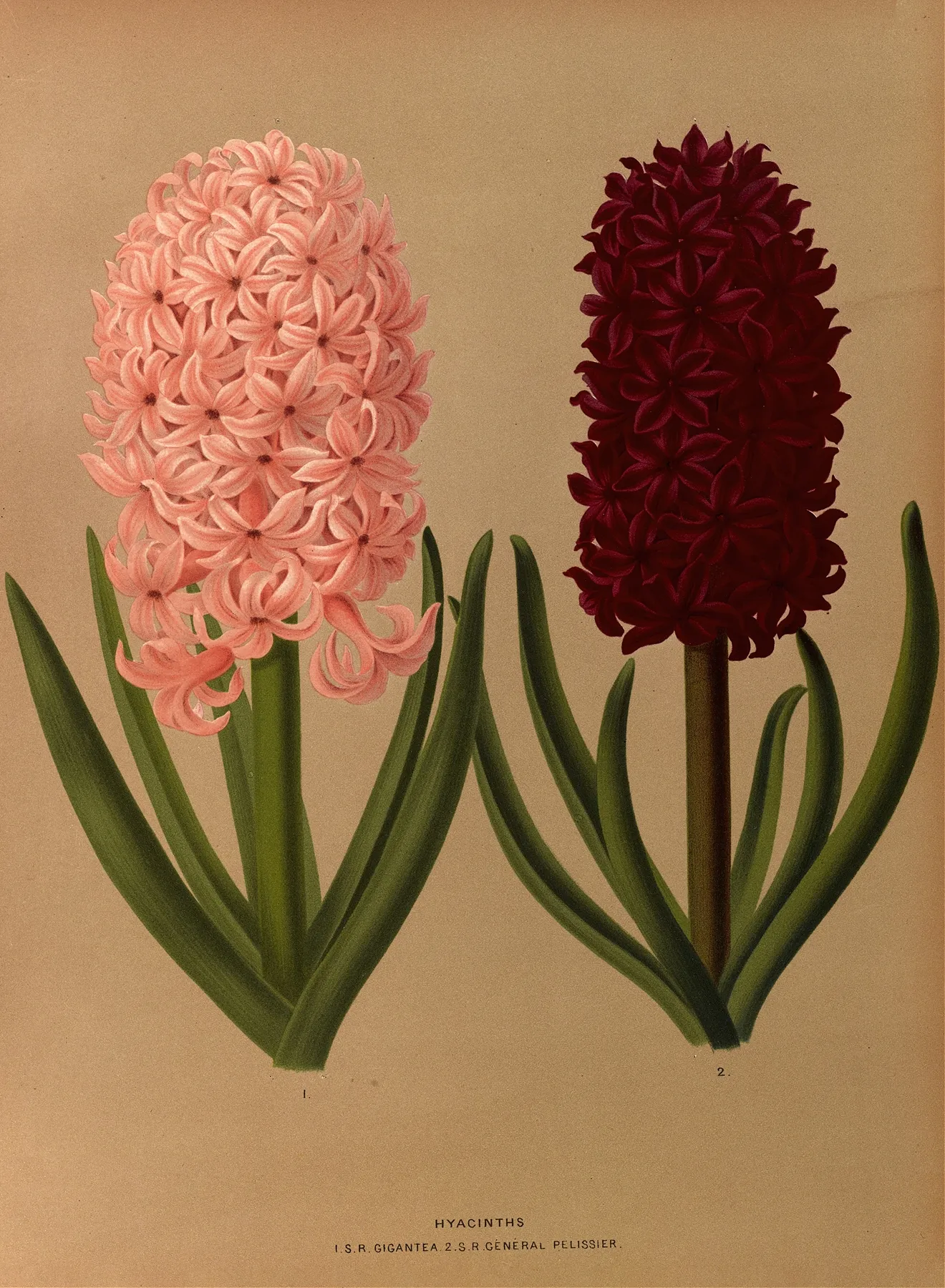
HYACINTHS I.S.R.GIGANTEA.2.S.R.CÊNÉRAL PELISSIER
Hyacinths 8
About this plate
Hyacinths 8 is plate 50, from Haarlem's Flora, drawn by Arentine H. Arendsen. This public-domain plate is reproduced at high resolution, free to view and download. Publication: Haarlem : 1872-1881..
Twelve ways of seeing
One plate, read twelve times over: its name, its colour, the burin and the brush, the shape of the sheet, the season, the soil it came from, the book it belongs to, its language of flowers, the poem it answers to, the lore behind it, how to look, and what remains.
-
The Name
The plate is titled “Hyacinths 8”, numbered Plate 50. No reliable binomial survives on the plate, so it must be cited by its original title. Neither a Chinese name nor a reliable binomial survives: the plate can only be cited by its printed title, and left to speak for itself.
-
Form and Colour
Bulbous plants store the year underground — bulb, corm or tuber — then send up a few thick leaves and a single scape, with six tepals in cup, funnel or star. Filed under orange — an amber orange. The colour is built in washes: a pale ground first, then deepening at the petal base and in shadow. Read the outline, then the colour layers, then the touch of the brush.
-
Line and Colour
In the later nineteenth century chromolithography took over: colour printed rather than painted, line demoted. Images grew more accurate and less personal. Look closely at the line and the colour: an unbroken line means engraving, colour crossing the outline by half a millimetre means hand-colouring. Craft leaves franker evidence than inscriptions.
-
Composition
Tall and narrow, the plant rising in one movement with generous margins above and below — the upright format of most floras. (about 1.36 : 1). No details are appended: this is a plate for looking, not for keying out.
-
Season
Early spring to early summer, genus by genus: tulips and hyacinths first, gladiolus and amaryllis later. The year 1872 on the plate is the year of publication, not of flowering — the gathering came a year or two earlier.
-
Provenance
Three homelands: the Mediterranean, Central Asia and South Africa. The tulip came from Ottoman gardens and became a Dutch mania; South African bulbs filled European glasshouses after 1800. In the same volume the kin are shelved together; set several plates side by side and the differences declare themselves.
-
The Book
“Haarlem's Flora” was drawn by Arentine H. Arendsen and published 1872-1881. This plate is Plate 50. The image is in the public domain; the hand-colouring on the paper is still one person's hand, two centuries ago.
-
Symbolism
The tulip was an imperial emblem in Istanbul and a speculative bubble in Amsterdam; the hyacinth sprang from a boy's blood in Greek myth. What bulbs share is concealment: next year kept underground. This plate leans orange, which in flower language adds one more degree of feeling. Flower language was added later; the flower knows nothing of it, and that innocence is part of its power.
-
Poetic Resonance
兰陵美酒郁金香,玉碗盛来琥珀光。
—— 唐·李白《客中行》
Fine wine of Lanling, fragrant with turmeric; poured in a jade bowl, it glows like amber.
The poem gives the mood first and the picture supplies the form; set the line beside the plate and the orange the corolla becomes its resting point.
-
Classical Lore
Li Bai's 'orchid wine, fragrant with yujin' is often misread as tulips; the Tang yujin was a turmeric-like root used to scent wine — same name, different plant. Chinese flower books ranked plants by character; European floras described them by form and name. This plate belongs to the second tradition, yet bears reading by the first. Books fill in what the picture omits, and also hide what it shows: look first, read after.
-
How to Look
Look at the base: tulips overlap in two whorls to make a cup, hyacinths pack small flowers into a spike, gladiolus sets its blooms in a single row facing one way. Stand back for the habit, step close for the meeting of line and colour.
-
Afterword
The flower of 1872 is dust, yet its image on paper has outlived every living cousin.