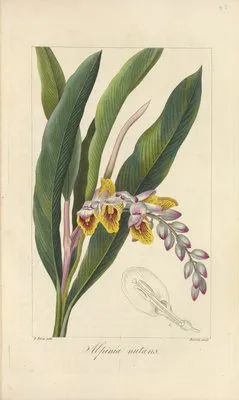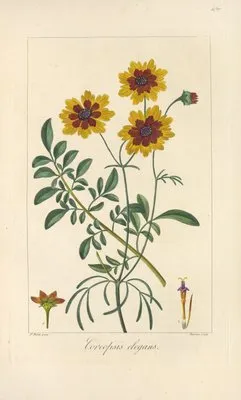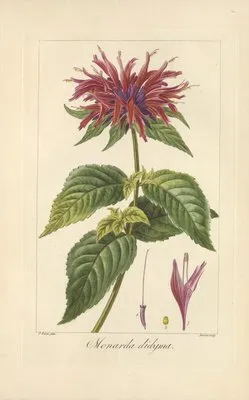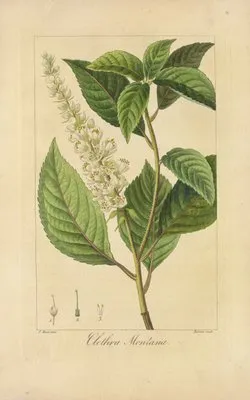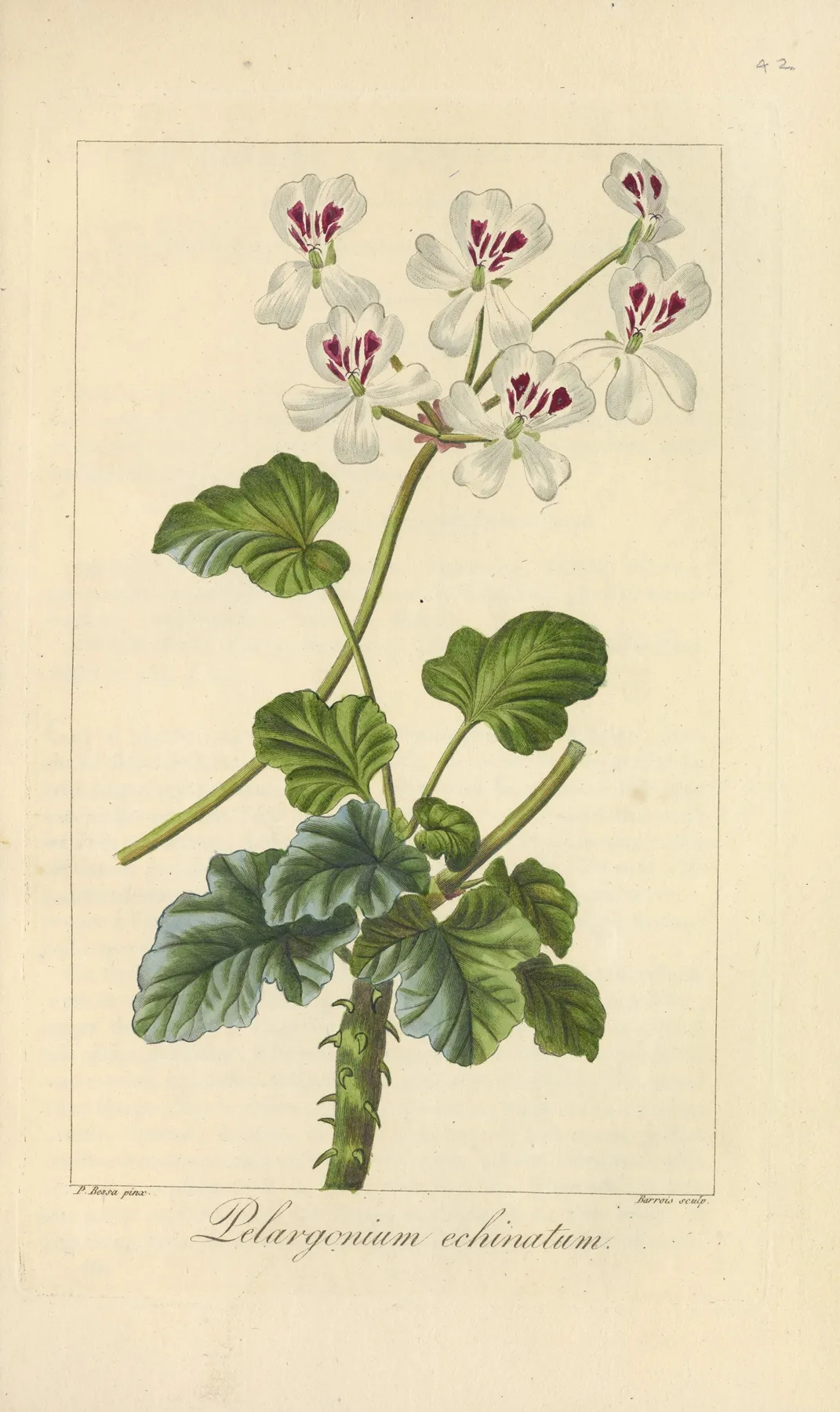
Pelargonium echinatum
Bersa pins|具刺天竺葵
Pelargonium echinatum
About this plate
Pelargonium echinatum is plate 21, from Herbier général de l'amateur, drawn by Jean Claude Michel Mordant de Launay. This public-domain plate is reproduced at high resolution, free to view and download. Publication: Paris, Audot, Libraire, 1816-1827.
Ten ways of seeing
- measured cast yellow-green
- upright 1.68 : 1
- published 1816
- Plate 21
Not a catalogue entry but a way of looking: how to stand, what to notice, how the line was cut — then, halfway, a line of Chinese poetry: how the ancients saw this same flower. After it, the flower's language, its season and homeland, its book; and at the end one line of classical prose — and a pair of eyes to take away.
-
First Look
论画以形似,见与儿童邻。
—— 宋·苏轼《书鄢陵王主簿所画折枝》
To judge painting by likeness alone is the view of a child.
The sheet is vertical: the eye climbs and settles in the upper half. Let the plant stand before you look for detail. Then step in close: watch where colour meets line, and whether the line ever breaks. Third, find where the yellow is deepest: the whole tonal order is measured from that patch.
-
Name and Thing
The binomial is Pelargonium echinatum: the first word is the genus it belongs among, the second the epithet that sets it apart. The genus name Pelargonium: Pelargonium comes from pelargos, the stork, for the beak-like fruit. The Chinese name 具刺天竺葵 is a modern rendering of the Latin, not an old garden name.
-
Form and Colour
Measured on this plate: flower colour covers 4.0% of the sheet, foliage 8.7%, the cast yellow-green. No other plate shares exactly this measure. Garden annuals and low perennials: many small, brilliantly coloured flowers to a stem, with leaves palmately lobed, pinnate or entire — the mainstay of the Victorian bedding scheme. Filed under yellow — a honey-yellow, built in washes from a pale ground. Three things fix the habit: leaf arrangement, tepal count, and how the flower is borne.
-
Composition
Tall and narrow, the plant rising in one movement with generous margins — the upright format of most floras. (about 1.68 : 1) No details are appended: a plate for looking, not for keying out. The plant covers only 15% of the sheet, centred near the centre; the emptiness is where the eye rests. Cover the margins with your thumb and the plate suffocates; uncover them and the flower breathes again.
-
Line and Colour
The first half of the nineteenth century moved from copper to steel to lithography; stipple could render the softest transition. There is evidence on the back too: the plate mark pressed into the paper, the slight relief of the pigment, lines worn shallow in a later printing. If you mean to copy it: take its skeleton, its margins and the order of its colours; the burin's hatching is the language of copper — suggest it with pencil density, do not imitate it stroke for stroke.
-
Poetic Resonance
同为懒慢园林客,共对萧条雨雪天。
—— 唐·白居易《雪夜小飲贈夢得》
The poem gives the mood first and the picture supplies the form; set the line beside the plate and the yellow the corolla becomes its resting point.
-
Symbolism
Bedding plants carry no imperial weight; they mean the everyday — window sill, border, festival, gift. Victorian floriography grew up among exactly these flowers. This plate leans yellow, which in flower language adds one more degree of feeling. Flower language was added later; the flower knows nothing of it, and that innocence is part of its power.
-
Season and Place
under glass they could be had from March. Gathered from everywhere by plant hunters and the glasshouse trade: pelargoniums from South Africa, campanulas from European mountains, lobelias from North America, fuchsias from Chile. The year 1816 on the plate is that of publication, not of flowering — the gathering came a year or two earlier. The volume was made in 1816-1827, when most of this knowledge came from living plants under glass.
-
The Book and the Hand
“Herbier général de l'amateur” was drawn by Jean Claude Michel Mordant de Launay and published 1816-1827. This plate is Plate 21. The image is public domain; the hand-colouring is still one person's hand.
-
The Written Tradition
写气图貌,既随物以宛转;属采附声,亦与心而徘徊。
—— 南朝梁·刘勰《文心雕龙·物色》
In tracing the spirit and drawing the shape one follows the object; in choosing colour and sound one lingers with the heart.
China had its own gardening literature — Chen Haozi's Hua Jing on courtyard planting — which, like European bedding, brought wild plants down to human scale. You need not parse every word: take the line, and the flower acquires a second face.
What to Take Away
Carry three rules away: whole before detail; line before colour; picture before book. The flower of that year is dust, yet its image on paper has outlived every living cousin.