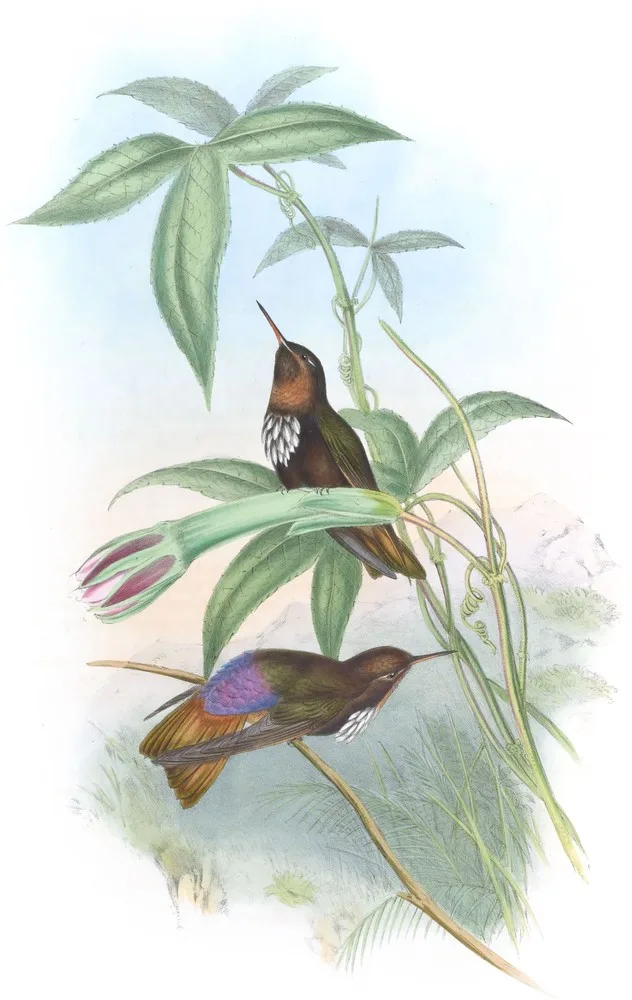
Aglæactis Castelnaudi
Aglæactis Castelnaudi
Castelnau’s Sunbeam
About this plate
The mountains near Cusco in Peru
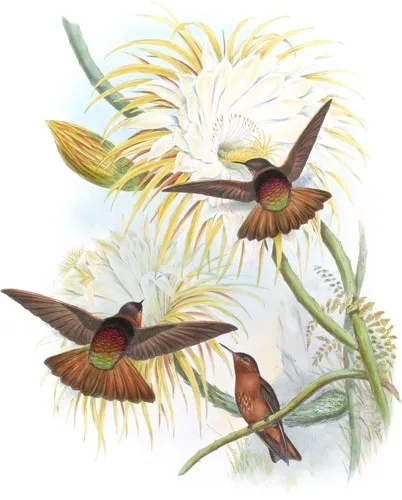
Two specimens of this extremely fine species of Aglæactis are all that are known; these were collected in the neighbourhood of Cusco by the celebrated and intrepid traveller, Count Castelnau, during his travels in Peru.
One of these specimens graces the gallery of the Jardin des Plantes at Paris, the other my own collection; the latter is probably a female, and the former a young male: whenever the fully adult bird is discovered, it will doubtless prove to be an object of the greatest beauty.
Its large size, the resplendent purple colouring of the back, and the great number of broad, elongated and pendent plumes of the breast, certainly render it the most ornamental species of the genus. It is allied to Aglæactis cupripennis and A. Pamela, which, combined with the A. caumatonotus, form one of the best-defined genera of the family.
This species has been named by MM. Bourcier and Mulsant in honour of its discoverer.
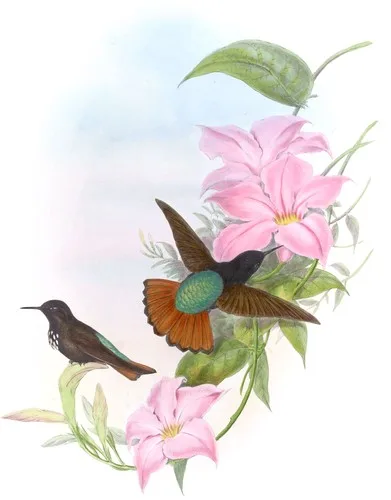
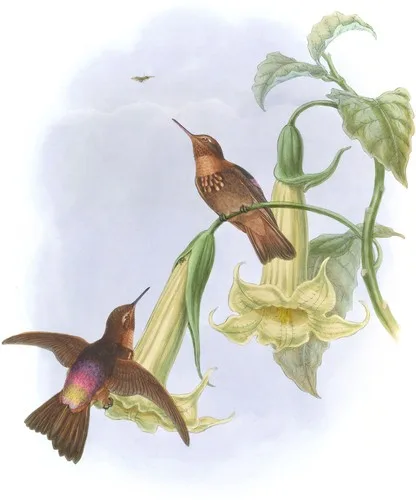
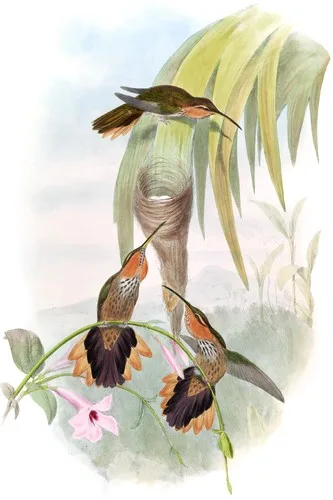
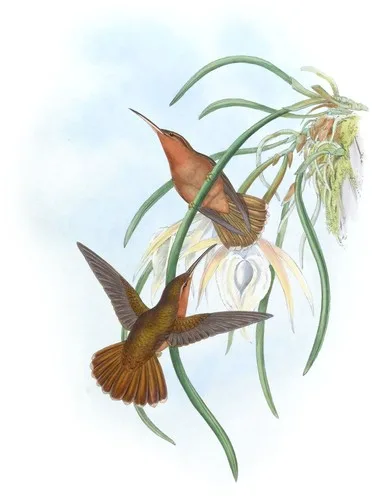
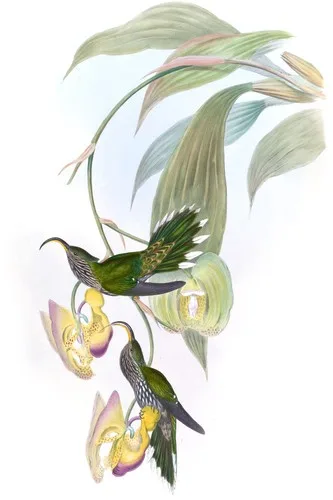
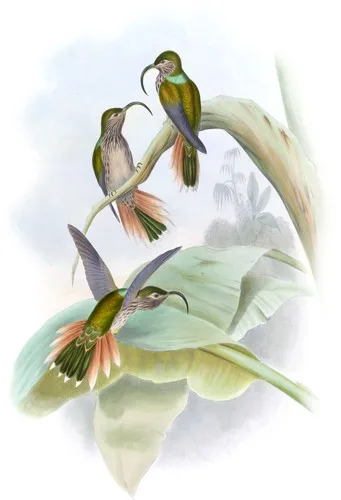
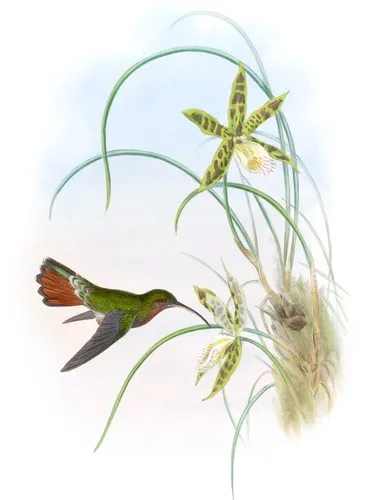
The male has the general plumage of a dark bronzy-brown, mottled with patches of a lighter hue about the sides of the head, neck and throat; lower part of the back and upper tail-coverts beautiful lilaceouspurple; wings bronzy-brown; on the centre of the chest a number of pendent white plumes; tail rufous, glossed with bronze on the central feathers and the margins and tips of the remainder; under surface bronzy-brown, fading into buffy-red on the under tail-coverts; upper mandible black; under mandible flesh-colour; feet brown.
The supposed female is very similar, but has only a trace of the fine lilaceous-purple on the rump and upper tail-coverts.
The figures are the size of life. The plant is the Tacsonta mollissima.
References
- Trochilus Castelnaudii, Boure. et Muls. Rev. Zool. 1848, p. 270.
- Trochilus Castelnaui, Gray and Mitch. Gen. of Birds, vol. ui., Supp. App. p. 30a, App. to p. 103.
- Aglaeactis castelnaudi, Bonap. Consp. Gen. Av., p. 73, Aglaeactis, sp. 4.—Reich. Aufz. der Col., p. 9.
- Aglæactis castelneaui, Bonap. Rev. et Mag. de Zool. 1854, p. 253.
Twelve ways of seeing
One plate, read twelve times over: its name, its colour, the burin and the brush, the shape of the sheet, the season, the soil it came from, the book it belongs to, its language of flowers, the poem it answers to, the lore behind it, how to look, and what remains.
-
The Name
The plate is titled “Aglæactis Castelnaudi”, numbered Pl. 180, Vol. III (book page 180). No reliable binomial survives on the plate, so it must be cited by its original title. Neither a Chinese name nor a reliable binomial survives: the plate can only be cited by its printed title, and left to speak for itself.
-
Form and Colour
The smallest of birds: a needle-fine bill, a forked tubular tongue, wings beating so fast the bird hovers and even flies backwards. Its colour is not pigment but structure — light bent by feather barbules, changing with the angle. No colour group is recorded for this plate, but the palette still belongs to its season. Read the outline, then the colour layers, then the touch of the brush.
-
Line and Colour
In the later nineteenth century chromolithography took over: colour printed rather than painted, line demoted. Images grew more accurate and less personal. Look closely at the line and the colour: an unbroken line means engraving, colour crossing the outline by half a millimetre means hand-colouring. Craft leaves franker evidence than inscriptions.
-
Composition
Tall and narrow, the plant rising in one movement with generous margins above and below — the upright format of most floras. (about 1.58 : 1). No details are appended: this is a plate for looking, not for keying out.
-
Season
In tropical America they are present all year, their season set by flowers; temperate hummingbirds follow the bloom north and back, thousands of kilometres a year. The year 1852 on the plate is the year of publication, not of flowering — the gathering came a year or two earlier.
-
Provenance
Americas only, from southern Alaska to Tierra del Fuego, richest in the Andes. China has no hummingbirds and no classical record of them; the name arrives with late-Qing travel writing. The localities on the plate are those of a century ago; plants travel and places change their names.
-
The Book
“Gould's Hummingbirds” was drawn by John Gould and published 1849-1887. This plate is Pl. 180, Vol. III, book page 180. The image is in the public domain; the hand-colouring on the paper is still one person's hand, two centuries ago.
-
Symbolism
For the Aztecs the hummingbird was warrior and sun; for Victorian Europe it was the ultimate ornament, millions killed for breast jewellery. China has no tradition here — and that blank is itself a history of exchange. Meanings change their tune: the same flower can say opposite things within a century.
-
Poetic Resonance
穿花蛱蝶深深见,点水蜻蜓款款飞。
—— 唐·杜甫《曲江二首》
Butterflies thread the flowers, seen deep within; dragonflies touch the water and fly on, slow and deliberate.
The poem gives the mood first and the picture supplies the form; set the line beside the plate and the bird itself becomes its resting point.
-
Classical Lore
Gould's Hummingbirds (1849–1887) used hand-coloured lithography over gold leaf so the iridescence survived on paper — a monument to Victorian printing and collecting alike. Chinese flower books ranked plants by character; European floras described them by form and name. This plate belongs to the second tradition, yet bears reading by the first. Books fill in what the picture omits, and also hide what it shows: look first, read after.
-
How to Look
Look at the metallic throat and back: structural colour that needed gold leaf or layered washes to match. Then bill length against corolla depth — bird and flower evolved together. Stand back for the habit, step close for the meeting of line and colour.
-
Afterword
The flower of 1852 is dust, yet its image on paper has outlived every living cousin.