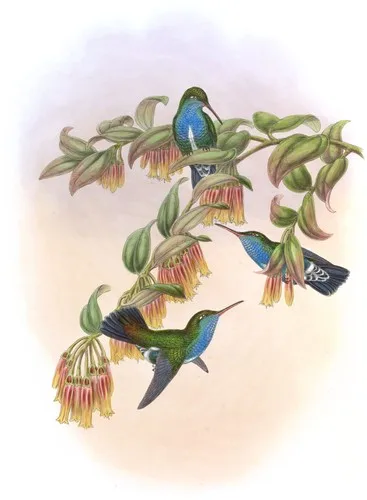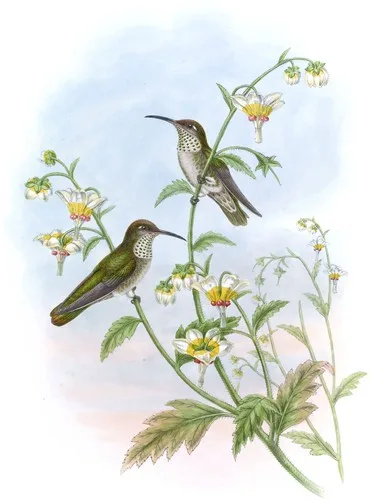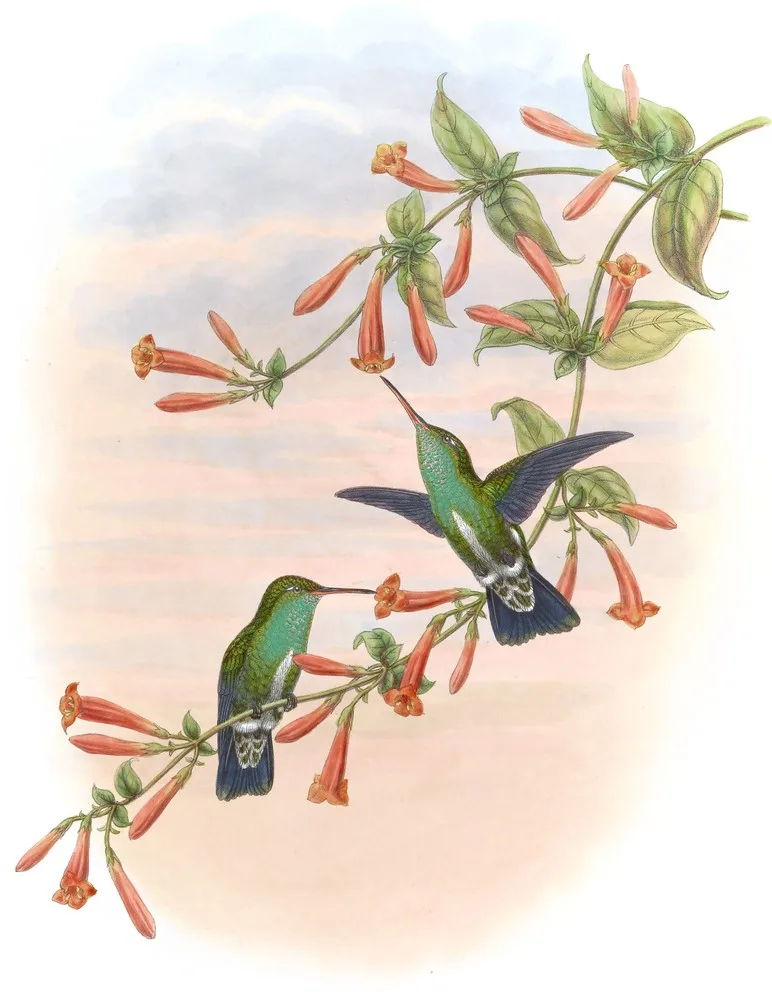
Agyrtria fluviatilis
安第斯蜂鸟
Agyrtria fluviatilis
Riverine Emerald
About this plate
The present species is placed, according to the arrangement set forth by Mr. Elliot, in oye section of the genus in which the crown of the head is dull green, and the under beicoyais white with a central streak of brown or green.
It differs from all its near allies in having a black tail, and the throat and breast grass-green with a slight bluish tinge.
The original specimens are in the Gould Collection, and WE received from the Rio Napo. It was afterwards met with by Mr. Edward Bartlett on the Lower easels at UID ang Mr. Hauxwell has sent specimens from Pebas. Mr. Stolzmann has likewise met with the species at Yurimaguas.
The figures in the Plate have been drawn from a male bird procured in the latter locality, and lent to us by Messrs. Salvin and Godman.
[R. B. S.]
References
- Thaumatias fluviatilis, Gould, Intr. Trochil. 8vo, p. 154 (1861).—Scel. & Salv. Proc. Zool. Soc. 1866, p. 194.—Iid. Nomencl. Av. Neotr. p. 92 (1873).—Elliot, Ibis, 1878, p. 51.—Mulsant, Hist. Nat. Ois.-Mouches, i. p. 253 (1874).
- Agyrtria fluviatilis, Heine, Journ. fir Orn. 1863, p. 184.—Elliot, Synopsis of the HummingBirds, p. 207 (1878).—Tacz. Orn. Pérou, i. p. 404 (1884).
Ten ways of seeing
- slightly upright 1.30 : 1
- published 1887
- Pl. 411, Suppl. Vol.
Not a catalogue entry but a way of looking: how to stand, what to notice, how the line was cut — then, halfway, a line of Chinese poetry: how the ancients saw this same flower. After it, the flower's language, its season and homeland, its book; and at the end one line of classical prose — and a pair of eyes to take away.
-
First Look
夫象物必在于形似,形似须全其骨气。
—— 唐·张彦远《历代名画记》
Likeness is the threshold; bone-and-breath is the point.
Slightly taller than wide; the eye lands above centre. Then step in close: watch where colour meets line, and whether the line ever breaks. Third, find the darkest small patch: the whole tonal order is measured from there.
-
Name and Thing
The binomial is Agyrtria fluviatilis: the first word is the genus it belongs among, the second the epithet that sets it apart. Two words carry a whole provenance. The Chinese name 安第斯蜂鸟 is a modern rendering of the Latin, not an old garden name.
-
Form and Colour
A bulb of overlapping fleshy scales gives the lily its Chinese name, 'hundred-fold'; six tepals reflex as the flower opens, around six stamens with long, T-shaped anthers.No colour group is recorded. Three things fix the habit: leaf arrangement, tepal count, and how the flower is borne.
-
Composition
Slightly taller than wide, the plant set a little above centre. (about 1.30 : 1) No details are appended: a plate for looking, not for keying out. Cover the margins with your thumb and the plate suffocates; uncover them and the flower breathes again.
-
Line and Colour
In the later nineteenth century chromolithography took over: colour printed rather than painted, line demoted. Take a loupe to three places: petal edge, leaf vein, caption. An unbroken line means engraving; colour crossing the outline means a hand. If you mean to copy it: block in the broad shapes and colours first, detail last; lithographic softness comes from thin washes — two or three pale layers will get you close.
-
Poetic Resonance
方石斛栽香百合,小盆山养水黄杨。
—— 宋·陆游《龟堂杂兴十首 其五》
The poem gives the mood first and the picture supplies the form; set the line beside the plate and the corolla becomes its resting point.
-
Symbolism
In the West the white lily is Marian purity, held by the angel of the Annunciation; in China the name sounds like 'a hundred years in harmony', a wedding wish. Flower language was added later; the flower knows nothing of it, and that innocence is part of its power.
-
Season and Place
the flowers last only days, so artists drew them just as they opened. Temperate north — China, Japan, Europe. Long used in Chinese medicine, lilies were hunted in East Asia by nineteenth-century collectors and transformed European gardens. The year 1887 on the plate is that of publication, not of flowering — the gathering came a year or two earlier. The volume was made in 1849-1887, when most of this knowledge came from living plants under glass.
-
The Book and the Hand
“Gould's Hummingbirds” was drawn by John Gould and published 1849-1887. This plate is Pl. 411, Suppl. Vol., book page 411. The image is public domain; the hand-colouring is still one person's hand.
-
The Written Tradition
多识于鸟兽草木之名。
—— 《论语·阳货》
…and from the Songs one learns the names of birds, beasts, plants and trees.
The Bencao Gangmu describes the bulb as garlic-like, edible and medicinal; Song writers already noted that the leaves vary while the flowers stay white. Keep the line; it will surface the next time you meet the same plant.
What to Take Away
If you keep one line, keep Guo Xi's: from afar its momentum, up close its texture. Two centuries on, the plant may still flower in some garden; the one on this sheet stopped in the season of 1887.