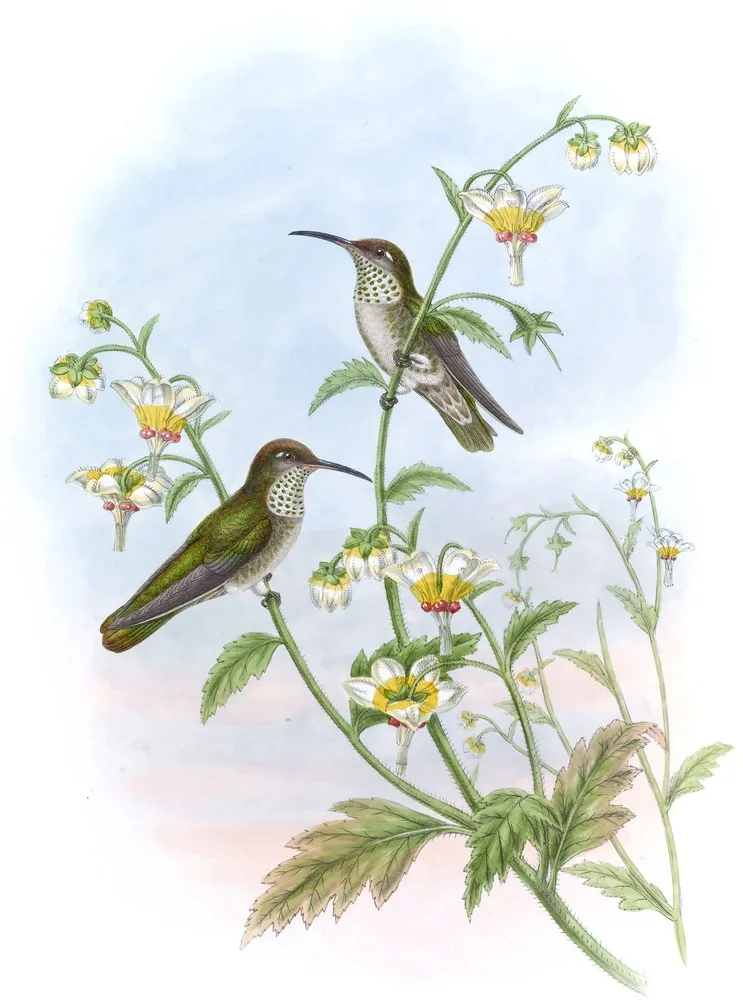
Agyrtria taczanowskii
安第斯蜂鸟
Agyrtria taczanowskii
Taczanowski’s Emerald
Ten ways of seeing
- upright 1.35 : 1
First Look
江馆清秋,晨起看竹,烟光日影露气,皆浮动于疏枝密叶之间。
—— 清·郑板桥《题画竹》
On an autumn morning at the river lodge I looked at the bamboo: mist, sunlight, dew, all drifting among the sparse and dense leaves.
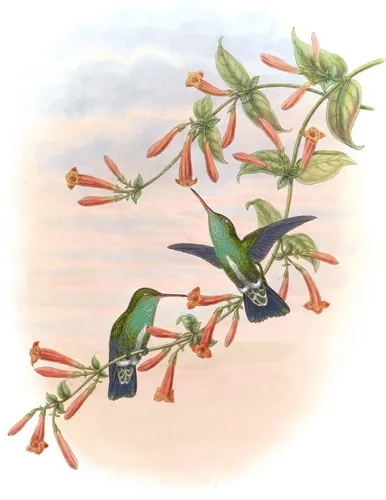
The sheet is vertical: the eye climbs and settles on the bird. Take the posture before the plumage. Then step in close: watch where colour meets line, and whether the line ever breaks. Third, find the darkest small patch: the whole tonal order is measured from there.
Name and Thing
The binomial is Agyrtria taczanowskii: the first word is the genus it belongs among, the second the epithet that sets it apart. Two words carry a whole provenance. The Chinese name 安第斯蜂鸟 is a modern rendering of the Latin, not an old garden name.
Form and Colour
The smallest of birds: a needle-fine bill, a forked tubular tongue, wings beating so fast the bird hovers and even flies backwards. Its colour is not pigment but structure — light bent by feather barbules, changing with the angle.No colour group is recorded. A single plant, laid out with nothing hidden.
Composition
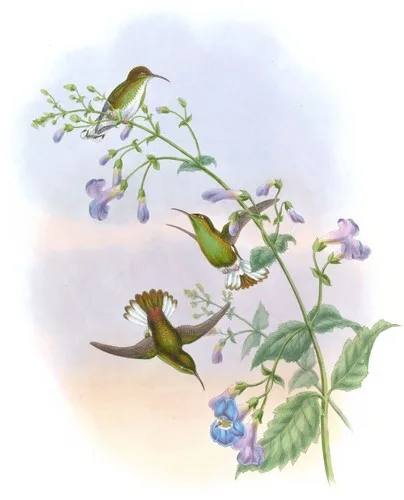
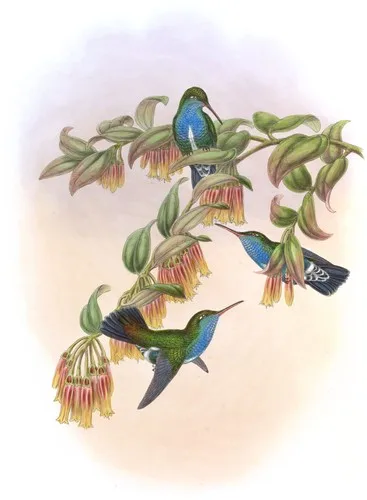
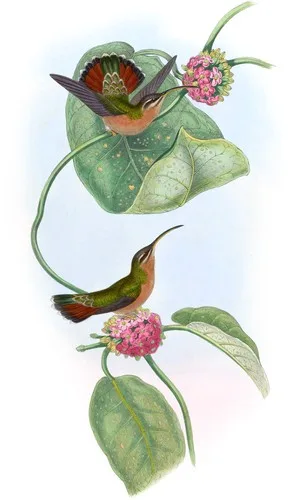
Tall and narrow, the bird perched mid-branch with generous margins above and below. No details are appended: a plate for looking, not for keying out. Cover the margins with your thumb and the plate suffocates; uncover them and the flower breathes again.
Line and Colour
In the later nineteenth century chromolithography took over: colour printed rather than painted, line demoted. Craft leaves franker evidence than inscriptions. If you mean to copy it: block in the broad shapes and colours first, detail last; lithographic softness comes from thin washes — two or three pale layers will get you close.
Poetic Resonance
夫列子御风而行,泠然善也,旬有五日而后反。
—— 《庄子·逍遥游》
Liezi rode the wind and came back after fifteen days, so light was his going.
The poem gives the mood first and the picture supplies the form; set the line beside the plate and the bird itself becomes its resting point.
Symbolism
For the Aztecs the hummingbird was warrior and sun; for Victorian Europe it was the ultimate ornament, millions killed for breast jewellery. China has no tradition here — and that blank is itself a history of exchange. In a flora it is a species first and a symbol second; the order is worth keeping.
Season and Place
temperate hummingbirds follow the bloom north and back, thousands of kilometres a year. the name arrives with late-Qing travel writing. The year 1887 on the plate is that of publication, not of flowering — the gathering came a year or two earlier. Much of what that generation knew of such birds came from specimens and cages; read locality and season both as hearsay.
The Book and the Hand
“Gould's Hummingbirds” carries only John Gould's name. From drawing to plate the sheet passed through several hands — the engraver aimed at accuracy, the colourist at speed, and between them lies each plate's unevenness.
What to Take Away
Next time you watch a bird: posture first, then where the plumage is deepest, and only then the field guide. The flower of that year is dust, yet its image on paper has outlived every living cousin.
About this plate
This species was described by Dr. Sclater from a specimen procured by Stolzmann at Guajango, in Peru.
It is allied to Agyrtria viridiceps of Gould, but has a much stronger bill and an even tail, and the spots on the throat are much smaller. Mr. Stolzmann met with the species both at Guajango and Calacate. At the latter place, he writes, “it is common, visiting the male flowers of the banana trees. It affects the same places as Cyanomyia cyanicollis. When perching on the dry leaves of the bananas it utters its song, composed of couplets in four tones, three or four times repeated in succession. Often when I have been working in front of my door, one of these Hamming-birds has come to catch the mosquitoes, which are very abundant in that locality. As I stood still, the bird came so close to me that I could feel the wind on my face, produced by the vibration of its wing. I thus had the opportunity of observing the manner in which it seized the mosquitoes, and I am astonished to see that Burmeister denies this habit in the Humming-birds.
“At Guajango, in the valley of the Marañon, this species is rare, but I have seen it several times about the flowers of the Agave.”
Dr. Taczanowski further adds that a specimen is in Dr. Raimondi’s collection from Paucal. Count von Berlepsch believes that the species ought to be separated generically, as its form differs widely from that of the members of the genus Agyrtria.
The following is a translation of Dr. Sclater’s original description:—
More metallic green, with a coppery gloss on the head; the feathers ashy underneath; wings dusky, the coverts like the back; the tail equal, uniform with the back, with a coppery tinge towards the tip, underneath dusky, coppery green towards the tip; the under surface of the body white, washed with pale ashy ou the sides, and especially on the vent; the whole of the throat covered with tiny heart-shaped spots of shining green; the bill strong and slightly curved.
[R. B. S.]
References
- Thaumasius taczanowskii, Sclater, Proc. Zool. Soc. 1879, p. 146. —Tacz. tom. cit. p. 239.-—Id. Proce. Zool. Soc. 1880, p. 208.
- Leucolia taczanowskii, Eudes-Deslongchamps, Cat. Deser. Trochil. i. p. 301.
- Thaumatias taczanowskii, Tacz. Orn. Pérou, i. p. 405 (1884).