Bourcieria traviesi
Bourcieria traviesi
Travie’s Inca
About this plate
This species, the type of which is in the celebrated collection of the late Count Turati at Milan, is an inhabitant of Colombia, but nothing is known respecting its range or exact habitat.
Mr. Elliot possesses a second specimen in his collection, also from Colombia, and a third is in Messrs. Salvin and Godman’s Collection, said to have been shot near Hondo, in the valley of the Magdalena River, Colombia.
The following description of the species is borrowed from Mr. Elliot’s well-known ‘Synopsis of the Trochilidæ,’ where he states that it may be told from its allies by its bronzy tail and by the metallic blue of the forehead and crown:—
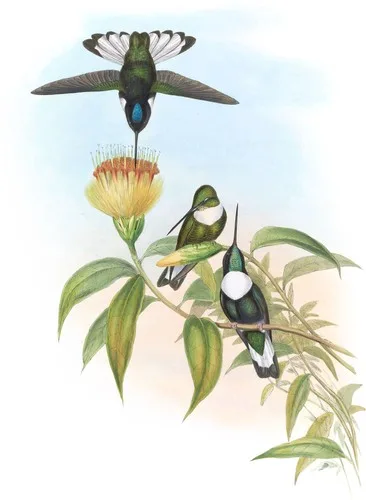
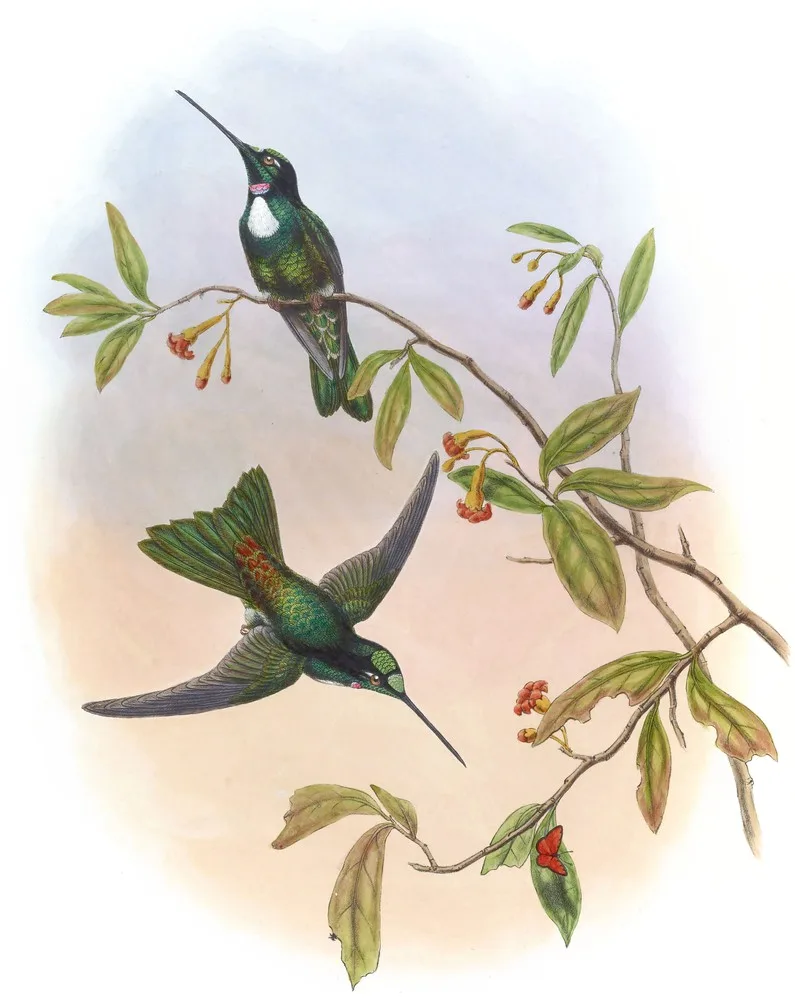
Male. Forehead and centre of crown blue, graduating into greenish blue near the occiput; remainder of the upper part of the head very dark grass-green, black in some lights. Throat green, with a small metallicviolet spot in the centre. A broad white band across the throat. Abdomen, flanks, and under tail-coverts glittering grass-green. Upper tail-coverts metallic violet-red. Tail dark greenish bronze. Bill black. Total length 5 inches, wing 2
, tail 2 , culmen 1 .
The female is unknown.
Mr. Elliot kindly lent the specimen from which the two figures in the Plate are drawn, an adult male being represented in two positions and of the size of life.
[R. B. S.]
References
- Diphlogena (Hehanthea) traviesi, Mulsant et Verreaux, Ann. Soc. Linn. Lyon, 2nd ser. xiv. vol. ii. p. 199 (1866).
- Eudosia traviesi, Mulsant, Hist. Nat. Ois.-Mouches, i. p. 2, pl. 1. (1877).
- Bourcieria traviesi, Elliot, Synopsis of the Humming-Birds, p. 77 (1878).
Twelve ways of seeing
- slightly upright 1.26 : 1
- published 1887
- Pl. 381, Suppl. Vol.
Not a catalogue entry but a way of looking: how to stand, what to notice, how the line was cut, when it flowers, where it came from, who made it — and then the poems and the classics that taught China to see the same flower. Read the twelve in order and the plate opens.
-
First Look
论画以形似,见与儿童邻。
—— 宋·苏轼《书鄢陵王主簿所画折枝》
To judge painting by likeness alone is the view of a child.
Slightly taller than wide; the eye lands on the bird's head, a little above centre. Then step in close: watch where colour meets line, and whether the line ever breaks. Third, find the darkest small patch: the whole tonal order is measured from there.
-
Name and Thing
The binomial is Bourcieria traviesi: the first word is the genus it belongs among, the second the epithet that sets it apart. Two words carry a whole provenance. No established Chinese name exists, so it is cited by its binomial alone.
-
Form and Colour
The smallest of birds: a needle-fine bill, a forked tubular tongue, wings beating so fast the bird hovers and even flies backwards. Its colour is not pigment but structure — light bent by feather barbules, changing with the angle.No colour group is recorded. Read the outline, then the colour layers, then the brush.
-
Composition
Slightly taller than wide, the bird set a little above centre, the eye landing at head and bill. (about 1.26 : 1) No details are appended: a plate for looking, not for keying out. Blank paper is not unfinished work: it is where the eye rests.
-
Line and Colour
In the later nineteenth century chromolithography took over: colour printed rather than painted, line demoted. Take a loupe to three places: petal edge, leaf vein, caption. An unbroken line means engraving; colour crossing the outline means a hand.
-
Season
In tropical America they are present all year, their season set by flowers; temperate hummingbirds follow the bloom north and back, thousands of kilometres a year. The year 1887 on the plate is that of publication, not of flowering — the gathering came a year or two earlier. The best time to read such a plate is its flowering season: three minutes under the tree explains what no text can.
-
Provenance
Americas only, from southern Alaska to Tierra del Fuego, richest in the Andes. China has no hummingbirds and no classical record of them; the name arrives with late-Qing travel writing. The localities on the plate are those of a century ago; plants travel and places change their names.
-
The Book and the Hand
“Gould's Hummingbirds” was drawn by John Gould and published 1849-1887. This plate is Pl. 381, Suppl. Vol., book page 381. The image is public domain; the hand-colouring is still one person's hand.
-
Poetic Resonance
夫列子御风而行,泠然善也,旬有五日而后反。
—— 《庄子·逍遥游》
Liezi rode the wind and came back after fifteen days, so light was his going.
The poem gives the mood first and the picture supplies the form; set the line beside the plate and the bird itself becomes its resting point.
-
The Written Tradition
人无癖不可与交,以其无深情也。
—— 明·张岱《陶庵梦忆》
Never make a friend of a man without an obsession: he has no deep feeling.
Gould's Hummingbirds (1849–1887) used hand-coloured lithography over gold leaf so the iridescence survived on paper — a monument to Victorian printing and collecting alike. Keep the line; it will surface the next time you meet the same plant.
-
Symbolism
For the Aztecs the hummingbird was warrior and sun; for Victorian Europe it was the ultimate ornament, millions killed for breast jewellery. China has no tradition here — and that blank is itself a history of exchange. Meanings change their tune: the same flower can say opposite things within a century.
-
What to Take Away
If you keep one line, keep Guo Xi's: from afar its momentum, up close its texture. A flora exists to be consulted; look long enough and you forget to consult — someone in 1887 gave a whole day to a single flower.