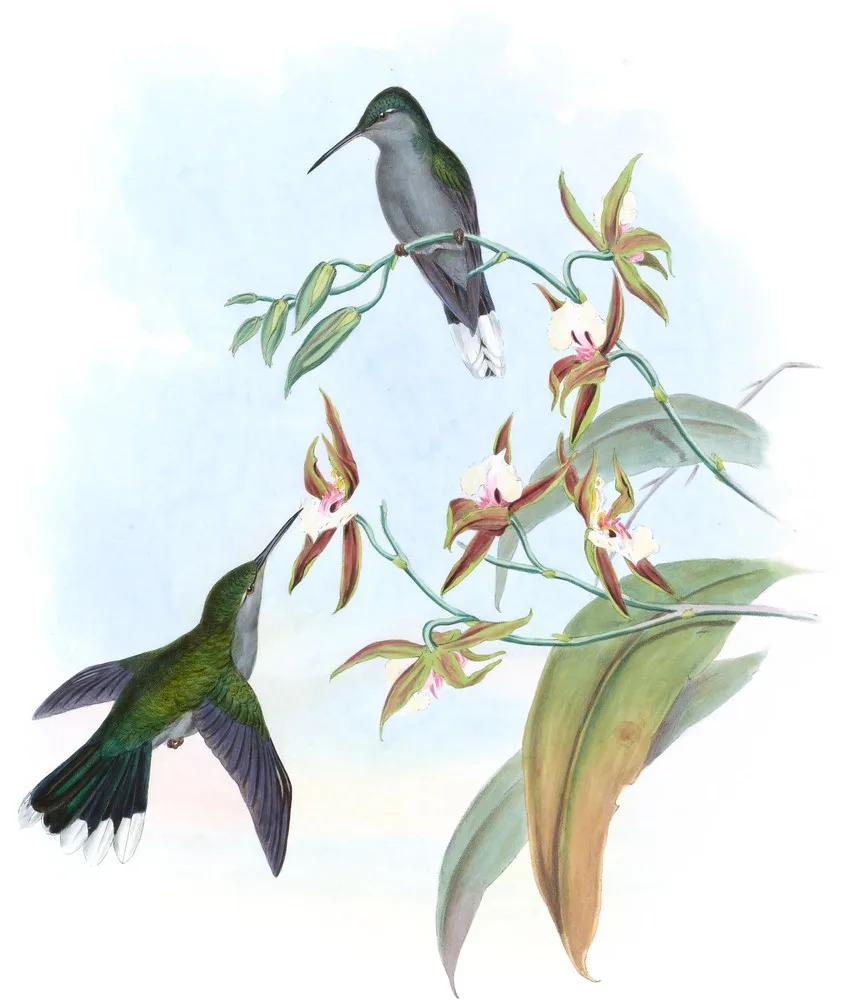
Campylopterus latipennis
燕尾刀翅蜂鸟
Campylopterus latipennis
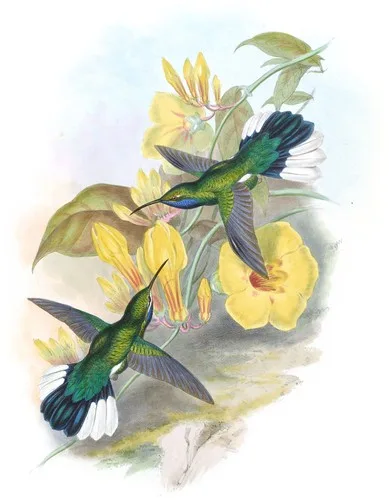
Broad-shafted Sabre-wing
About this plate
Cayenne and British Guiana
The Campylopterus latipennis is one of the very earliest-known species of Humming-Bird; a glance at the long list of names by which it has been described in the works of Linnæus, Boddaert, Gmelin, Latham, Buffon, &c., will at once induce the reader to come to such a conclusion.
Long known, however, as the species has been, no reliable information has been transmitted to us as to its habits and economy, or the specific purpose for which the broad shafts of the wings have been designed. They doubtless aid the bird in cleaving the air with great rapidity, but they perhaps have some other especial use, though what that may be cannot be easily imagined, since they do not occur in the females, and are only to be found in the very old males. If we wish to see this bird in a state of nature, a journey to Cayenne and French Guiana will enable us to attain the object of our desire, as it is in those countries, particularly Cayenne, that the specimens sent to Europe are collected. Of these the greater part are of course sent to Paris, whence they find their way to this country.
I believe I have still another species of this form from Ecuador, intermediate between C. latipennis and C. obscurus; but of this more at some other time, when additional specimens have arrived; at present I have only seen the one which graces my collection. This bird is certainly not the female of either of the abovementioned species; it has longer wings than either of them, and, moreover, differs in the extent of the white tipping of the outer tail-feathers.
Of the three or four known species of grey-breasted Campylopteri, the present has by far the greatest amount of white at the tips of the lateral tail-feathers.
I believe that no difference exists in the colouring of the sexes of the Campylopterus latipennis, and that the dilated shafts of the outer wing-feathers is the only tangible character by which the sexes can be distinguished.
Modern research has discovered that the earliest specific appellation assigned to this bird is that of largipennis, given to it by Boddaert; by that name, however, it is known to but few, while that of latipennis is just as familiar. I have therefore in this instance deviated from the law of priority, and adopted the term which is most generally applied to it.
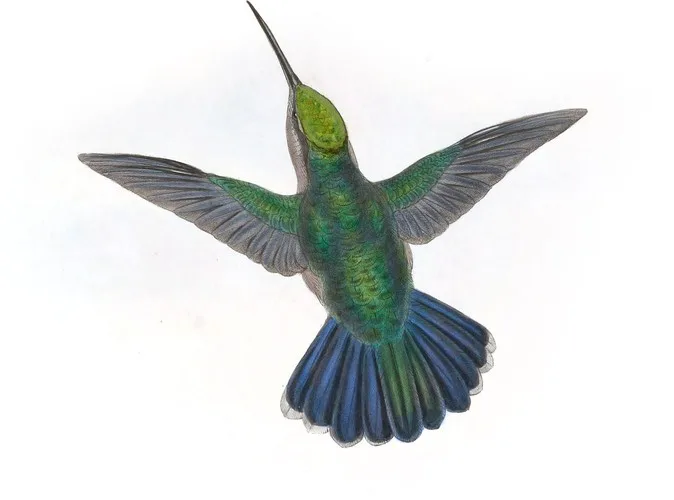
Head, all the upper surface, wing- and tail-coverts, sides of the neck, and flanks deep oil-green; wings dark purplish brown; two centre tail-feathers dark green; the next on each side black, washed with green at the base, and slightly tipped with whitish; the remainder black, largely tipped with white; all the under surface dark grey; bill black.
The figures are of the natural size. The plant is the Odontoglossum hastilabium, var. fuscatum.
References
- Trochilus campylopterus, Gmel. Linn. Syst. Nat., tom. i. p. 499.—Valenc. Dict. Sci. Nat., tom. xxxv. p. 492.—Drap. Dic. Class. Sci. Nat., tom. iv. p. 325.
- Trochilus cinereus, Gmel. edit. Linn. Syst. Nat., tom. i. p. 490.
- Trochilus largipennis, Bodd. latipennis, Lath. Ind. Orn., vol. i. p. 310.—Vieill. Nouv. Dict. d’Hist. Nat., tom. vii. p. 365.—Swains. Zool. Ill. vol. iii. pls. 130, 131.—Jard. Nat. Lib. Hum.-Birds, vol. i. p. 146.—Vieill. et Bonn. Ency. Méth.Orn., 2me partie, p. 566.
- L’Oiseau-mouche à larges tuyaux, Buff. Hist. Nat. des Ois., tom. vi. p.35.—Aud. et Vieill. Ois. dor., tom. i. p. 51, pl. 21
- L’Oiseau-mouche à larges tuyaux de Cayenne, Buff. Pl. Enl. 672. fig. 2.
- Polytmus largipennis, Gray and Mitch. Gen. of Birds, vol. i. p. 107, Polytmus, sp. 1
- Broad-shafted Humming-Bird, Lath. Gen. Syn., vol. ii. p. 765.—Id. Gen. Hist., vol. iv. p. 321.
- Ornismya latipennis, Less. Hist. Nat. des Ois. Mou. p. 121, pl. 34.Id. Tab. des Esp. des Ois. Mou., p. xlii.
- Campylopterus latipennis, Swains. Zool. Journ. vol. iii. p. 358.—Jard. Nat. Lib. Hum.-Birds, vol.i. pl. 34.—Bonap. Consp. Gen. Av., p. 71, Campylopterus, sp. 1.—Less. Ind. Gen. et Syn. des Ois. du gen. Trochilus, p. v.—Reichenb. Auf. der Col., p. 11—Bonap. Rev. et Mag. de Zool., 1854, p. 250.
- Trochilus cinereus, Lath. Ind. Orn., vol. i. p. 308.
- Colibri à ventre cendre, Aud. et Vieill. Ois. dor., tom. i. p. 18. pl. 5.
- Ash-bellied Humming-Bird, Lath. Gen. Syn., vol. ii. p. 759.—Shaw, Gen. Zool., vol. viii. p. 297.—Lath. Gen. Hist., vol. iv. p. 316.
- Le Colibri à ventre cendré, Aud. et Vieill. Ois. dor., tom. i. p. 18, pl. 5?
Twelve ways of seeing
- slightly upright 1.18 : 1
- published 1850
- Pl. 48, Vol. II
Not a catalogue entry but a way of looking: how to stand, what to notice, how the line was cut, when it flowers, where it came from, who made it — and then the poems and the classics that taught China to see the same flower. Read the twelve in order and the plate opens.
-
First Look
六法者何?一、气韵生动是也;二、骨法用笔是也;三、应物象形是也;四、随类赋彩是也;五、经营位置是也;六、传移模写是也。
—— 南齐·谢赫《古画品录》
The six laws: spirit resonance alive; bone-method in the brush; matching form; colour by kind; planning the placing; copying the masters.
Slightly taller than wide; the eye lands on the bird's head, a little above centre. Then step in close: watch where colour meets line, and whether the line ever breaks. Third, find the darkest small patch: the whole tonal order is measured from there.
-
Name and Thing
The binomial is Campylopterus latipennis: the first word is the genus it belongs among, the second the epithet that sets it apart. Two words carry a whole provenance. The Chinese name 燕尾刀翅蜂鸟 is a modern rendering of the Latin, not an old garden name.
-
Form and Colour
The smallest of birds: a needle-fine bill, a forked tubular tongue, wings beating so fast the bird hovers and even flies backwards. Its colour is not pigment but structure — light bent by feather barbules, changing with the angle.No colour group is recorded. Three things fix the habit: leaf arrangement, tepal count, and how the flower is borne.
-
Composition
Slightly taller than wide, the bird set a little above centre, the eye landing at head and bill. (about 1.18 : 1) No details are appended: a plate for looking, not for keying out. Blank paper is not unfinished work: it is where the eye rests.
-
Line and Colour
In the later nineteenth century chromolithography took over: colour printed rather than painted, line demoted. Take a loupe to three places: petal edge, leaf vein, caption. An unbroken line means engraving; colour crossing the outline means a hand.
-
Season
In tropical America they are present all year, their season set by flowers; temperate hummingbirds follow the bloom north and back, thousands of kilometres a year. The year 1850 on the plate is that of publication, not of flowering — the gathering came a year or two earlier. The best time to read such a plate is its flowering season: three minutes under the tree explains what no text can.
-
Provenance
Americas only, from southern Alaska to Tierra del Fuego, richest in the Andes. China has no hummingbirds and no classical record of them; the name arrives with late-Qing travel writing. In the same volume the kin are shelved together; set several plates side by side.
-
The Book and the Hand
“Gould's Hummingbirds” was drawn by John Gould and published 1849-1887. This plate is Pl. 48, Vol. II, book page 48. The image is public domain; the hand-colouring is still one person's hand.
-
Poetic Resonance
穿花蛱蝶深深见,点水蜻蜓款款飞。
—— 唐·杜甫《曲江二首》
Butterflies thread the flowers, seen deep within; dragonflies touch the water and fly on, slow and deliberate.
The poem gives the mood first and the picture supplies the form; set the line beside the plate and the bird itself becomes its resting point.
-
The Written Tradition
论画以形似,见与儿童邻。
—— 宋·苏轼《书鄢陵王主簿所画折枝》
To judge a painting by likeness alone is the view of a child.
Gould's Hummingbirds (1849–1887) used hand-coloured lithography over gold leaf so the iridescence survived on paper — a monument to Victorian printing and collecting alike. You need not parse every word: take the line, and the flower acquires a second face.
-
Symbolism
For the Aztecs the hummingbird was warrior and sun; for Victorian Europe it was the ultimate ornament, millions killed for breast jewellery. China has no tradition here — and that blank is itself a history of exchange. In a flora it is a species first and a symbol second; the order is worth keeping.
-
What to Take Away
Carry three rules away: whole before detail; line before colour; picture before book. Two centuries on, the plant may still flower in some garden; the one on this sheet stopped in the season of 1850.