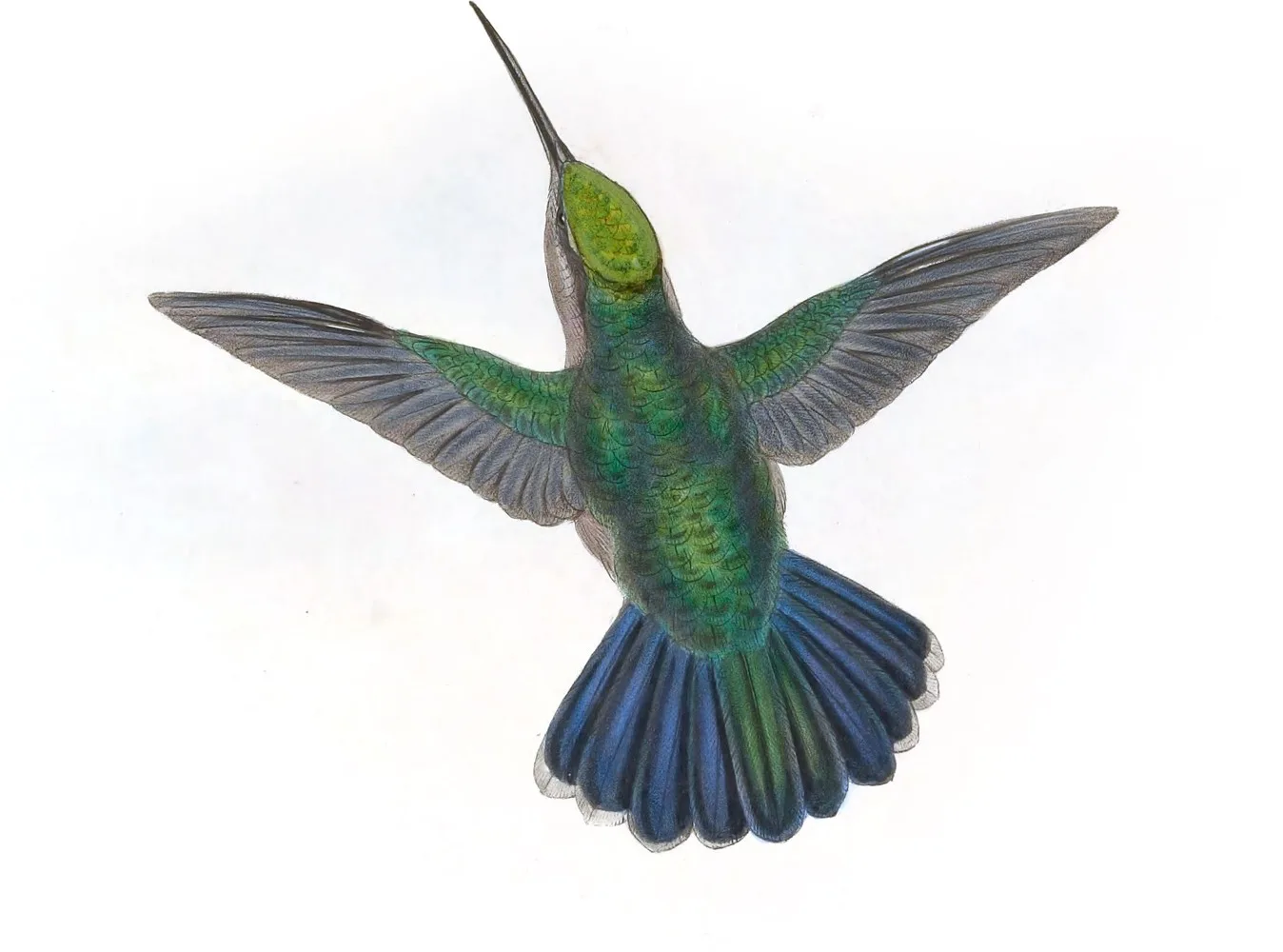
Campylopterus Villavicencio
燕尾刀翅蜂鸟·Campylopterus Villavicencio
Campylopterus Villavicencio
Villavicencio’s Sabre-wing
Ten ways of seeing
- broad 0.74 : 1
First Look
真山水之川谷,远望之以取其势,近看之以取其质。
—— 宋·郭熙《林泉高致·山水训》
Mountains and valleys: from afar take their momentum, up close take their texture — the two distances from which any picture is read.
Broad and horizontal: the eye travels side to side. Find where it stops. Then step in close: watch where colour meets line, and whether the line ever breaks. Third, find the darkest small patch: the whole tonal order is measured from there.
Name and Thing
The binomial is Campylopterus villavicencio: the first word is the genus it belongs among, the second the epithet that sets it apart. Two words carry a whole provenance. No established Chinese name exists, so it is cited by its binomial alone.
Form and Colour
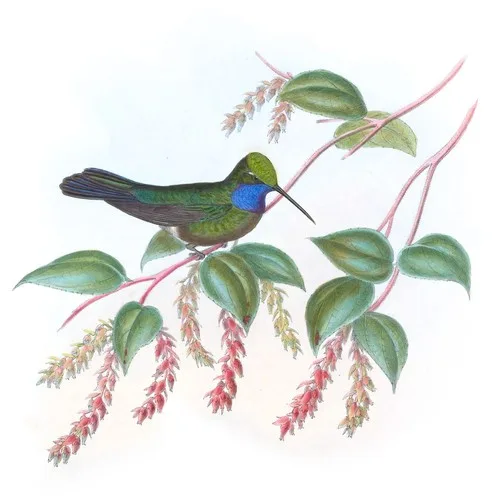
The smallest of birds: a needle-fine bill, a forked tubular tongue, wings beating so fast the bird hovers and even flies backwards. Its colour is not pigment but structure — light bent by feather barbules, changing with the angle.No colour group is recorded. Three things fix the habit: leaf arrangement, tepal count, and how the flower is borne.
Composition
Broad and horizontal — the format for perched, spread-wing or grouped birds. No details are appended: a plate for looking, not for keying out. Old plates set the plant slightly off centre, with unequal margins — that small imbalance is what keeps it alive.
Line and Colour
In the later nineteenth century chromolithography took over: colour printed rather than painted, line demoted. Take a loupe to three places: petal edge, leaf vein, caption. An unbroken line means engraving; colour crossing the outline means a hand. If you mean to copy it: block in the broad shapes and colours first, detail last; lithographic softness comes from thin washes — two or three pale layers will get you close.
Poetic Resonance
夫列子御风而行,泠然善也,旬有五日而后反。
—— 《庄子·逍遥游》
Liezi rode the wind and came back after fifteen days, so light was his going.
The poem gives the mood first and the picture supplies the form; set the line beside the plate and the bird itself becomes its resting point.
Symbolism
For the Aztecs the hummingbird was warrior and sun; for Victorian Europe it was the ultimate ornament, millions killed for breast jewellery. China has no tradition here — and that blank is itself a history of exchange. In a flora it is a species first and a symbol second; the order is worth keeping.
Season and Place
In tropical America they are present all year, their season set by flowers. the name arrives with late-Qing travel writing. The year 1850 on the plate is that of publication, not of flowering — the gathering came a year or two earlier. The bud and the ripe fruit on one branch tell the season; the name in the title often tells the journey.
The Book and the Hand
“Gould's Hummingbirds” carries only John Gould's name. A plate is collective work: drawer, engraver and colourist were different hands, and the unnamed ones decided how good it looks.
What to Take Away
Appreciation is not knowledge but habit — one more look each time. Two centuries on, the plant may still flower in some garden; the one on this sheet stopped in the season of 1850.
About this plate
Forests bordering the Rio Napo in Ecuador
The Campyopterus Villavicencio was first described by M. Bourcier, from a specimen obtained by him during his sojourn in Ecuador, and named in honour of a gentleman attached to the study of natural history resident in that country.
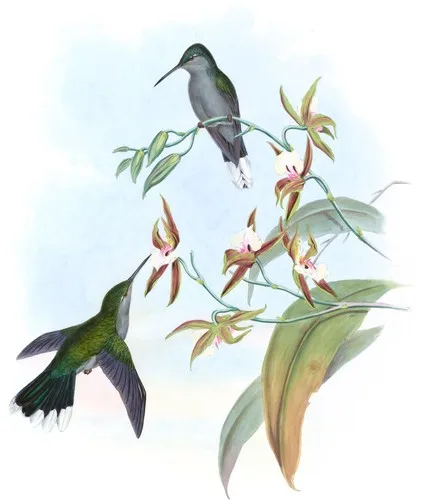
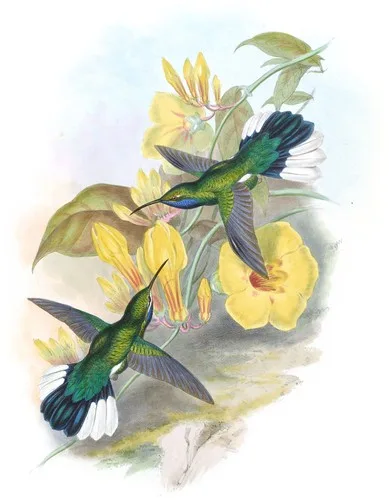
A single specimen is also contained in the Loddigesian collection. Both these examples appear to be females, and assimilate so closely in size and in some parts of their colouring to the bird lately named C. splendens by Mr. G. N. Lawrence of New York, that I am induced to believe them to be so many examples of one and the same species. I do net, however, insist upon such being the case, and therefore only place them together provisionally. In the length and form of the bill, in the general colouring of the tail and of the upper and under surface, they are precisely similar; the only observable difference being, that Mr. Lawrence’s specimen has a splendid deep-blue throat-mark, which is entirely absent in M. Bourcier’s and the Loddigesian examples. As both sexes of some other species of the Campylopteri are very sombrely coloured, it is just possible that Mr. Lawrence’s bird may prove to be distinct, in which case his name of splendens may be restored, and retained for the bird represented in the upper figure on the accompanying Plate, and that of Villavicencio for the lower one. Mr. Lawrence’s example was procured by Mr. Wm. E. Moore, between the head waters of the Napo and Quito, the same locality in which the other specimens were obtained.
The following is a description of M. Bourcier’s specimen:—
Crown of the head metallic golden green; upper surface, wing-coverts and flanks dark golden green; wings purplish brown; two centre tail-feathers dark green, the remainder steel-blue, the two outer ones tipped, and the others slightly fringed with greyish white at the tip; all the under surface ashy grey; bill black; feet brown.
Mr. Lawrence’s specimen differs in having a gorget of rich deep metallic blue on the throat, and in the lateral tail-feathers being merely fringed instead of tipped with greyish white.
The Plate represents the two birds of the natural size. The plant is the Gualtheria bracteata.
References
- Trochilus Villaviscensio, Boure. Compt. Rend. de l’Acad. des Sci., tom. xxxii. p. 187.
- Helomaster Villaviscensio, Reich. Auf. der Col., p. 13.
- Heliomastes villavisencio, Bonap. Rev. Zool, 1854, p. 251.
- Campylopterus splendens, Lawr. in Ann. Lye. Nat. Hist. New York, vol. vi. p. 262?