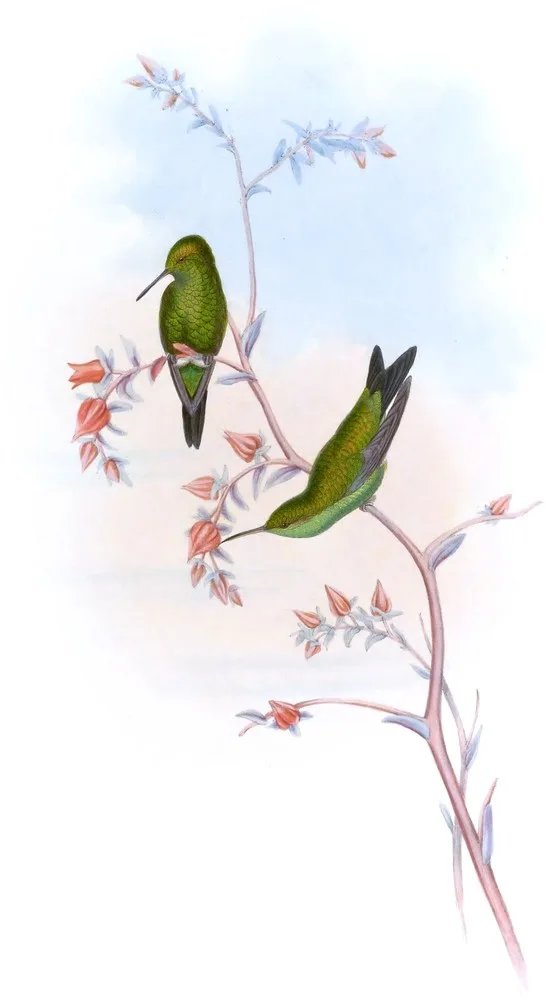
Chlorostilbon angustipennis
翠蜂鸟属
Chlorostilbon angustipennis
Columbian Emerald
About this plate
Panama and New Granada
In attempting to investigate the little green Humming-Birds, the ornithologist enters upon a task of no ordinary difficulty.
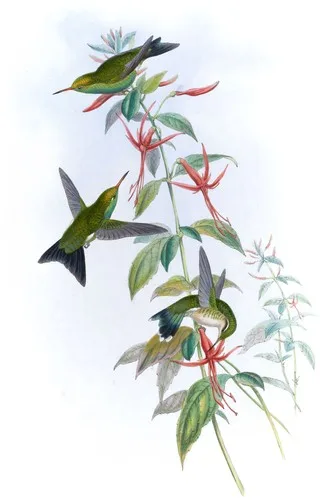
Many have been the days I have spent in endeavouring to correctly separate into species the birds known by the name of chrysogaster, aurigaster, and angustipennis, with, in every instance, anything but a satisfactory result; and, had I not had access to the typical specimens to which these terms had been applied, it would have been impossible to have achieved what I have done in the present work. Of one thing I am certain, namely, that the angustipennis of Fraser and the chrysogaster of M. Bourcier are one and the same bird; forI have the types of both now before me, and they do not differ in the slightest degree. M. Bourcier, I believe, considered his chrysogaster to differ from angustipennis in having a brilliant crown; but his type-specimen, with the name of chrysogaster written by his own hand, is destitute of brilliancy on that part; I am therefore induced to consider that both names have reference to the same species, and thus the law of priority compels me to adopt that of angustipennis, and sink chrysogaster to the rank of a synonym. As to the aurigaster, I am still in doubt. We really want better information respecting the little green Humming-Birds, and a larger number of specimens than we now possess, before the various species can be determined with accuracy; at present, we do not even know with certainty the female of the very common bird here represented; in all probability she will have all the under surface grey washed with green on the flanks, and a tail, unlike that of the male, with the two centre feathers green, the two next green at the base, then black, and white at the tip, while the two outer ones will probably be green at the base, succeeded by three nearly equal bands of grey, black, and greyish white. I have a specimen from Panama which answers to this description, and which I think may be the female of the present species; but I have not figured it, lest such should not be the case.
The Chlorostilbon angustipennis ranges over the whole of the Andean region from Panama to Bogota; it may, in fact, be said to inhabit the temperate portions of all the high lands of Columbia.
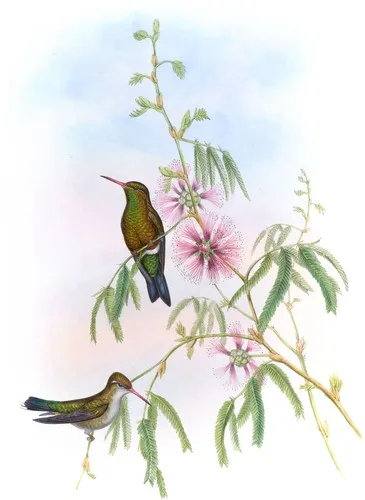
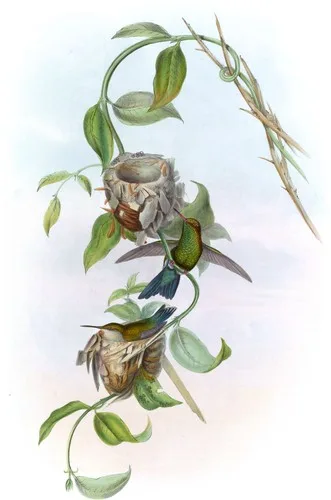
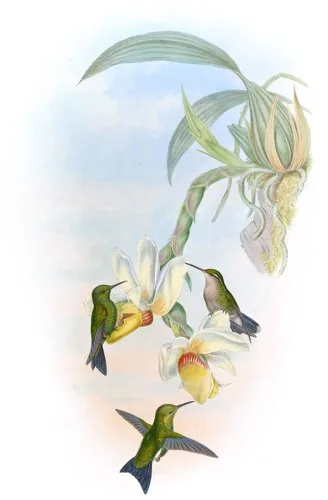
Crown of the head, all the upper surface, and wing-coverts golden bronze, passing into green on the upper tail-coverts; wings purplish brown; tail black glossed with dark green; throat luminous golden green, becoming of a richer and more golden hue on the sides of the neck, flanks, and abdomen; under tail-coverts brilliant grass-green; upper mandible black; lower mandible flesh colour at the base, black at the tip; feet blackish brown.
The figures are of the natural size.
References
- Trochilus angustipennis, Fras. in Proc. of Zool. Soc., part viii. p. 18.
- Hylocharis angustipennis, Gray and Mitch. Gen. of Birds, vol. i. p. 114, Hylocharis, sp. 21.
- Hylocharis chrysogaster, Bourc. Rev. Zool. 1843, p. 101?—Ib. Ann. Soe. Sci. Phys. et Nat. Lyon, 1843, p. 40?
- Hylocharis chrysogaster, Bonap. Consp. Gen. Av., tom. i. p. 74, Hylocharis, sp. 7?—Ib. Rev. et Mag. de Zool. 1854, p. 255?—Gray and Mitch. Gen. of Birds, vol. i. p. 115, Hylocharis, sp. 43?—Sclater in Proc. of Zool. Soc., part xxv. p. 17?
Twelve ways of seeing
- upright 1.83 : 1
- published 1861
- Pl. 353, Vol. V
Not a catalogue entry but a way of looking: how to stand, what to notice, how the line was cut, when it flowers, where it came from, who made it — and then the poems and the classics that taught China to see the same flower. Read the twelve in order and the plate opens.
-
First Look
搜尽奇峰打草稿。
—— 清·石涛《苦瓜和尚画语录》
Exhaust the strange peaks, and then make the sketch.
The sheet is vertical: the eye climbs and settles on the bird. Take the posture before the plumage. Then step in close: watch where colour meets line, and whether the line ever breaks. Third, find the darkest small patch: the whole tonal order is measured from there.
-
Name and Thing
The binomial is Chlorostilbon angustipennis: the first word is the genus it belongs among, the second the epithet that sets it apart. Two words carry a whole provenance. The Chinese name 翠蜂鸟属 is a modern rendering of the Latin, not an old garden name.
-
Form and Colour
The smallest of birds: a needle-fine bill, a forked tubular tongue, wings beating so fast the bird hovers and even flies backwards. Its colour is not pigment but structure — light bent by feather barbules, changing with the angle.No colour group is recorded. A single plant, laid out with nothing hidden.
-
Composition
Tall and narrow, the bird perched mid-branch with generous margins above and below. (about 1.83 : 1) No details are appended: a plate for looking, not for keying out. Cover the margins with your thumb and the plate suffocates; uncover them and the flower breathes again.
-
Line and Colour
In the later nineteenth century chromolithography took over: colour printed rather than painted, line demoted. There is evidence on the back too: the plate mark pressed into the paper, the slight relief of the pigment, lines worn shallow in a later printing.
-
Season
In tropical America they are present all year, their season set by flowers; temperate hummingbirds follow the bloom north and back, thousands of kilometres a year. The year 1861 on the plate is that of publication, not of flowering — the gathering came a year or two earlier. Note the season. Phenology is the most practical tool of appreciation.
-
Provenance
Americas only, from southern Alaska to Tierra del Fuego, richest in the Andes. China has no hummingbirds and no classical record of them; the name arrives with late-Qing travel writing. In the same volume the kin are shelved together; set several plates side by side.
-
The Book and the Hand
“Gould's Hummingbirds” was drawn by John Gould and published 1849-1887. This plate is Pl. 353, Vol. V, book page 353. The image is public domain; the hand-colouring is still one person's hand.
-
Poetic Resonance
夫列子御风而行,泠然善也,旬有五日而后反。
—— 《庄子·逍遥游》
Liezi rode the wind and came back after fifteen days, so light was his going.
The poem gives the mood first and the picture supplies the form; set the line beside the plate and the bird itself becomes its resting point.
-
The Written Tradition
庭下如积水空明,水中藻荇交横,盖竹柏影也。
—— 宋·苏轼《记承天寺夜游》
The courtyard seemed flooded with clear water, weeds crossing in it — in fact the shadows of bamboo and cypress.
Gould's Hummingbirds (1849–1887) used hand-coloured lithography over gold leaf so the iridescence survived on paper — a monument to Victorian printing and collecting alike. Keep the line; it will surface the next time you meet the same plant.
-
Symbolism
For the Aztecs the hummingbird was warrior and sun; for Victorian Europe it was the ultimate ornament, millions killed for breast jewellery. China has no tradition here — and that blank is itself a history of exchange. Flower language was added later; the flower knows nothing of it, and that innocence is part of its power.
-
What to Take Away
Appreciation is not knowledge but habit — one more look each time. The flower of that year is dust, yet its image on paper has outlived every living cousin.