Chlorostilbon Poortmanni
翠蜂鸟属·Chlorostilbon Poortmanni
Chlorostilbon Poortmanni
Poortman’s Emerald
Ten ways of seeing
- slightly upright 1.21 : 1
First Look
竖划三寸,当千仞之高;横墨数尺,体百里之迥。
—— 南朝宋·宗炳《画山水序》
A vertical stroke of three inches stands for a cliff of a thousand fathoms; a few feet of ink holds a hundred li.
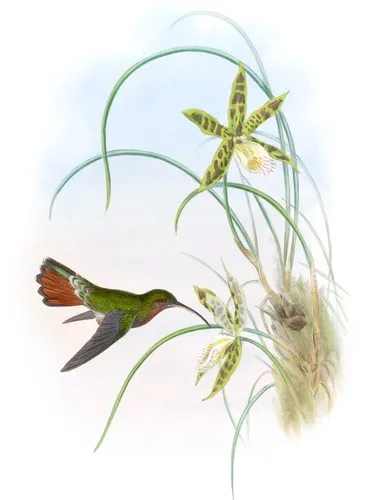
Slightly taller than wide; the eye lands on the bird's head, a little above centre. Then step in close: watch where colour meets line, and whether the line ever breaks. Third, find the darkest small patch: the whole tonal order is measured from there.
Name and Thing
The binomial is Chlorostilbon poortmanni: the first word is the genus it belongs among, the second the epithet that sets it apart. Two words carry a whole provenance. No established Chinese name exists, so it is cited by its binomial alone.
Form and Colour
The smallest of birds: a needle-fine bill, a forked tubular tongue, wings beating so fast the bird hovers and even flies backwards. Its colour is not pigment but structure — light bent by feather barbules, changing with the angle.No colour group is recorded. Three things fix the habit: leaf arrangement, tepal count, and how the flower is borne.
Composition
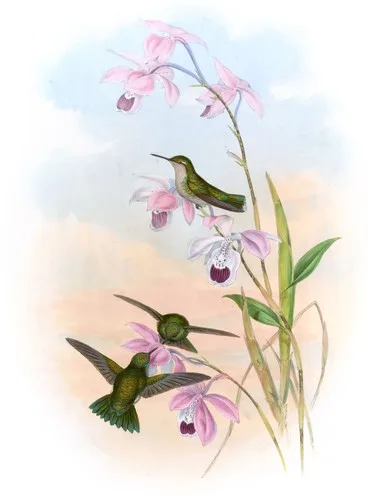
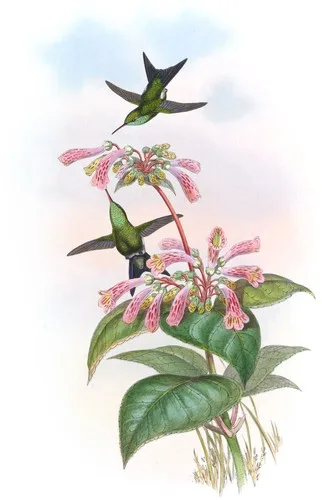
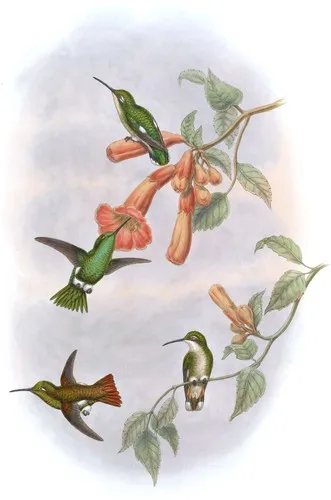
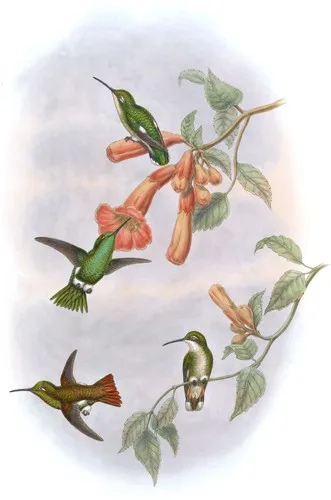
Slightly taller than wide, the bird set a little above centre, the eye landing at head and bill. No details are appended: a plate for looking, not for keying out. Old plates set the plant slightly off centre, with unequal margins — that small imbalance is what keeps it alive.
Line and Colour
In the later nineteenth century chromolithography took over: colour printed rather than painted, line demoted. There is evidence on the back too: the plate mark pressed into the paper, the slight relief of the pigment, lines worn shallow in a later printing. If you mean to copy it: block in the broad shapes and colours first, detail last; lithographic softness comes from thin washes — two or three pale layers will get you close.
Poetic Resonance
夫列子御风而行,泠然善也,旬有五日而后反。
—— 《庄子·逍遥游》
Liezi rode the wind and came back after fifteen days, so light was his going.
The poem gives the mood first and the picture supplies the form; set the line beside the plate and the bird itself becomes its resting point.
Symbolism
For the Aztecs the hummingbird was warrior and sun; for Victorian Europe it was the ultimate ornament, millions killed for breast jewellery. China has no tradition here — and that blank is itself a history of exchange. Flower language was added later; the flower knows nothing of it, and that innocence is part of its power.
Season and Place
In tropical America they are present all year, their season set by flowers. Americas only, from southern Alaska to Tierra del Fuego, richest in the Andes. China has no hummingbirds and no classical record of them. The year 1861 on the plate is that of publication, not of flowering — the gathering came a year or two earlier. Read the locality and the flowering season both with a discount: one is hearsay, the other a ten-day peak.
The Book and the Hand
“Gould's Hummingbirds” carries only John Gould's name. A plate is collective work: drawer, engraver and colourist were different hands, and the unnamed ones decided how good it looks.
What to Take Away
Appreciation is not knowledge but habit — one more look each time. A flora exists to be consulted; look long enough and you forget to consult — someone in 1861 gave a whole day to a single flower.
About this plate
New Granada
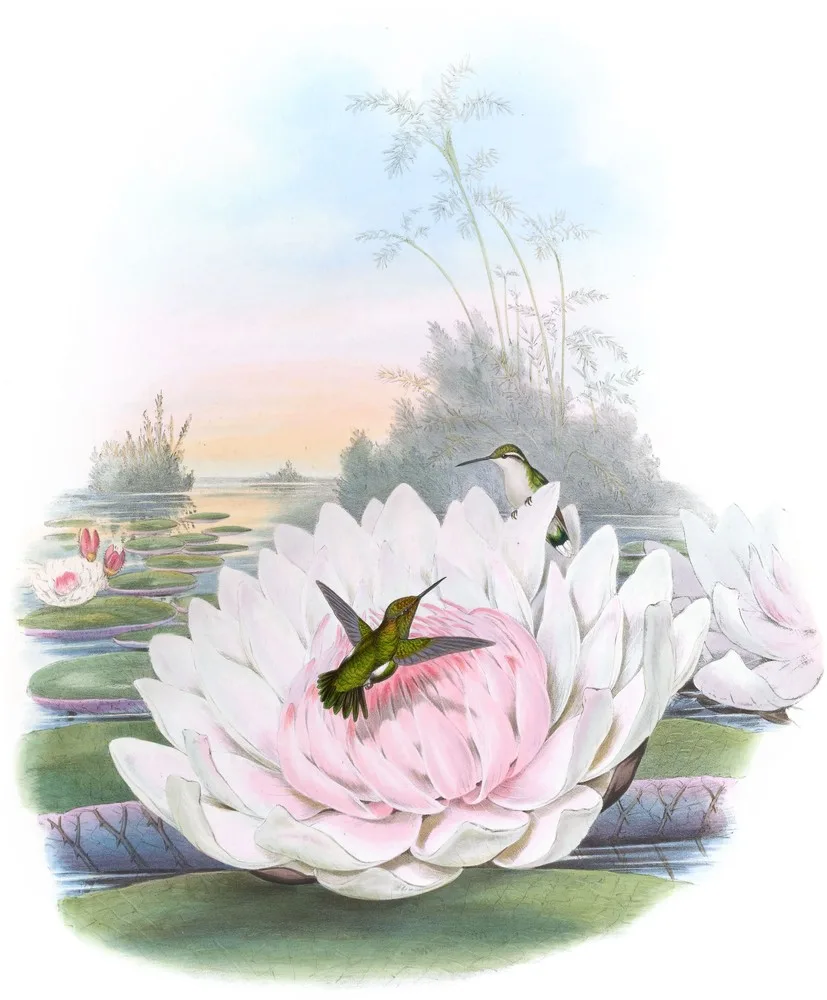
If the term insignificant should ever be applied to this bird, it certainly cannot be employed when speaking of the lovely plant figured on the accompanying Plate.
Now it may be asked, if the bird and the plant are ever in such close juxtaposition as I have represented them; to which I reply, that in all probability they are, though I have no actual evidence that such is the case; I know that the Humming-Birds examine individually most of the plants in the regions they frequent, whether in the woods or savannahs, and the chances are, therefore, that the Victoria regia is not unvisited by this bird during its peregrinations.
No one member of this little group of Humming-Birds is so diminutive as the present species, whose short tail, composed of ten narrow feathers, will at all times serve to distinguish it from its allies, the nearest of which is the Chlorostilbon Aliciæ. Both species inhabit the same part of America,—that is, Columbia and the country immediately to the eastward. We often receive examples from Bogota; indeed it may be said that all, or nearly all, the specimens sent to this country and to France are from thence. The same difference occurs in the colouring of the sexes of both species; the females having the under surface grey, instead of glittering green. The young males are all intermediate in their style of colouring, but have larger tails than the female.
Head golden orange; all the upper surface, wing- and tail-coverts reddish bronzy green; wings purplish brown; tail dark bronzy green, both on the upper and under surface; all the under surface, including the under tail-coverts, dull bronzy green; bill black; feet dark brown.
The female has the upper surface similarly coloured to that of the male, but far less brilliant; the under surface grey; the wings purplish brown; the centre tail-feathers green; the remainder green at the base, passing into black near the extremity, and tipped with greyish; under tail-coverts greyish brown.
The young male is similar to the female, but has the under surface spangled with golden green.
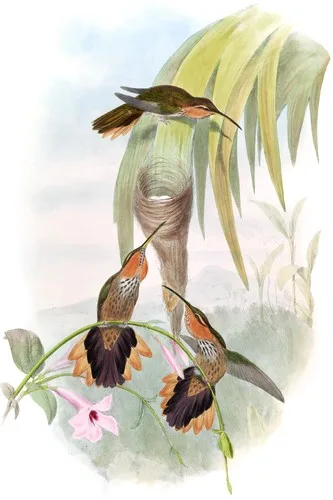
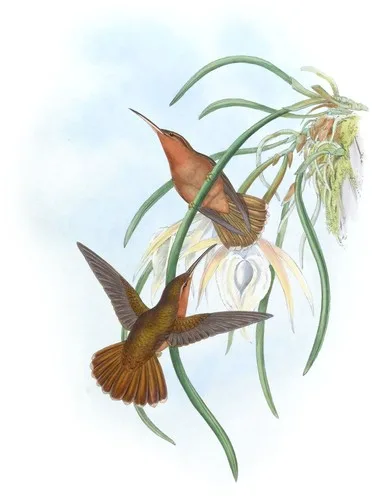
The Plate represents a male and a female of the natural size.
References
- Ornismya Poortman, Bourc. in Rev. Zool. 1843, p. 2.
- Hylocharis Portmanni, Gray and Mitch. Gen. of Birds, vol. i. p. 115, Hylocharis, sp. 48.—Sclat. in Proc. of Zool. Soc., part xxii. p. 141.
- Hylocharis portman, Bonap. Consp. Gen. Av., p. 74, Hylocharis, sp. 11.
- Chlorestes Poortmanni, Reichenb. Auf. der Col., p. 7.
- Chlorostilbon poortmani, Bonap. Rev. et Mag. de Zool. 1854, p. 255.