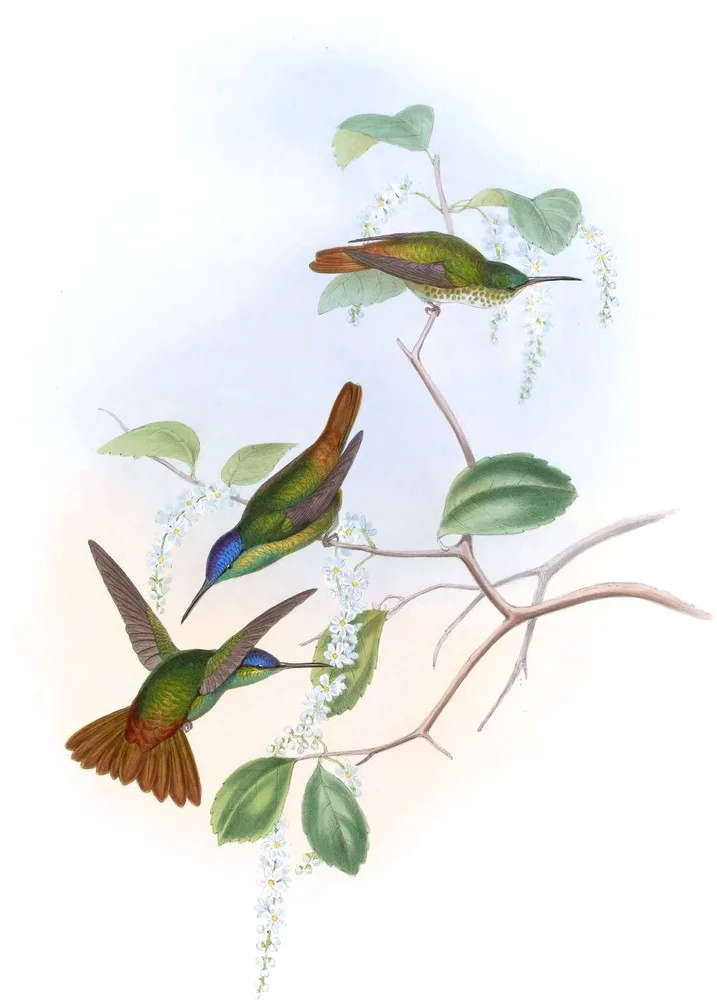
Chrysuronia Josephinæ
Chrysuronia Josephinæ
Josephine’s Humming-bird
About this plate
The upper parts of the River Amazon, where specimens were procured by Mr. Bates
Josephine’s Humming-bird is one of those species with which we are but little acquainted: my own collection contains two examples; one of these I purchased in Paris; the other I received direct from the Upper Amazon, where it was procured by Mr. Bates, a thorough naturalist, endowed with courage, energy, and perseverance fully equal to the performance of the task he has undertaken—that of exploring the rich districts of the Upper Amazon.
England may indeed be proud of two such sons as Wallace and Bates, to whom zoologists especially must feel grateful for a vast extension of their scientific knowledge.
In point of affinity this species is very closely allied to the well-known Chrysuronia Œnone; like that bird it has a splendid golden-bronzy tail; but the rich blue which adorns the throat as well as the head of that species is confined to the head alone in C. Josephine, the whole of whose under surface is green. We really have seen so little of this bird that it is unsafe to say whether the female be or be not contained in our collections; but I may predict that, when discovered, she will be found to differ very little from the female of C. Œnone.
This species has been dedicated by MM. Bourcier and Mulsant to Madame Julien Lacroix.
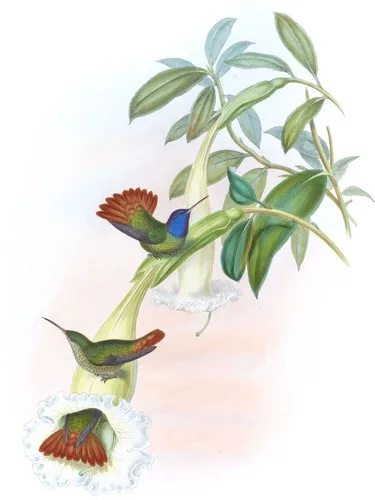
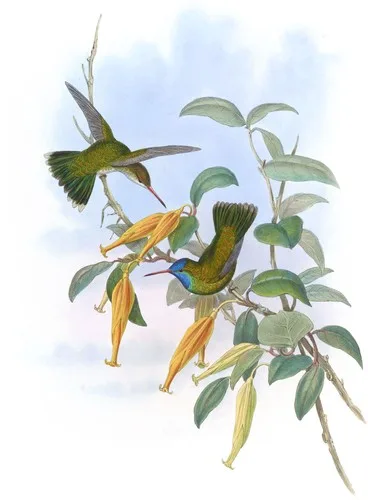
Crown of the head rich deep blue, tinged in some specimens with green; upper surface and wing-coverts golden green; under surface shining grass-green; wings purplish brown; upper tail-coverts coppery bronze; tail fine golden bronze in some examples, and rich coppery bronze in others; under tail-coverts golden bronze fringed with grey; upper mandible black; under mandible for four-fifths of its length apparently fleshy white, the tip darker.
The figures are of the natural size.
References
- Ormsmyia Josephinæ, Boure. and Muls. Rev. Zool. 1848, p. 272.
- Trochilus Josephinæ, Gray and Mitch. Gen. of Birds, vol. ii. Supp. App. 30a., App. to p. 103.
- Chrysuronia Josephinæ, Reich. Auf. der Col., p. 9.
- Chrysuronia josephina, Bonap. Rev. Zool. 1854, p. 254.
Twelve ways of seeing
- upright 1.39 : 1
- published 1861
- Pl. 326, Vol. V
Not a catalogue entry but a way of looking: how to stand, what to notice, how the line was cut, when it flowers, where it came from, who made it — and then the poems and the classics that taught China to see the same flower. Read the twelve in order and the plate opens.
-
First Look
搜尽奇峰打草稿。
—— 清·石涛《苦瓜和尚画语录》
Exhaust the strange peaks, and then make the sketch.
The sheet is vertical: the eye climbs and settles on the bird. Take the posture before the plumage. Then step in close: watch where colour meets line, and whether the line ever breaks. Third, find the darkest small patch: the whole tonal order is measured from there.
-
Name and Thing
No reliable binomial survives, so the printed title must serve. Neither name nor binomial survives: the printed title must do.
-
Form and Colour
The smallest of birds: a needle-fine bill, a forked tubular tongue, wings beating so fast the bird hovers and even flies backwards. Its colour is not pigment but structure — light bent by feather barbules, changing with the angle.No colour group is recorded. A single plant, laid out with nothing hidden.
-
Composition
Tall and narrow, the bird perched mid-branch with generous margins above and below. (about 1.39 : 1) No details are appended: a plate for looking, not for keying out. Blank paper is not unfinished work: it is where the eye rests.
-
Line and Colour
In the later nineteenth century chromolithography took over: colour printed rather than painted, line demoted. There is evidence on the back too: the plate mark pressed into the paper, the slight relief of the pigment, lines worn shallow in a later printing.
-
Season
In tropical America they are present all year, their season set by flowers; temperate hummingbirds follow the bloom north and back, thousands of kilometres a year. The year 1861 on the plate is that of publication, not of flowering — the gathering came a year or two earlier. Note the season. Phenology is the most practical tool of appreciation.
-
Provenance
Americas only, from southern Alaska to Tierra del Fuego, richest in the Andes. China has no hummingbirds and no classical record of them; the name arrives with late-Qing travel writing. The volume was made in 1849-1887, when most of this knowledge came from living plants under glass.
-
The Book and the Hand
“Gould's Hummingbirds” was drawn by John Gould and published 1849-1887. This plate is Pl. 326, Vol. V, book page 326. The image is public domain; the hand-colouring is still one person's hand.
-
Poetic Resonance
夫列子御风而行,泠然善也,旬有五日而后反。
—— 《庄子·逍遥游》
Liezi rode the wind and came back after fifteen days, so light was his going.
The poem gives the mood first and the picture supplies the form; set the line beside the plate and the bird itself becomes its resting point.
-
The Written Tradition
论画以形似,见与儿童邻。
—— 宋·苏轼《书鄢陵王主簿所画折枝》
To judge a painting by likeness alone is the view of a child.
Gould's Hummingbirds (1849–1887) used hand-coloured lithography over gold leaf so the iridescence survived on paper — a monument to Victorian printing and collecting alike. Keep the line; it will surface the next time you meet the same plant.
-
Symbolism
For the Aztecs the hummingbird was warrior and sun; for Victorian Europe it was the ultimate ornament, millions killed for breast jewellery. China has no tradition here — and that blank is itself a history of exchange. Meanings change their tune: the same flower can say opposite things within a century.
-
What to Take Away
If you keep one line, keep Guo Xi's: from afar its momentum, up close its texture. The flower of that year is dust, yet its image on paper has outlived every living cousin.