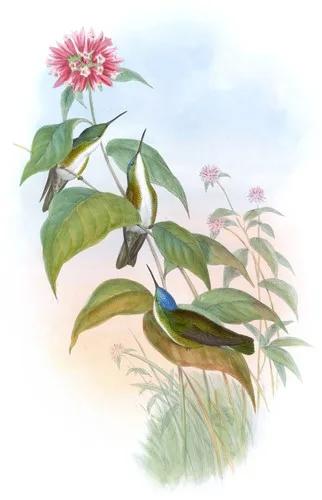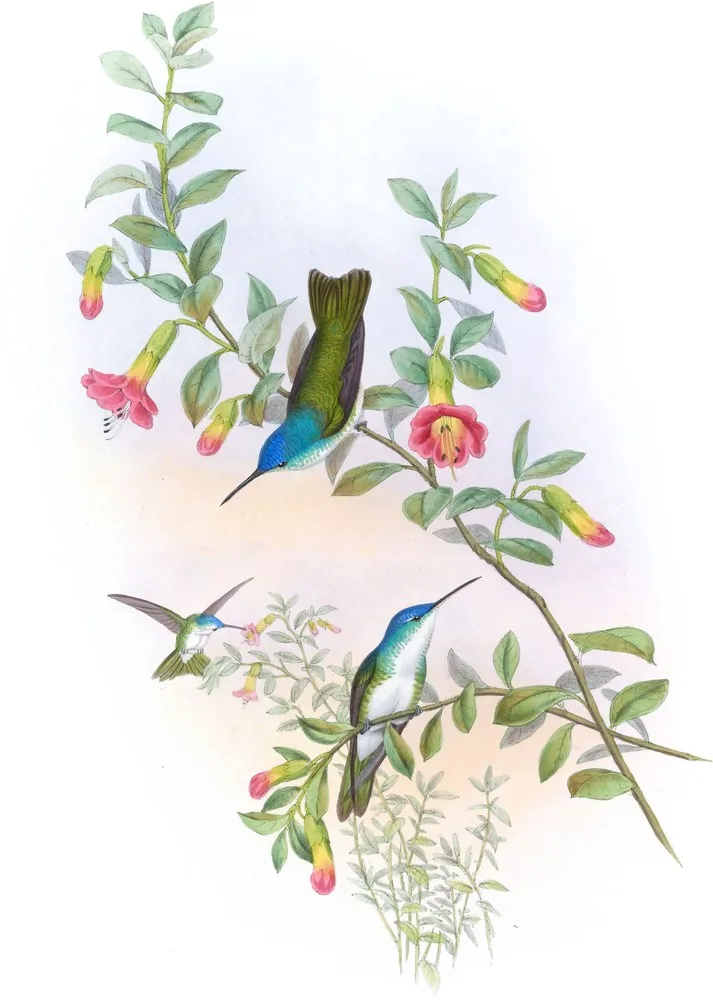
Cyanomyia cyanicollis
Cyanomyia cyanicollis
Blue-necked Azure-Crown
About this plate
Peru
The range of the members of the genus Cyanomyia extends over many degrees of latitude, or from Mexico to Peru, but all are inhabitants of temperate regions, none ascending to the snow-line, or descending to the sultry plains below.
The C. quadricolor of Mexico may be regarded as the species which proceeds farthest towards the north, and the present bird (which is found in Peru) to the south. For the specimens I possess I am indebted to M. Warszewicz. How much has science been enriched by his researches, and how often have I had to speak in terms of commendation of the energy and perseverance of this celebrated traveller!
The nearest ally of the Cyanomyia cyanocollis is the C. Franciæ; but it may be readily distinguished from the latter species by the blue tint of the sides and nape of the neck, those parts partaking of the same hue as the crown.
It is most interesting to observe how wonderfully Nature has varied the specific characters of this group of birds—characters which mainly depend upon a difference in colour and markings: thus, two of the Cyanomyiæ have the nape of the neck brought prominently before our notice by the brilliant colouring of this part, and two others by the uniform whiteness of their under surface, while the C. cyanocephala at present stands alone in having a blue crown unaccompanied by the other characters. It is probable that another species, somewhat similarly coloured, will yet be discovered; indeed I already possess evidence that such will be the case, for I have a single specimen of a young male of some new species, the colouring of which, judging from analogy, tells me that, whenever the adult may be discovered, it will be allied to C. cyanocephala.
Of the Cyanomyta cyanocollis no female has yet been sent to Europe; in colouring she will doubtless resemble the female of C. Franciæ and C. cyanocephala.
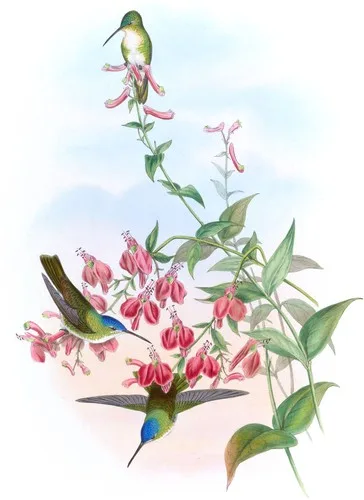
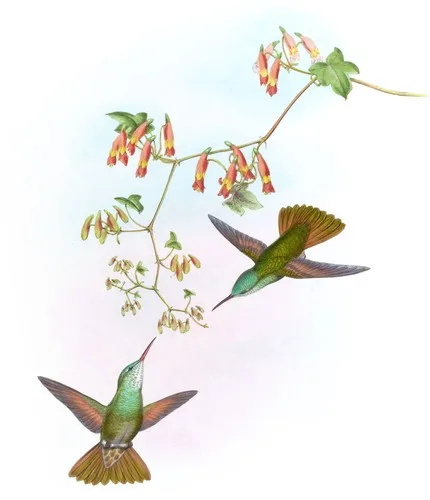
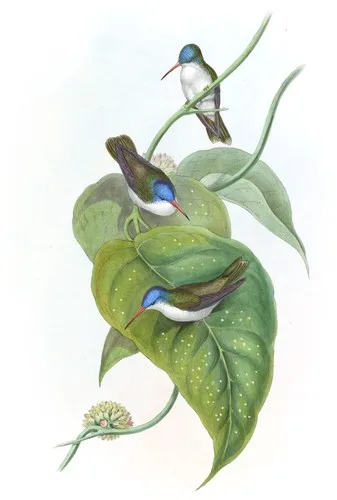
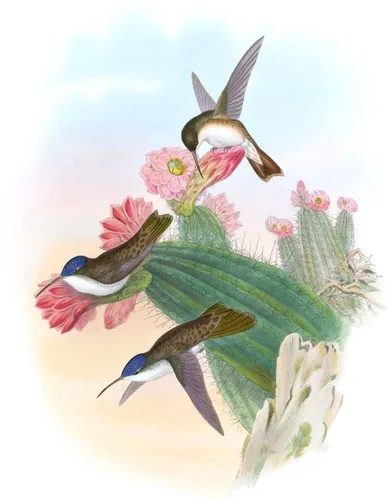
Crown of the head, sides, and nape of the neck greenish blue; upper surface bronzy green; throat, centre of the abdomen, and under tail-coverts white; flanks bronzy brown; tail bronzy green, all but the two middle feathers crossed near the tip with an obscure dusky band; upper mandible and tip of the lower mandible black, the remainder of the latter fleshy white; feet dark brown.
The*figures are of the natural size. The plant is the Cantua bicolor.
References
- Trochilus (———?) cyanocollis, Gould in Proc. of Zool. Soc., part xxi. p. 61.
- Uranomitra cyanicollis, Reichenb. Auf. der Col., p. 10.
- Cyanomyia cyanicollis, Bonap. Rev. et Mag. de Zool. 1854, p. 254.
Ten ways of seeing
- upright 1.40 : 1
- published 1861
- Pl. 288, Vol. V
Not a catalogue entry but a way of looking: how to stand, what to notice, how the line was cut — then, halfway, a line of Chinese poetry: how the ancients saw this same flower. After it, the flower's language, its season and homeland, its book; and at the end one line of classical prose — and a pair of eyes to take away.
-
First Look
真山水之川谷,远望之以取其势,近看之以取其质。
—— 宋·郭熙《林泉高致·山水训》
Mountains and valleys: from afar take their momentum, up close take their texture — the two distances from which any picture is read.
The sheet is vertical: the eye climbs and settles on the bird. Take the posture before the plumage. Then step in close: watch where colour meets line, and whether the line ever breaks. Third, find the darkest small patch: the whole tonal order is measured from there.
-
Name and Thing
The binomial is Cyanomyia cyanicollis: the first word is the genus it belongs among, the second the epithet that sets it apart. Two words carry a whole provenance. No established Chinese name exists, so it is cited by its binomial alone.
-
Form and Colour
The smallest of birds: a needle-fine bill, a forked tubular tongue, wings beating so fast the bird hovers and even flies backwards. Its colour is not pigment but structure — light bent by feather barbules, changing with the angle.No colour group is recorded. A single plant, laid out with nothing hidden.
-
Composition
Tall and narrow, the bird perched mid-branch with generous margins above and below. (about 1.40 : 1) No details are appended: a plate for looking, not for keying out. Blank paper is not unfinished work: it is where the eye rests.
-
Line and Colour
In the later nineteenth century chromolithography took over: colour printed rather than painted, line demoted. Craft leaves franker evidence than inscriptions. If you mean to copy it: block in the broad shapes and colours first, detail last; lithographic softness comes from thin washes — two or three pale layers will get you close.
-
Poetic Resonance
穿花蛱蝶深深见,点水蜻蜓款款飞。
—— 唐·杜甫《曲江二首》
Butterflies thread the flowers, seen deep within; dragonflies touch the water and fly on, slow and deliberate.
The poem gives the mood first and the picture supplies the form; set the line beside the plate and the bird itself becomes its resting point.
-
Symbolism
For the Aztecs the hummingbird was warrior and sun; for Victorian Europe it was the ultimate ornament, millions killed for breast jewellery. China has no tradition here — and that blank is itself a history of exchange. Meanings change their tune: the same flower can say opposite things within a century.
-
Season and Place
In tropical America they are present all year, their season set by flowers. Americas only, from southern Alaska to Tierra del Fuego, richest in the Andes. China has no hummingbirds and no classical record of them. The year 1861 on the plate is that of publication, not of flowering — the gathering came a year or two earlier. The volume was made in 1849-1887, when most of this knowledge came from living plants under glass.
-
The Book and the Hand
“Gould's Hummingbirds” was drawn by John Gould and published 1849-1887. This plate is Pl. 288, Vol. V, book page 288. The image is public domain; the hand-colouring is still one person's hand.
-
The Written Tradition
竖划三寸,当千仞之高;横墨数尺,体百里之迥。
—— 南朝宋·宗炳《画山水序》
A vertical stroke of three inches stands for a cliff of a thousand fathoms; a few feet of ink holds a hundred li. Smallness of scale was never the obstacle.
Gould's Hummingbirds (1849–1887) used hand-coloured lithography over gold leaf so the iridescence survived on paper — a monument to Victorian printing and collecting alike. Keep the line; it will surface the next time you meet the same plant.
What to Take Away
Carry three rules away: whole before detail; line before colour; picture before book. A flora exists to be consulted; look long enough and you forget to consult — someone in 1861 gave a whole day to a single flower.