Delattria viridipallens
Delattria viridipallens
Green-throated Cazique
About this plate
Guatemala
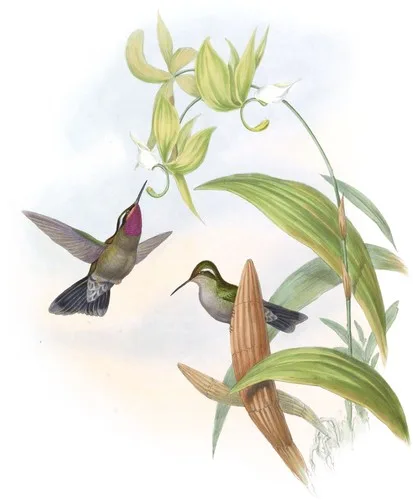
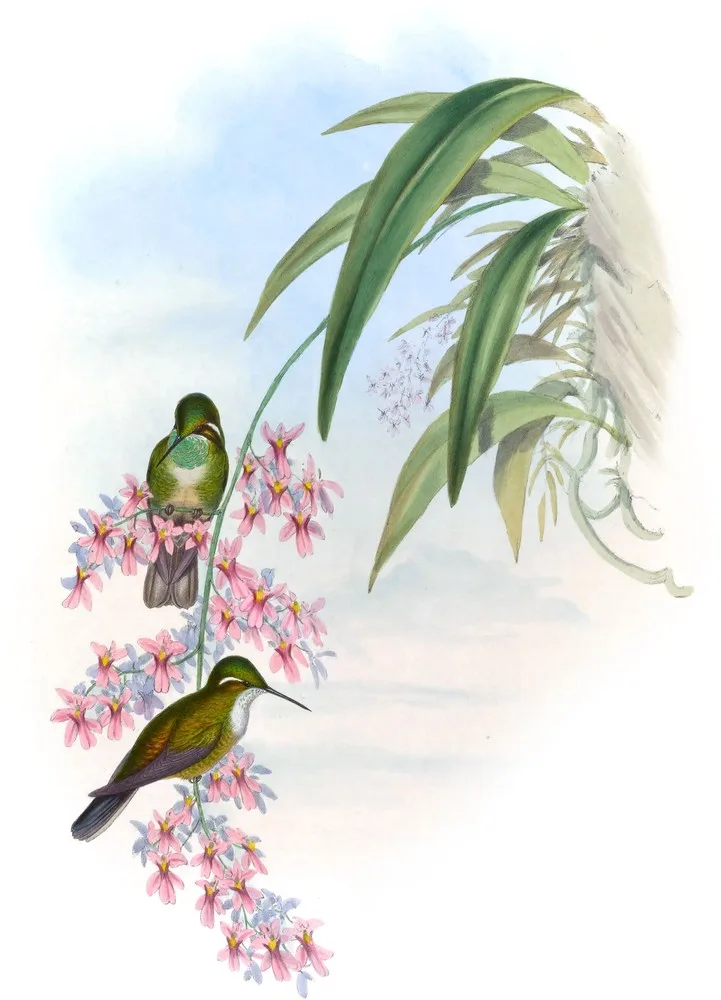
The Delattria viridipallens is a native of Guatemala and Mexico. The specimens from which MM. Bourcier and Mulsant took their description were brought to Europe by M. De Lattre, who obtained them at Coban; others, in my own collection, have been sent to me by my friend George Ure Skinner, Esq., from Guatemala, where they had been procured and beautifully prepared by M. Riviera Paz. The species offers but little to recommend it to our notice, for its structure exhibits no peculiarity, nor is its plumage conspicuous for beauty,—indeed it is its want of colour that is its principal characteristic; even the pale green colouring of the throat, which suggested the specific appellation of viridipallens, is not very bright or glittering, and hence I have not sought the aid of a metallic agent in depicting it, but have depended upon ordinary means for its faithful representation.
Like Delattria Henrici and D. delattria-clemenciæ, this bird bears the semi-crescentic mark of white behind the eye, and like them, too, presents a similar difference in the colouring of the throat of the two sexes, the female being destitute of the green hue which decorates that part in the male.
The male has the head, upper surface, wing-coverts and flanks coppery green, the coppery hue prevailing on the lower part of the back and rump; behind the eye a semi-crescentic mark of white; throat pale green; breast and abdomen white; under tail-coverts pale greenish grey, fringed with white; wings purplish brown; central tail-feathers bluish brown; the remainder brownish grey, the grey tint becoming gradually more apparent or stronger as the feathers recede from the centre; bill black; feet dark brown.
The female is very similar, but has the throat greyish white instead of green; and the lateral tail-feathers of a paler hue than those of the male.
The birds are represented of the natural size, on the Oncidium ornithorhynchum, one of the beautiful Orchids of Guatemala.
References
- Trochilus viridi-pallens, Boure. et Muls. Ann. de la Soe. Sci. de Lyons, 1846, p. 321.—Ib. Rey. Zool. 1846, p. 316.
- Polytmus viridi-pallens, Gray and Mitch. Gen. of Birds, vol. i. p. 108, Polytmus, sp. 57.
- Delattria viridi-pallens, Bonap. Consp. Gen. Av., p. 70, Delattria, sp. 2.
- Thaumantias viridipallens, Bonap. Rev. et Mag. de Zool. 1854, p. 255.
- Agyrtria viridipallens, Reichenb. Aufz. der Colibris, p. 10.
Twelve ways of seeing
- upright 1.39 : 1
- published 1850
- Pl. 63, Vol. II
Not a catalogue entry but a way of looking: how to stand, what to notice, how the line was cut, when it flowers, where it came from, who made it — and then the poems and the classics that taught China to see the same flower. Read the twelve in order and the plate opens.
-
First Look
竖划三寸,当千仞之高;横墨数尺,体百里之迥。
—— 南朝宋·宗炳《画山水序》
A vertical stroke of three inches stands for a cliff of a thousand fathoms; a few feet of ink holds a hundred li.
The sheet is vertical: the eye climbs and settles on the bird. Take the posture before the plumage. Then step in close: watch where colour meets line, and whether the line ever breaks. Third, find the darkest small patch: the whole tonal order is measured from there.
-
Name and Thing
The binomial is Delattria viridipallens: the first word is the genus it belongs among, the second the epithet that sets it apart. Two words carry a whole provenance. No established Chinese name exists, so it is cited by its binomial alone.
-
Form and Colour
The smallest of birds: a needle-fine bill, a forked tubular tongue, wings beating so fast the bird hovers and even flies backwards. Its colour is not pigment but structure — light bent by feather barbules, changing with the angle.No colour group is recorded. Three things fix the habit: leaf arrangement, tepal count, and how the flower is borne.
-
Composition
Tall and narrow, the bird perched mid-branch with generous margins above and below. (about 1.39 : 1) No details are appended: a plate for looking, not for keying out. Blank paper is not unfinished work: it is where the eye rests.
-
Line and Colour
In the later nineteenth century chromolithography took over: colour printed rather than painted, line demoted. There is evidence on the back too: the plate mark pressed into the paper, the slight relief of the pigment, lines worn shallow in a later printing.
-
Season
In tropical America they are present all year, their season set by flowers; temperate hummingbirds follow the bloom north and back, thousands of kilometres a year. The year 1850 on the plate is that of publication, not of flowering — the gathering came a year or two earlier. The plate records ten days of peak; the other three hundred are leaf, fruit and rest.
-
Provenance
Americas only, from southern Alaska to Tierra del Fuego, richest in the Andes. China has no hummingbirds and no classical record of them; the name arrives with late-Qing travel writing. In the same volume the kin are shelved together; set several plates side by side.
-
The Book and the Hand
“Gould's Hummingbirds” was drawn by John Gould and published 1849-1887. This plate is Pl. 63, Vol. II, book page 63. The image is public domain; the hand-colouring is still one person's hand.
-
Poetic Resonance
穿花蛱蝶深深见,点水蜻蜓款款飞。
—— 唐·杜甫《曲江二首》
Butterflies thread the flowers, seen deep within; dragonflies touch the water and fly on, slow and deliberate.
The poem gives the mood first and the picture supplies the form; set the line beside the plate and the bird itself becomes its resting point.
-
The Written Tradition
人无癖不可与交,以其无深情也。
—— 明·张岱《陶庵梦忆》
Never make a friend of a man without an obsession: he has no deep feeling.
Gould's Hummingbirds (1849–1887) used hand-coloured lithography over gold leaf so the iridescence survived on paper — a monument to Victorian printing and collecting alike. You need not parse every word: take the line, and the flower acquires a second face.
-
Symbolism
For the Aztecs the hummingbird was warrior and sun; for Victorian Europe it was the ultimate ornament, millions killed for breast jewellery. China has no tradition here — and that blank is itself a history of exchange. Flower language was added later; the flower knows nothing of it, and that innocence is part of its power.
-
What to Take Away
If you keep one line, keep Guo Xi's: from afar its momentum, up close its texture. Two centuries on, the plant may still flower in some garden; the one on this sheet stopped in the season of 1850.