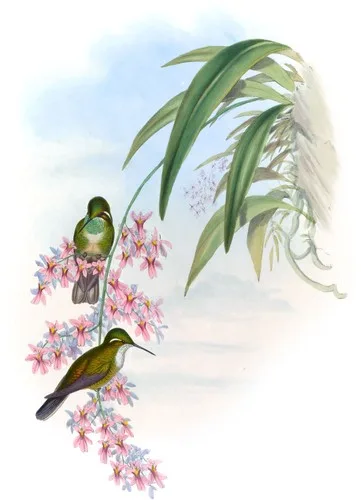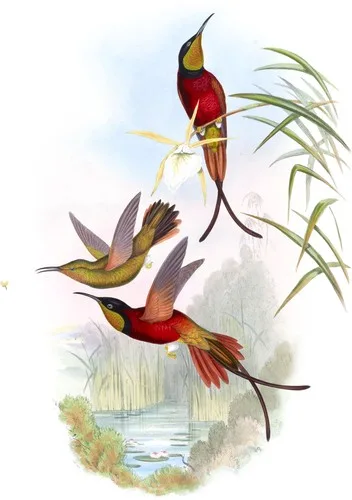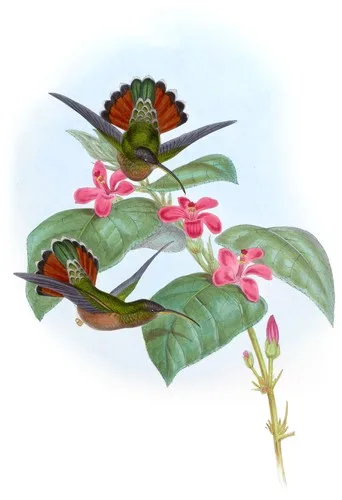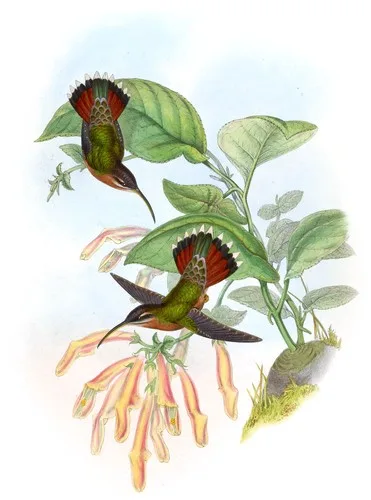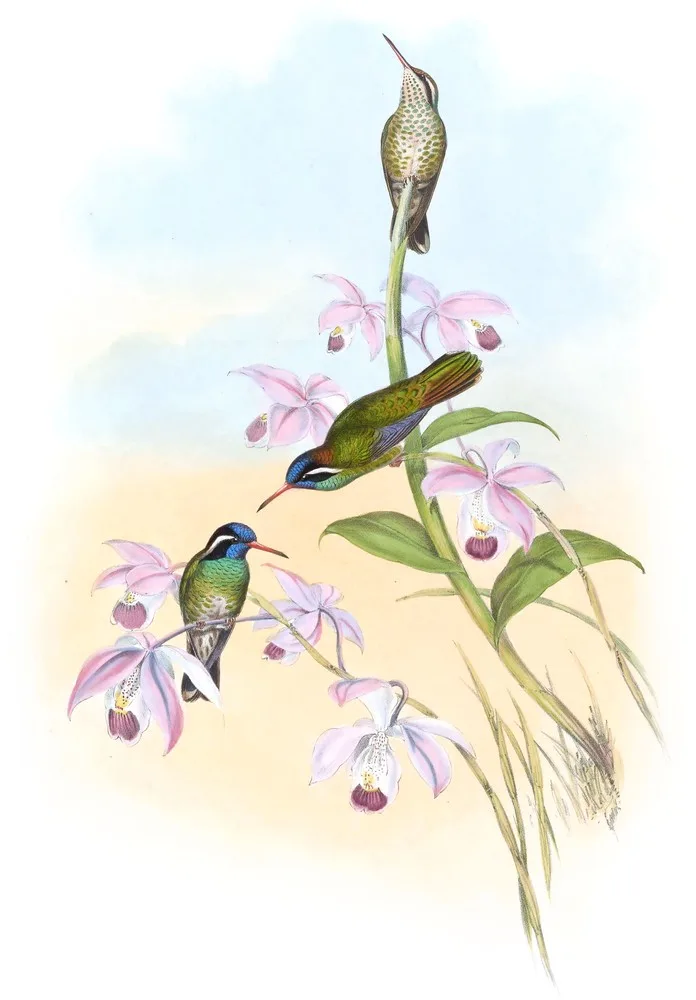
Heliopædica melanotis
Heliopædica melanotis
Black-eared Humming-bird
Ten ways of seeing
- upright 1.44 : 1
First Look
夫象物必在于形似,形似须全其骨气。
—— 唐·张彦远《历代名画记》
Likeness is the threshold; bone-and-breath is the point.
The sheet is vertical: the eye climbs and settles on the bird. Take the posture before the plumage. Then step in close: watch where colour meets line, and whether the line ever breaks. Third, find the darkest small patch: the whole tonal order is measured from there.
Name and Thing
No reliable binomial survives, so the printed title must serve. Neither name nor binomial survives: the printed title must do.
Form and Colour
The smallest of birds: a needle-fine bill, a forked tubular tongue, wings beating so fast the bird hovers and even flies backwards. Its colour is not pigment but structure — light bent by feather barbules, changing with the angle.No colour group is recorded. Read the outline, then the colour layers, then the brush.
Composition
Tall and narrow, the bird perched mid-branch with generous margins above and below. No details are appended: a plate for looking, not for keying out. Old plates set the plant slightly off centre, with unequal margins — that small imbalance is what keeps it alive.
Line and Colour
In the later nineteenth century chromolithography took over: colour printed rather than painted, line demoted. Decide first whether it was printed or painted; only then discuss whether it is beautiful. If you mean to copy it: block in the broad shapes and colours first, detail last; lithographic softness comes from thin washes — two or three pale layers will get you close.
Poetic Resonance
穿花蛱蝶深深见,点水蜻蜓款款飞。
—— 唐·杜甫《曲江二首》
Butterflies thread the flowers, seen deep within; dragonflies touch the water and fly on, slow and deliberate.
The poem gives the mood first and the picture supplies the form; set the line beside the plate and the bird itself becomes its resting point.
Symbolism
For the Aztecs the hummingbird was warrior and sun; for Victorian Europe it was the ultimate ornament, millions killed for breast jewellery. China has no tradition here — and that blank is itself a history of exchange. In a flora it is a species first and a symbol second; the order is worth keeping.
Season and Place
temperate hummingbirds follow the bloom north and back, thousands of kilometres a year. Americas only, from southern Alaska to Tierra del Fuego, richest in the Andes. China has no hummingbirds and no classical record of them. The year 1850 on the plate is that of publication, not of flowering — the gathering came a year or two earlier. Read the locality and the flowering season both with a discount: one is hearsay, the other a ten-day peak.
The Book and the Hand
“Gould's Hummingbirds” carries only John Gould's name. A plate is collective work: drawer, engraver and colourist were different hands, and the unnamed ones decided how good it looks.
What to Take Away
Next time you watch a bird: posture first, then where the plumage is deepest, and only then the field guide. The flower of that year is dust, yet its image on paper has outlived every living cousin.
About this plate
Guatemala and Mexico
Although Prince Charles Bonaparte and all recent writers consider the present bird and the Trochilus leucotis to be identical, and have made the two names synonymous, I have very great doubt as to the accuracy of this opinion, as Vieillot makes no mention of the splendid blue colouring of the crown, and moreover states that his bird is from Brazil, while the native countries of the one here figured are Guatemala and Mexico.
It is doubtless the Ornismya Arsennii of Lesson, as the figures given by him accord with the two sexes; but his name must give place to the prior one of melanotis assigned to it by Swainson. Lesson evidently had no knowledge of its native country, as, in his description of the male, he states it is from Brazil, and in his endeavour to correct this error, mentions in his account of the female that it is not from Brazil, but from Paraguay, while it is not found in either country. It is one of the prettiest and most highly coloured of the Trochilide, and moreover differs so much in form, and particularly in its markings, from all others that I have proposed for it a new generic title.
I observe that specimens from Mexico are a trifle larger in all their admeasurements than those sent from Guatemala; their colouring, however, is precisely the same.
The sexes differ considerably, the female having none of the brilliant blue on the face or the glittering green of the chest, which are so conspicuous in the opposite sex.
The following is Swainson’s short but expressive description of this bird:—
Golden green; front and chin sapphire-blue; throat emerald-green; ears black, margined above with white; bill red; tail even. Table-land of Mexico, Temiscaltipec, Real del Monte.
To this I may add that the wings are purplish brown; the two centre tail-feathers bronzy green; the lateral feathers in some instances black tipped with bronze, in others their outer webs are bronzy and the inner black; abdomen grey; flanks greenish.
The female has the crown brownish grey; upper surface, wing-coverts, flanks and two centre tail-feathers bronzy green; lateral tail-feathers deep bluish black, washed with bronze at the base and tipped with grey, particularly the outer feather; ear-coverts black, above which is a mark of white; under surface buffy white, spangled here and there with green.
The figures are of the natural size. The plant is the Barkeria elegans.
References
- Trochilus melanotus, Swains. Phil. Mag. 1827, p. 441.
- Trochilus leucotis, Vieill. 2nde Edit. du Nouv. Dict. d’Hist. Nat., tom. xxii. p. 428.—Ib. Ency. Méth. Orn., part 11. p. 559?
- Ornismya Arsennii, Less. Hist. Nat. des Ois.-Mou., pp. xxvij, 60. pl. 9.—Ib. Supp., p. 152. pl. 27.—Ib. Ind. Gen. et Syn. des Ois. du Gen. Trochilus, p. xxxix.—Ib. Traité dOrn., p. 279.—Jard. Nat. Lib. Humming-birds, vol. i. p. 137. pl. 20.
- Thaumatias leucotis, Bonap. Consp. Gen. Av. p. 78, Thaumatias, sp. 8?
- Basilinna leucotis, Reichenb. Aufz. der Colibris, p. 13?