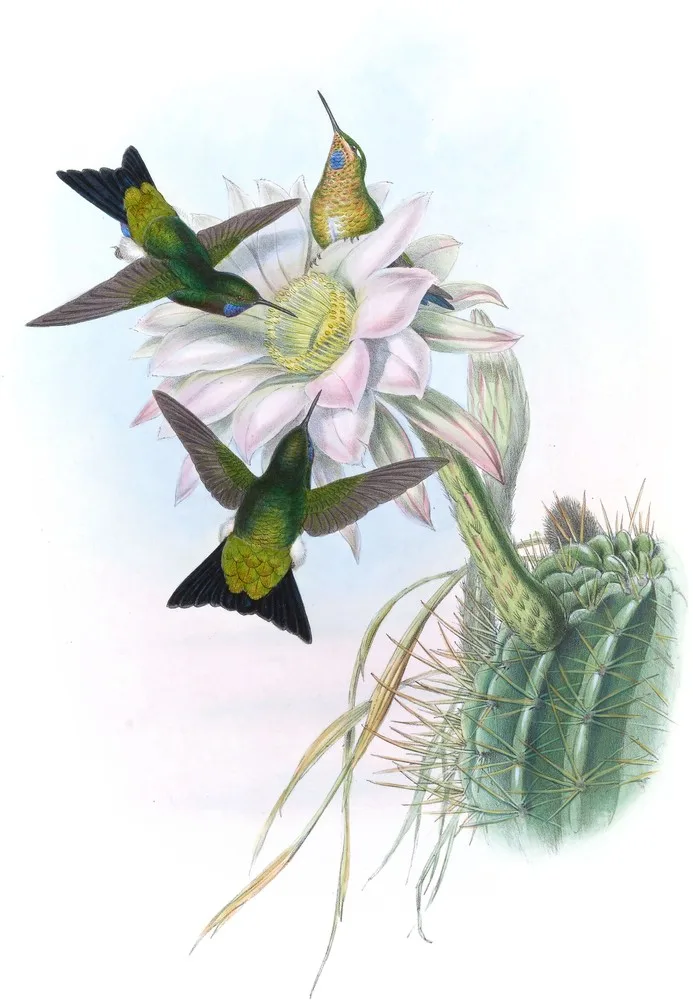
Eriocnemis vestita
紫颏毛腿蜂鸟
Eriocnemis vestita
Glowing Puff-leg
About this plate
The Andes of New Granada. Commonly sent from Bogota.
It is to be regretted that some more appropriate term than ves¢itus had not been selected as the specific designation of this wonderful little bird—I say wonderful advisedly; for every one who, for the first time, finds himself in front of the compartment in my collection in which this species is placed, gives utterance to some exclamation expressive of the admiration excited by its striking beauty and the glow-worm like splendour of its upper tail-coverts.
This brilliancy is more apparent at certain hours of the day; for instance, it is more beautiful in the evening after sunset than at mid-day, the brilliancy being then more strikingly contrasted and relieved by the dark hue of the tail-feathers. It is unquestionably one of the finest species of its genus, and one of the most resplendent of the Trochidæ: would that it were possible for me even faintly to depict it! but no, the most finished drawing can be but a phantom of the original, and it is only by an examination of specimens that my readers can form any adequate idea of the splendour and beauty of this gem; and how much more gorgeous must the bird appear in its native wilds! But a short period has elapsed since we first became aware of the existence of this lovely bird; twenty-five years ago it was totally unknown; during the quarter of a century ending with 1859 it has, however, become extremely common, so much so, indeed, that no collection need be without the richest examples: its market value is very small, and thousands upon thousands have already found their way to Europe. Its native country is Columbia, and it is nowhere more abundant than in the neighbourhood of Santa Fé de Bogota: it is within an area of 100 miles from this place that not only this, but’a host of other species of Humming-birds have been procured. Its large snow-white boots must render the bird a very conspicuous object both when flying and when at rest, for it surely cannot conceal these lengthened tufts of feathers even if so disposed. The female is not so gorgeously attired as the male, neither are her leg-tufts so conspicuous; still she is far from being destitute of beauty.
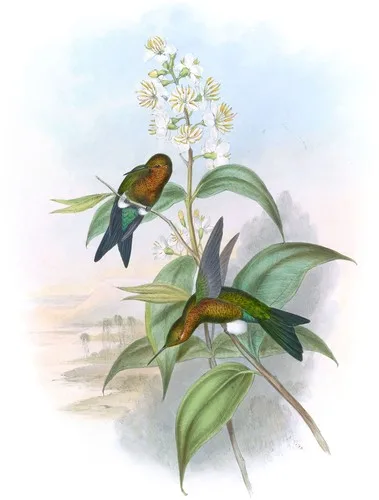
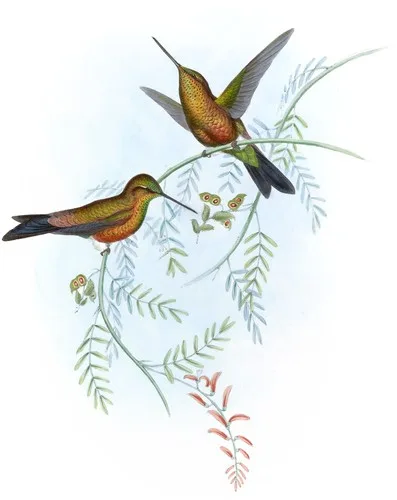
The male has the head, throat, neck, upper part of the back, and wing-coverts deep bronzy green; centre of the back purer green; lower part of the back and upper tail-coverts yellowish green, of the most intense metallic brilliancy; wings purplish brown; tail bluish black; a circular spot on the chin and under tail-coverts deep rich metallic blue; abdomen and flanks glittering golden green; thighs thickly clothed with white downy feathers; bill black; feet brown.
On looking at the bird in front, the head and neck appear to be of a deep black; but on changing the position, those parts are found to be of the colour described.
The female has a similar distribution of colour, but the hues are altogether less brilliant; the central tail-feathers are green instead of bluish black; the upper tail-coverts are not so much developed; there is only an indication of the blue spot on the throat; the under surface assumes a rusty tint, and the feathers are merely tipped, or spangled with the brilliant hue so conspicuous in the male; and the blue under tail-feathers are less developed.
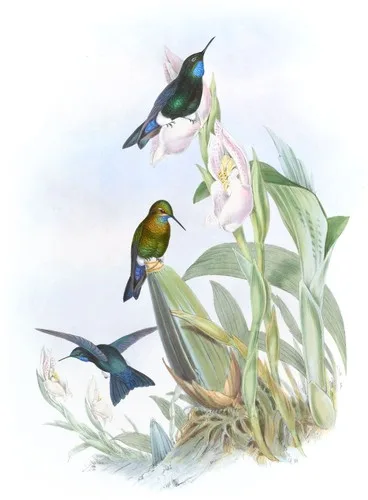
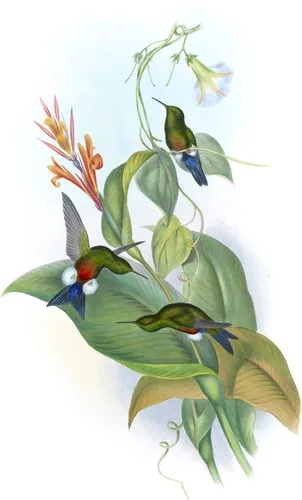
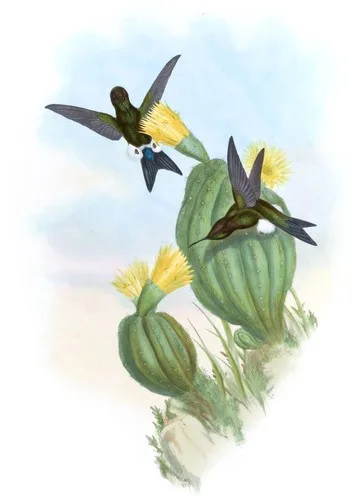
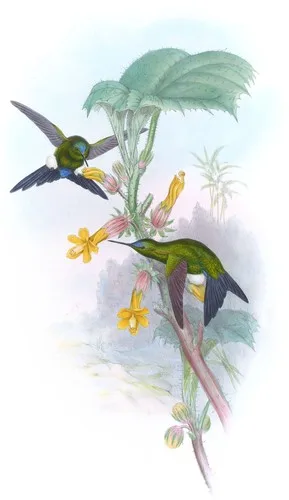
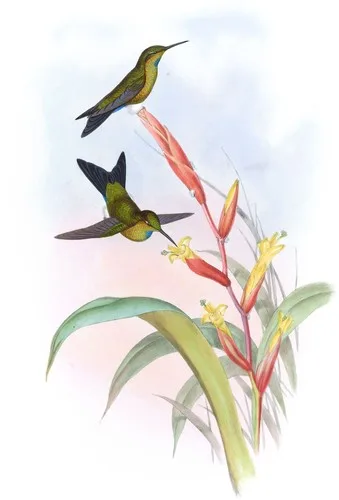
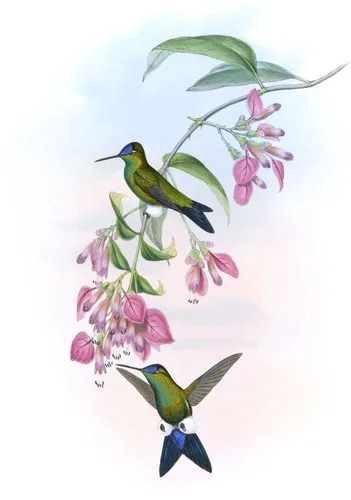
The Plate represents two males and a female of the natural size. The plant is the Echenopsis cristata.
References
- Ormsmya vestita, Longuem. Rey. Zool. 1838, p. 314.—De Latt. et Boure. Rev. Zool. 1839, p. 18, and 1840, p. 8.
- Trochilus uropygials, Fras. in Proc. of Zool. Soc., part viii. p. 15.
- Ornismya glomata, Less. Echo du Monde Savant.
- Hylocharis vestita, Gray and Mitch. Gen. of Birds, vol. 1. p. 114, Hylocharis, sp. 2.
- Eriopus vestita, Bonap. Consp. Gen. Av., p. 80, Eriopus, sp. 1.
- Eriocnemis vestita, Reich. Auf. der Col., p. 9.
- Eriocnemys vestitus, Bonap. Rey. Zool. 1854, p. 252.
Ten ways of seeing
- upright 1.44 : 1
- published 1854
- Pl. 275, Vol. IV
Not a catalogue entry but a way of looking: how to stand, what to notice, how the line was cut — then, halfway, a line of Chinese poetry: how the ancients saw this same flower. After it, the flower's language, its season and homeland, its book; and at the end one line of classical prose — and a pair of eyes to take away.
-
First Look
竖划三寸,当千仞之高;横墨数尺,体百里之迥。
—— 南朝宋·宗炳《画山水序》
A vertical stroke of three inches stands for a cliff of a thousand fathoms; a few feet of ink holds a hundred li.
The sheet is vertical: the eye climbs and settles on the bird. Take the posture before the plumage. Then step in close: watch where colour meets line, and whether the line ever breaks. Third, find the darkest small patch: the whole tonal order is measured from there.
-
Name and Thing
The binomial is Eriocnemis vestita: the first word is the genus it belongs among, the second the epithet that sets it apart. Two words carry a whole provenance. The Chinese name 紫颏毛腿蜂鸟 is a modern rendering of the Latin, not an old garden name.
-
Form and Colour
The smallest of birds: a needle-fine bill, a forked tubular tongue, wings beating so fast the bird hovers and even flies backwards. Its colour is not pigment but structure — light bent by feather barbules, changing with the angle.No colour group is recorded. Three things fix the habit: leaf arrangement, tepal count, and how the flower is borne.
-
Composition
Tall and narrow, the bird perched mid-branch with generous margins above and below. (about 1.44 : 1) No details are appended: a plate for looking, not for keying out. Cover the margins with your thumb and the plate suffocates; uncover them and the flower breathes again.
-
Line and Colour
In the later nineteenth century chromolithography took over: colour printed rather than painted, line demoted. Take a loupe to three places: petal edge, leaf vein, caption. An unbroken line means engraving; colour crossing the outline means a hand. If you mean to copy it: block in the broad shapes and colours first, detail last; lithographic softness comes from thin washes — two or three pale layers will get you close.
-
Poetic Resonance
穿花蛱蝶深深见,点水蜻蜓款款飞。
—— 唐·杜甫《曲江二首》
Butterflies thread the flowers, seen deep within; dragonflies touch the water and fly on, slow and deliberate.
The poem gives the mood first and the picture supplies the form; set the line beside the plate and the bird itself becomes its resting point.
-
Symbolism
For the Aztecs the hummingbird was warrior and sun; for Victorian Europe it was the ultimate ornament, millions killed for breast jewellery. China has no tradition here — and that blank is itself a history of exchange. In a flora it is a species first and a symbol second; the order is worth keeping.
-
Season and Place
In tropical America they are present all year, their season set by flowers. Americas only, from southern Alaska to Tierra del Fuego, richest in the Andes. China has no hummingbirds and no classical record of them. The year 1854 on the plate is that of publication, not of flowering — the gathering came a year or two earlier. The volume was made in 1849-1887, when most of this knowledge came from living plants under glass.
-
The Book and the Hand
“Gould's Hummingbirds” was drawn by John Gould and published 1849-1887. This plate is Pl. 275, Vol. IV, book page 275. The image is public domain; the hand-colouring is still one person's hand.
-
The Written Tradition
竖划三寸,当千仞之高;横墨数尺,体百里之迥。
—— 南朝宋·宗炳《画山水序》
A vertical stroke of three inches stands for a cliff of a thousand fathoms; a few feet of ink holds a hundred li. Smallness of scale was never the obstacle.
Gould's Hummingbirds (1849–1887) used hand-coloured lithography over gold leaf so the iridescence survived on paper — a monument to Victorian printing and collecting alike. Keep the line; it will surface the next time you meet the same plant.
What to Take Away
If you keep one line, keep Guo Xi's: from afar its momentum, up close its texture. Two centuries on, the plant may still flower in some garden; the one on this sheet stopped in the season of 1854.