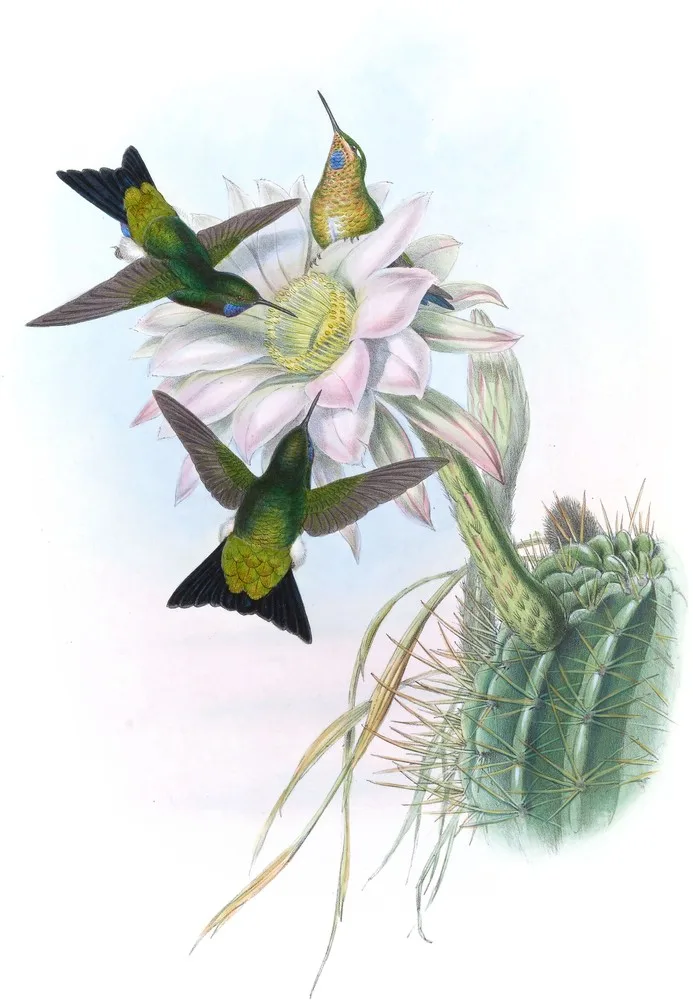
紫颏毛腿蜂鸟
Eriocnemis vestita
Eriocnemis vestita
Glowing Puff-leg
- 中文名
- 紫颏毛腿蜂鸟
- 学名
- Eriocnemis vestita
- 合集
- 古尔德蜂鸟图谱
- 绘者
- John Gould(约翰·古尔德)
- 年代
- 1854
- 图版号
- Pl. 275, Vol. IV
- 原书页码
- p.275
- 授权
- CC0 1.0 Universal (Public domain)
十观
- 纵幅 1.44∶1
第一眼
竖划三寸,当千仞之高;横墨数尺,体百里之迥。
—— 南朝宋·宗炳《画山水序》
三寸的竖线可当千仞高山,几尺横墨能容百里之远。尺幅从来不是障碍,取舍才是本事。这一幅是竖的:眼睛从下往上走,落点在中段那只鸟身上。先别急着看羽毛,让姿态先立起来。第二步凑近一寸:看线与色的交界,色有没有压住线,线有没有断。第三步,把视线放到最深的那一小块:整幅的用色秩序,都是从那里排开的。
名与实
学名 Eriocnemis vestita:前一词是属,管它归在哪一类;后一词是种加词,管它在这一类里凭什么与众不同。名字是通行证,也是懒办法——记住两个词,就抓住了一整个物种。中文名“紫颏毛腿蜂鸟”是后人据学名回译的通行叫法,与古书里的旧名未必对得上——名与物之间,总隔着一层翻译。
形与色
蜂鸟为美洲最小之鸟,喙细长如针,舌分叉成管,可伸入花心吸蜜;翼小而振频极高,能悬停、能倒飞。此幅未作色相归档,只能就形制论。没有解剖图,就靠主株一处一处看过去:叶怎么排,花怎么着生,果在哪里。
构图与呼吸
画幅高而窄,鸟栖在枝的中段,上下留白多——十九世纪鸟谱的标准版式,留给它飞走的余地。全幅只画一只,不作解剖附图——这类图更近于“观赏”,而非“鉴定”。老图谱爱把主株摆在偏中线的位置,左右留得不一样多:这一点偏心,正是画面活起来的原因。
一刀一色
十九世纪后半叶,石版与彩色石印渐成主流:颜色可以直接印出,不再依赖手工,线条反倒退居其次。图像的“准确”提高了,手性却淡了。还有一种证据在纸背:铜版压进纸里的那道痕、上色处微微凸起的颜料、再版时磨浅的线。扫描件里也能看出七分。想动笔临它的人记住一句:先铺大块的形与色,干后再收细部;石印的柔和层次来自薄涂与网点,水彩分两三遍淡铺即可逼近。
诗境
穿花蛱蝶深深见,点水蜻蜓款款飞。
—— 唐·杜甫《曲江二首》
中土无蜂鸟,然“穿花”之态,杜甫早已写过:贴着花心走,是采蜜者的共同姿态。诗以气行,画以形立;两种“看”叠在一起,才是看画的意思。
花语
阿兹特克以蜂鸟为战神与太阳的化身;欧洲维多利亚时代则以蜂鸟为收藏与装饰的极致,百万只羽毛被做成胸饰。中国旧籍无此鸟,故无象征——这空白本身,就是一部博物学交流史。在图谱里,它首先是一个物种,其次才是一种象征——这个次序值得记住。
时与地
热带美洲几乎全年可见,花期即其季节。仅产美洲,自阿拉斯加南部至火地岛,以安第斯山最为繁盛。中土无蜂鸟,汉籍不载,晚清海外游记始见其名。图上所记的 1854 年是刊行之年,不是采到那只鸟的年份;真正的观察记录通常比出版早一两年。图上的产地常是“据说来自”,图上的花期常是“盛开那十日”——两处都要打个折扣读。
书与人
《古尔德蜂鸟图谱》只署了约翰·古尔德一个人的名字。版画是集体工程:绘图、刻版、上色各有其人,真正决定这幅图好不好看的,常是没留下名字的刻工与上色师。
带走一双眼睛
如果只能记一句,就记郭熙那八个字:远望取其势,近看取其质。看图、看花、看人,都一样。图谱的用意是“以备查考”,看久了却会忘记查考:1854 年的一个人,为一只鸟花了整整一天。
关于本图版
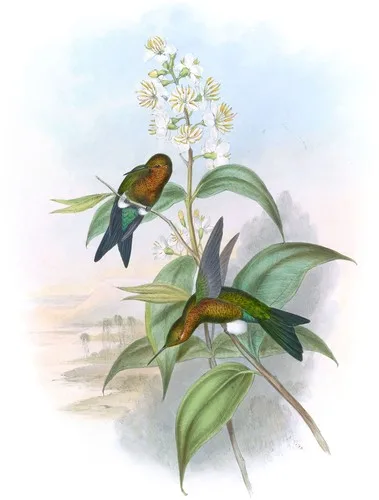
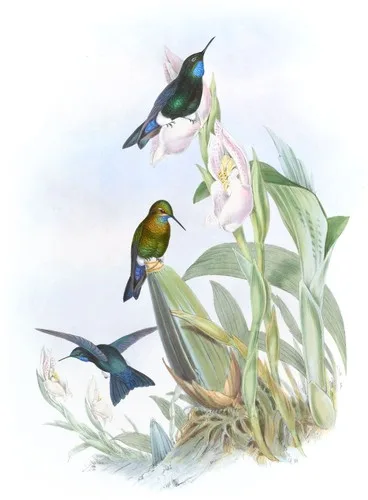
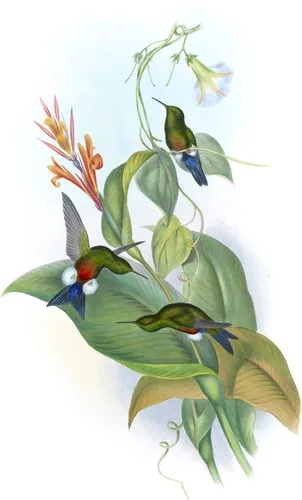
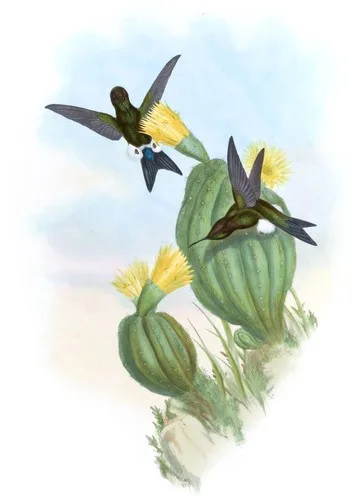
《古尔德蜂鸟图谱》(Gould's Hummingbirds)由约翰·古尔德绘制,1849—1887 年间印行,本图即其中一幅。图中描绘的是紫颏毛腿蜂鸟,学名 Eriocnemis vestita,在分类体系中列于蜂鸟科(Trochilidae)。
该合集全编共 421 幅图版,此图为其中之一,图版编号 Pl. 275, Vol. IV,对应原书第 275 页,版式为纵幅。图像由公有领域原件扫描修复而来,细节在放大视图中仍清晰可辨。
原书文字(英文 / 法文)
The Andes of New Granada. Commonly sent from Bogota.
It is to be regretted that some more appropriate term than ves¢itus had not been selected as the specific designation of this wonderful little bird—I say wonderful advisedly; for every one who, for the first time, finds himself in front of the compartment in my collection in which this species is placed, gives utterance to some exclamation expressive of the admiration excited by its striking beauty and the glow-worm like splendour of its upper tail-coverts.
This brilliancy is more apparent at certain hours of the day; for instance, it is more beautiful in the evening after sunset than at mid-day, the brilliancy being then more strikingly contrasted and relieved by the dark hue of the tail-feathers. It is unquestionably one of the finest species of its genus, and one of the most resplendent of the Trochidæ: would that it were possible for me even faintly to depict it! but no, the most finished drawing can be but a phantom of the original, and it is only by an examination of specimens that my readers can form any adequate idea of the splendour and beauty of this gem; and how much more gorgeous must the bird appear in its native wilds! But a short period has elapsed since we first became aware of the existence of this lovely bird; twenty-five years ago it was totally unknown; during the quarter of a century ending with 1859 it has, however, become extremely common, so much so, indeed, that no collection need be without the richest examples: its market value is very small, and thousands upon thousands have already found their way to Europe. Its native country is Columbia, and it is nowhere more abundant than in the neighbourhood of Santa Fé de Bogota: it is within an area of 100 miles from this place that not only this, but’a host of other species of Humming-birds have been procured. Its large snow-white boots must render the bird a very conspicuous object both when flying and when at rest, for it surely cannot conceal these lengthened tufts of feathers even if so disposed. The female is not so gorgeously attired as the male, neither are her leg-tufts so conspicuous; still she is far from being destitute of beauty.
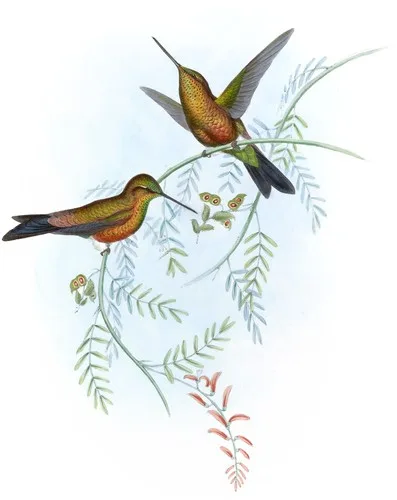
The male has the head, throat, neck, upper part of the back, and wing-coverts deep bronzy green; centre of the back purer green; lower part of the back and upper tail-coverts yellowish green, of the most intense metallic brilliancy; wings purplish brown; tail bluish black; a circular spot on the chin and under tail-coverts deep rich metallic blue; abdomen and flanks glittering golden green; thighs thickly clothed with white downy feathers; bill black; feet brown.
On looking at the bird in front, the head and neck appear to be of a deep black; but on changing the position, those parts are found to be of the colour described.
The female has a similar distribution of colour, but the hues are altogether less brilliant; the central tail-feathers are green instead of bluish black; the upper tail-coverts are not so much developed; there is only an indication of the blue spot on the throat; the under surface assumes a rusty tint, and the feathers are merely tipped, or spangled with the brilliant hue so conspicuous in the male; and the blue under tail-feathers are less developed.
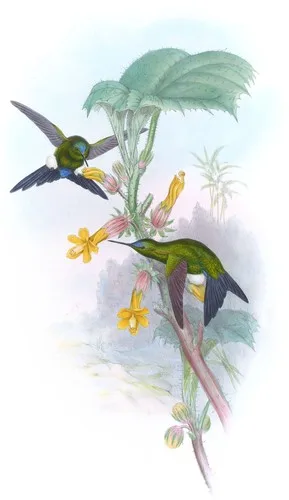
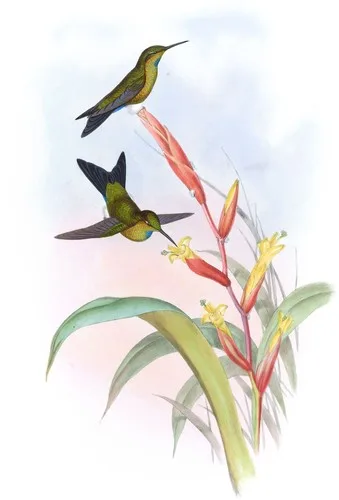
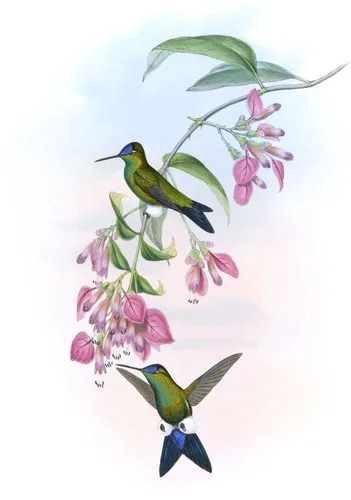
The Plate represents two males and a female of the natural size. The plant is the Echenopsis cristata.
References
- Ormsmya vestita, Longuem. Rey. Zool. 1838, p. 314.—De Latt. et Boure. Rev. Zool. 1839, p. 18, and 1840, p. 8.
- Trochilus uropygials, Fras. in Proc. of Zool. Soc., part viii. p. 15.
- Ornismya glomata, Less. Echo du Monde Savant.
- Hylocharis vestita, Gray and Mitch. Gen. of Birds, vol. 1. p. 114, Hylocharis, sp. 2.
- Eriopus vestita, Bonap. Consp. Gen. Av., p. 80, Eriopus, sp. 1.
- Eriocnemis vestita, Reich. Auf. der Col., p. 9.
- Eriocnemys vestitus, Bonap. Rey. Zool. 1854, p. 252.