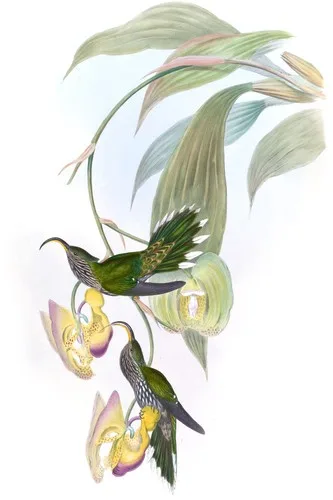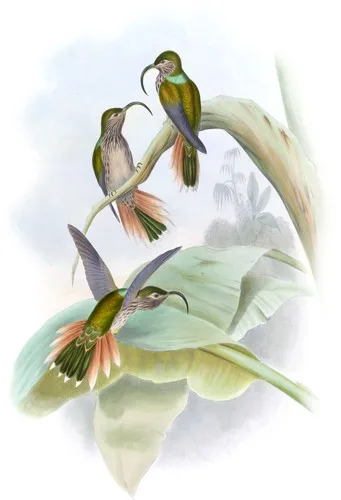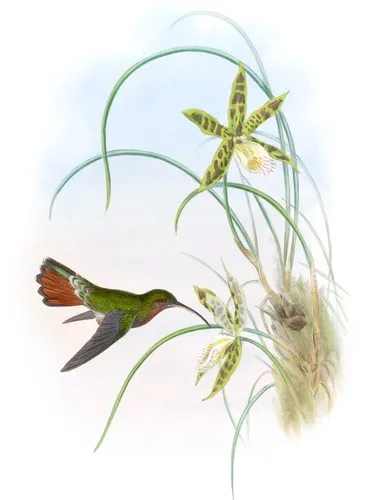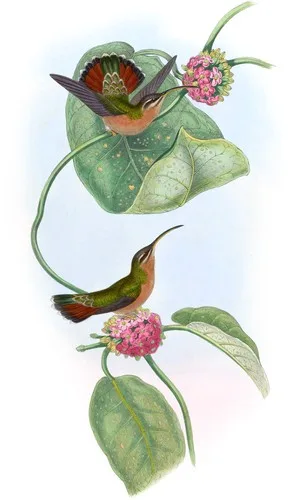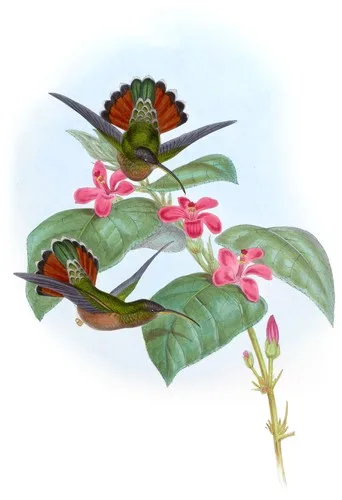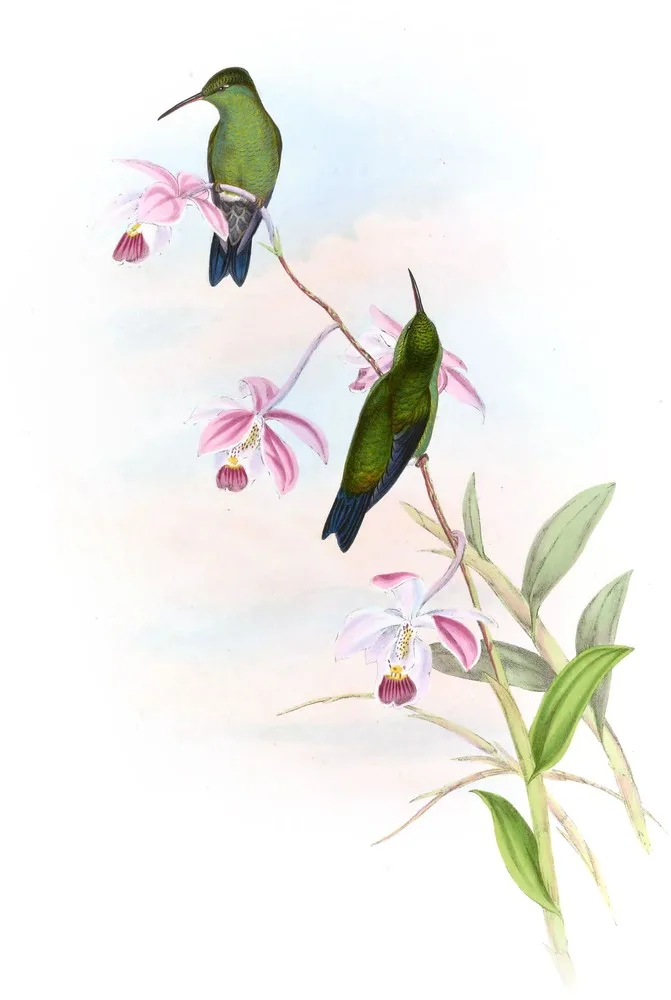
Erythronota Saucerottei
红背红尾鸲·Erythronota Saucerottei
Erythronota Saucerottei
Saucerotte’s Erythonote
Ten ways of seeing
- upright 1.49 : 1
First Look
真山水之川谷,远望之以取其势,近看之以取其质。
—— 宋·郭熙《林泉高致·山水训》
Mountains and valleys: from afar take their momentum, up close take their texture — the two distances from which any picture is read.
The sheet is vertical: the eye climbs and settles on the bird. Take the posture before the plumage. Then step in close: watch where colour meets line, and whether the line ever breaks. Third, find the darkest small patch: the whole tonal order is measured from there.
Name and Thing
The binomial is Erythronota saucerottei: the first word is the genus it belongs among, the second the epithet that sets it apart. Two words carry a whole provenance. No established Chinese name exists, so it is cited by its binomial alone.
Form and Colour
The smallest of birds: a needle-fine bill, a forked tubular tongue, wings beating so fast the bird hovers and even flies backwards. Its colour is not pigment but structure — light bent by feather barbules, changing with the angle.No colour group is recorded. A single plant, laid out with nothing hidden.
Composition
Tall and narrow, the bird perched mid-branch with generous margins above and below. No details are appended: a plate for looking, not for keying out. Blank paper is not unfinished work: it is where the eye rests.
Line and Colour
In the later nineteenth century chromolithography took over: colour printed rather than painted, line demoted. Decide first whether it was printed or painted; only then discuss whether it is beautiful. If you mean to copy it: block in the broad shapes and colours first, detail last; lithographic softness comes from thin washes — two or three pale layers will get you close.
Poetic Resonance
夫列子御风而行,泠然善也,旬有五日而后反。
—— 《庄子·逍遥游》
Liezi rode the wind and came back after fifteen days, so light was his going.
The poem gives the mood first and the picture supplies the form; set the line beside the plate and the bird itself becomes its resting point.
Symbolism
For the Aztecs the hummingbird was warrior and sun; for Victorian Europe it was the ultimate ornament, millions killed for breast jewellery. China has no tradition here — and that blank is itself a history of exchange. In a flora it is a species first and a symbol second; the order is worth keeping.
Season and Place
In tropical America they are present all year, their season set by flowers. Americas only, from southern Alaska to Tierra del Fuego, richest in the Andes. China has no hummingbirds and no classical record of them. The year 1861 on the plate is that of publication, not of flowering — the gathering came a year or two earlier. The bud and the ripe fruit on one branch tell the season; the name in the title often tells the journey.
The Book and the Hand
“Gould's Hummingbirds” carries only John Gould's name. The image is public domain; the hand-colouring is still one person's hand.
What to Take Away
Next time you watch a bird: posture first, then where the plumage is deepest, and only then the field guide. A flora exists to be consulted; look long enough and you forget to consult — someone in 1861 gave a whole day to a single flower.
About this plate
New Granada
The native country of the Erythronota Saucerottei is New Grenada, whence it was brought by Delattre.
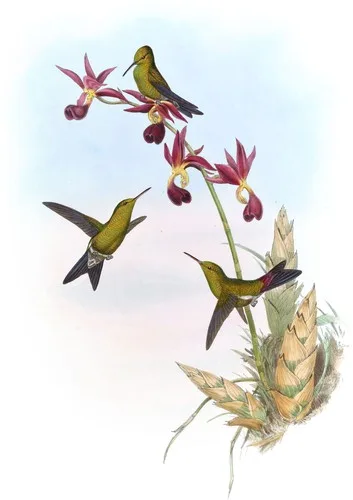
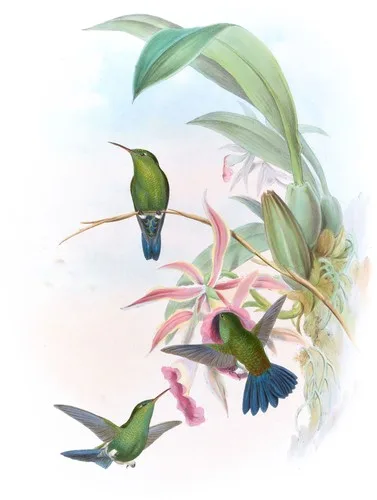
In point of affinity, this bird is nearly allied to E. Sophiæ; but it may always be distinguished by its rather larger size, and by the duller colouring of its breast and under surface, and especially by the dull olive-green hue of the centres of the under tail-coverts, which in E. Sophiæ are blue. As is the case with the Erythronote, no perceptible difference is observable in the sexes, either in size or colour.
Crown of the head and upper surface deep grass-green, becoming of a brown hue towards the lower part of the back; upper tail-coverts and tail steely black; all the under surface dull green, of a paler hue than that of the upper surface, and very slightly luminous; under tail-coverts steely brown edged with greyish white; wings steely black like the tail; upper mandible black; under mandible fleshy at the base, black at the tip.
The figures are of the natural size. The plant is the Barkeria elegans.
References
- Trochilus Saucerottei, Bourc. et Delatt. Rev. Zool., 1846, p. 311.
- Polytmus Saucerotti, Gray and Mitch. Gen. of Birds, vol. i. p. 108, Polytmus, sp. 67.
- Saucerottia typica, Bonap. Consp. Gen. Av., tom. i. p. 77; Id. Rev. et Mag. de Zool., 1854, p. 255; Saucerottia, sp. 1., Reichenb. Aufz. der Col., p. 7.
- Chlorestes typicus, Reichenb. Troch. Enum., p. 4, pl. 701. figs. 4569–70.
- Hemithylaca Saucerottei, Cab. et Hein. Mus. Hein., Theil iii. p. 38, note.