Gouldia Popelairi
Gouldia Popelairi
Popelaire’s Thorn-tail
Ten ways of seeing
- upright 1.43 : 1
First Look
江馆清秋,晨起看竹,烟光日影露气,皆浮动于疏枝密叶之间。
—— 清·郑板桥《题画竹》
On an autumn morning at the river lodge I looked at the bamboo: mist, sunlight, dew, all drifting among the sparse and dense leaves.
The sheet is vertical: the eye climbs and settles on the bird. Take the posture before the plumage. Then step in close: watch where colour meets line, and whether the line ever breaks. Third, find the darkest small patch: the whole tonal order is measured from there.
Name and Thing
The binomial is Gouldia popelairi: the first word is the genus it belongs among, the second the epithet that sets it apart. Two words carry a whole provenance. No established Chinese name exists, so it is cited by its binomial alone.
Form and Colour
The smallest of birds: a needle-fine bill, a forked tubular tongue, wings beating so fast the bird hovers and even flies backwards. Its colour is not pigment but structure — light bent by feather barbules, changing with the angle.No colour group is recorded. Three things fix the habit: leaf arrangement, tepal count, and how the flower is borne.
Composition
Tall and narrow, the bird perched mid-branch with generous margins above and below. No details are appended: a plate for looking, not for keying out. Blank paper is not unfinished work: it is where the eye rests.
Line and Colour
In the later nineteenth century chromolithography took over: colour printed rather than painted, line demoted. Craft leaves franker evidence than inscriptions. If you mean to copy it: block in the broad shapes and colours first, detail last; lithographic softness comes from thin washes — two or three pale layers will get you close.
Poetic Resonance
夫列子御风而行,泠然善也,旬有五日而后反。
—— 《庄子·逍遥游》
Liezi rode the wind and came back after fifteen days, so light was his going.
The poem gives the mood first and the picture supplies the form; set the line beside the plate and the bird itself becomes its resting point.
Symbolism
For the Aztecs the hummingbird was warrior and sun; for Victorian Europe it was the ultimate ornament, millions killed for breast jewellery. China has no tradition here — and that blank is itself a history of exchange. Flower language was added later; the flower knows nothing of it, and that innocence is part of its power.
Season and Place
temperate hummingbirds follow the bloom north and back, thousands of kilometres a year. the name arrives with late-Qing travel writing. The year 1852 on the plate is that of publication, not of flowering — the gathering came a year or two earlier. The bud and the ripe fruit on one branch tell the season; the name in the title often tells the journey.
The Book and the Hand
“Gould's Hummingbirds” carries only John Gould's name. From drawing to plate the sheet passed through several hands — the engraver aimed at accuracy, the colourist at speed, and between them lies each plate's unevenness.
What to Take Away
Appreciation is not knowledge but habit — one more look each time. Two centuries on, the plant may still flower in some garden; the one on this sheet stopped in the season of 1852.
About this plate
New Granada
Were it possible to visit the planets, in search of the hidden secrets of nature, one could scarcely expect to find a greater number of remarkable novelties, in the way of birds, than have been revealed by the more recent explorations among the great Andean ranges, of which the present bird is certainly not one of the least interesting.
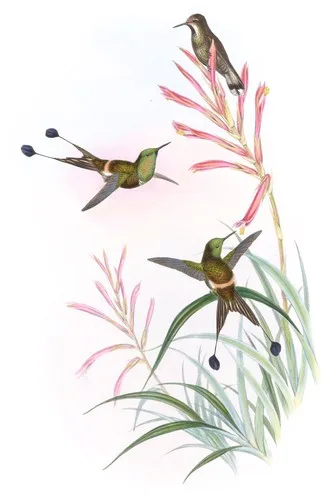
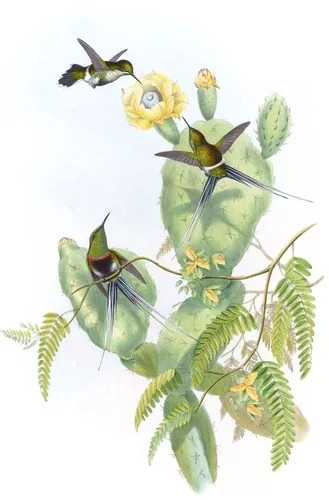
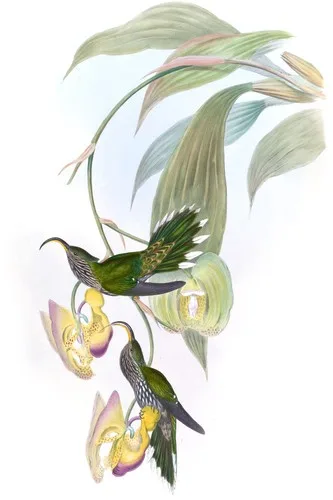
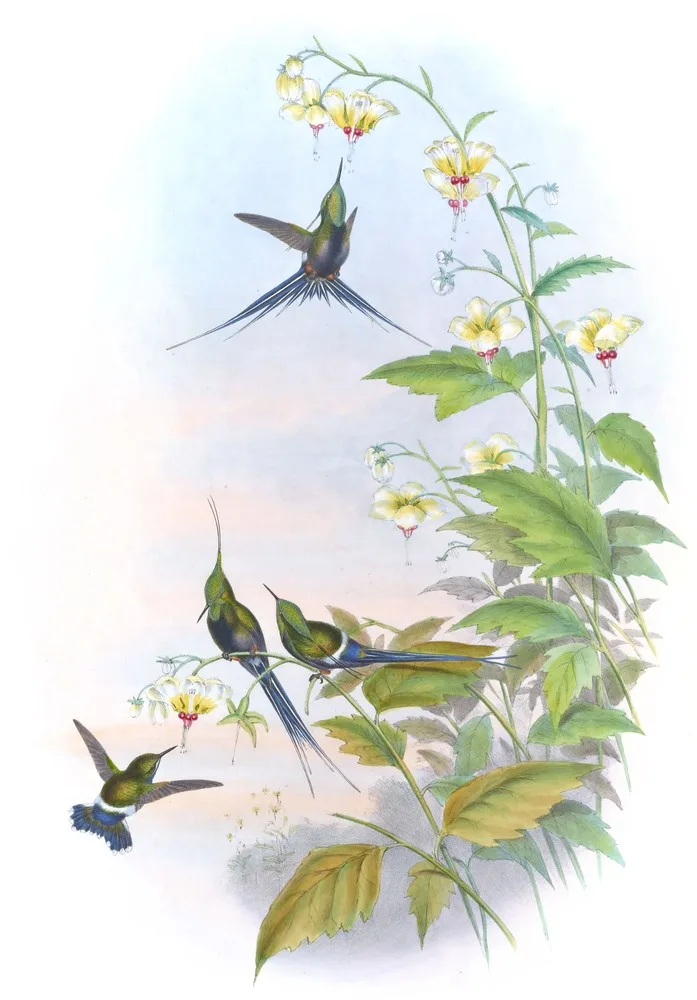
Like the other members of the genus, to which the name of Gouldia has been given by Prince Charles Lucien Bonaparte, it is distinguished by the elegance of its form and by the beauty of its markings, to which in this case is added a graceful attenuated crest formed of lengthened hair-like plumes, two of which, as will be seen on reference to the accompanying Plate, extend far beyond the rest. The honour of first recording the existence of this species, is due to the Vicomte Du Bus of Brussels, who, when describing and figuring it some few years since in his “Esquisses Ornithologiques” above referred to, named it Trochilus Popelairii, in honour of the Baron Popelaire de Terloo, who had discovered it in Peru and enriched the Museum at Brussels with this and many other interesting objects obtained during his explorations in South America. The specimen from which M. Du Bus took his description remained for some time unique, but I have since obtained specimens procured in Peru by M. Warszewicz, more recently examples have been sent me from the neighbourhood of Popayan, and I am indebted to Mr. Mark, Her Majesty’s Consul at Bogota, for a specimen collected in the vicinity of that city: it is clear then that the species enjoys a very wide range, extending over six or eight degrees of latitude in the elevated regions of Peru and Columbia. Mr. Mark tells me that the hot districts of Gramalote, an almost uninhabited part of the country to the eastward of Bogota, is one of the localities in which it is found; M. Warszewicz killed it at a considerable elevation among the Andes of Quindios; and M. Parzudaki, of Paris, informs me that it is met with in the Llanos de San Martins in New Grenada. This, I regret to say, is all the information I have been able to obtain respecting this little gem; we must therefore await the result of future explorations for an account of its habits, actions and economy. That it is a quick flier I am certain, from the conformation of its wings and its general structure.
The female offers the same difference in form from her mate that is found to exist in the sexes of Gouldia Langsdorffi; but the bright red hue of her legs and thighs at once indicates her specific relationship.
The male has the crown of the head, the shorter feathers of the crest, face and throat shining yellowish grass-green; lengthened filamentous feathers of the crest black; wings purplish brown; upper surface, wing- and upper tail-coverts golden green, across the rump a band of white expanding into a large patch on each flank, and overhanging the thighs, below this band the golden green deepens into blackish brown; centre of the abdomen black; flanks brown, with darker centres; under tail-coverts greyish white; upper surface of the tail steel-blue, passing into brown on the apical portion of the external feather; the shafts of the middle feathers white, those of the remainder white at the base and brown for the remainder of their length; on the under surface the tail-feathers are of a more lively steel-blue, and the shafts are white throughout their entire length; thighs and tarsi rust-red.
The female has the upper surface, wing-coverts, flanks and tail-coverts dark bronzy green, the bronzy hue predominating on the back; rump crossed by a band of white, below which the feathers are of a darker hue as in the male; chin and a stripe down each side of the neck from the angle of the mouth greyish white; centre of the throat and abdomen bluish black; tail-feathers deep steel-blue, grey at the base and tipped with white, the white increasing in extent as the feathers recede from the centre; thighs rust-red.
The figures represent the two sexes of the natural size. The pretty flower, Loasa picta, which, like the bird, is a native of the Andes, is copied with permission from the Botanical Magazine, a work of great merit and usefulness, whether we regard the scientific descriptions by Sir William J. Hooker and Mr. Smith, or the artistic figures by Mr. Fitch.
References
- Trochilus Popelairii, Du Bus, Esquisses Orn., pl. 6.
- Mellisuga Popelairii, Gray and Mitch. Gen. of Birds, vol. i. p. 113, Mellisuga, sp. 70.
- Gouldia popelairi, Bonap. Consp. Gen. Av., p. 86, Gouldia, sp. 2.—Ib. Consp. Troch. in Rey. et Mag. de Zool. 1854, p: 297.