Gouldia Popelairi
Gouldia Popelairi
Popelaire’s Thorn-tail
- 学名
- Gouldia Popelairi
- 合集
- 古尔德蜂鸟图谱
- 绘者
- John Gould(约翰·古尔德)
- 年代
- 1852
- 图版号
- Pl. 127, Vol. III
- 原书页码
- p.127
- 授权
- CC0 1.0 Universal (Public domain)
十观
- 纵幅 1.43∶1
第一眼
江馆清秋,晨起看竹,烟光日影露气,皆浮动于疏枝密叶之间。
—— 清·郑板桥《题画竹》
郑板桥说他画竹,是先看见“烟光日影露气”在枝叶间浮动,才动手。看画时找这一层空气,比记住花的名字更要紧。这一幅是竖的:眼睛从下往上走,落点在中段那只鸟身上。先别急着看羽毛,让姿态先立起来。第二步凑近一寸:看线与色的交界,色有没有压住线,线有没有断。第三步,把视线放到最深的那一小块:整幅的用色秩序,都是从那里排开的。
名与实
学名 Gouldia popelairi:前一词是属,管它归在哪一类;后一词是种加词,管它在这一类里凭什么与众不同。一百多年前的命名者,把一种植物的来历压进了两个词。此幅尚无通行中文名,姑以学名相称;在没有本地名字的地方,学名就是它唯一的身份证。
形与色
蜂鸟为美洲最小之鸟,喙细长如针,舌分叉成管,可伸入花心吸蜜;翼小而振频极高,能悬停、能倒飞。此幅未作色相归档,只能就形制论。看羽:先看覆羽的层次,再看飞羽的排列,最后才看颜色——颜色是最后才被注意到的部分。
构图与呼吸
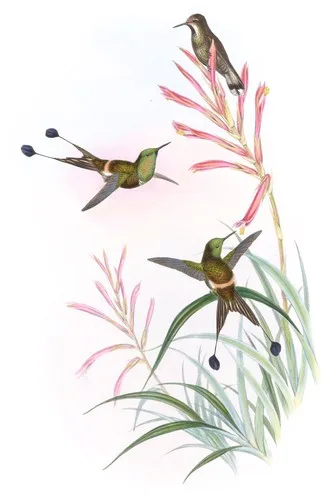
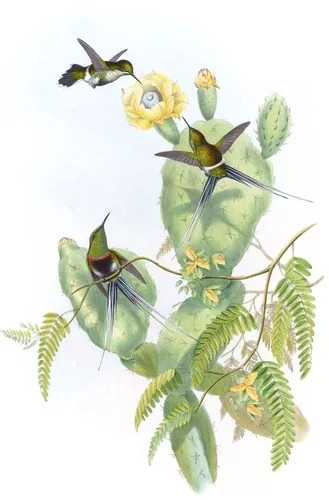
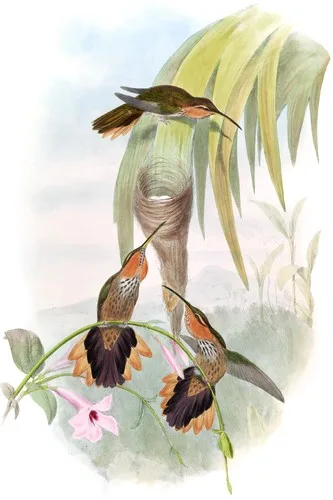
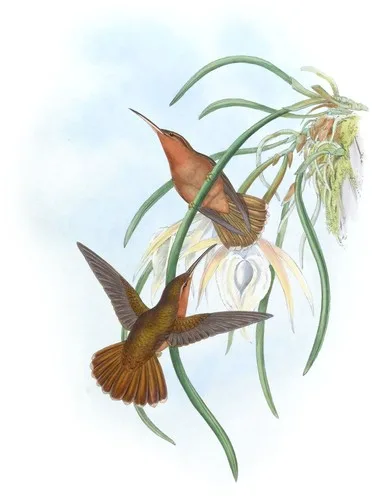
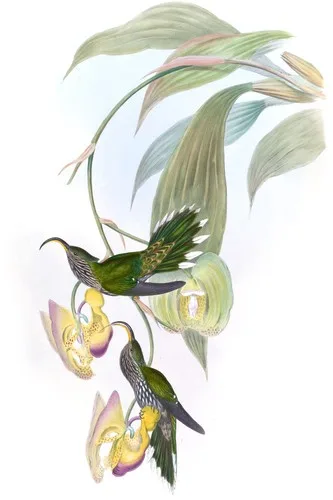
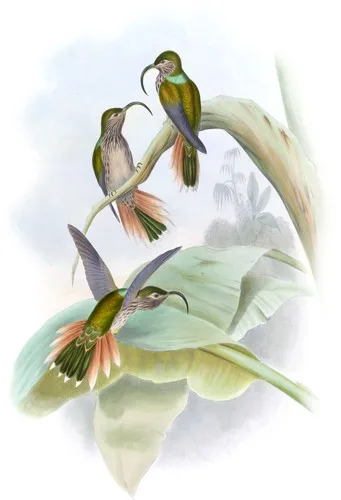
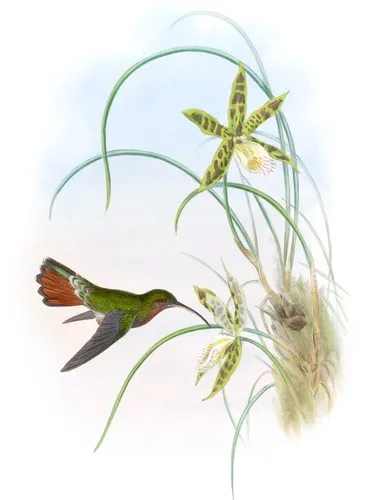
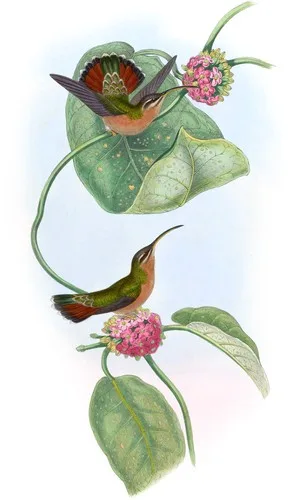
画幅高而窄,鸟栖在枝的中段,上下留白多——十九世纪鸟谱的标准版式,留给它飞走的余地。全幅只画一只,不作解剖附图——这类图更近于“观赏”,而非“鉴定”。空白不是没画完,是给眼睛留的落脚处:一张图若四边都塞满,花反而会闷。
一刀一色
十九世纪后半叶,石版与彩色石印渐成主流:颜色可以直接印出,不再依赖手工,线条反倒退居其次。图像的“准确”提高了,手性却淡了。工艺留下的破绽比题跋更诚实:刻工不会撒谎,上色的人赶时间的时候会。想动笔临它的人记住一句:先铺大块的形与色,干后再收细部;石印的柔和层次来自薄涂与网点,水彩分两三遍淡铺即可逼近。
诗境
夫列子御风而行,泠然善也,旬有五日而后反。
—— 《庄子·逍遥游》
蜂鸟悬停于空,不落不飞,最近于“御风”。庄子说的是一种自由的姿态,蜂鸟把它做成了生理事实。古人写到这一层,已不只是赏花,是借花说人;画面则只负责把那朵花留住。
花语
阿兹特克以蜂鸟为战神与太阳的化身;欧洲维多利亚时代则以蜂鸟为收藏与装饰的极致,百万只羽毛被做成胸饰。中国旧籍无此鸟,故无象征——这空白本身,就是一部博物学交流史。象征多半来自形状与气味:像杯的、像泪的、香的、臭的——先有形状,后有意义。
时与地
热带美洲几乎全年可见,花期即其季节。仅产美洲,自阿拉斯加南部至火地岛,以安第斯山最为繁盛。中土无蜂鸟,汉籍不载,晚清海外游记始见其名。图上所记的 1852 年是刊行之年,不是采到那只鸟的年份;真正的观察记录通常比出版早一两年。图上的产地常是“据说来自”,图上的花期常是“盛开那十日”——两处都要打个折扣读。
书与人
《古尔德蜂鸟图谱》只署了约翰·古尔德一个人的名字。从画稿到成图要过好几双手:转刻的人求准,上色的人求快——快与准之间,就是各幅之间深浅不一的来历。
带走一双眼睛
把这三件事带走:先整体后细节;先线后色;先看画再翻书。任何一张老图版,都可以用这三条读。二百年后,这只鸟的后代或许仍在某处活着;而纸上这一只,永远停在 1852 年的那个季节。
关于本图版
《古尔德蜂鸟图谱》(Gould's Hummingbirds)由约翰·古尔德绘制,1849—1887 年间印行,本图即其中一幅。画面主体为 Gouldia Popelairi,在分类体系中列于蜂鸟科(Trochilidae)。
该合集全编共 421 幅图版,此图为其中之一,图版编号 Pl. 127, Vol. III,对应原书第 127 页,版式为纵幅。图像由公有领域原件扫描修复而来,细节在放大视图中仍清晰可辨。
原书文字(英文 / 法文)
New Granada
Were it possible to visit the planets, in search of the hidden secrets of nature, one could scarcely expect to find a greater number of remarkable novelties, in the way of birds, than have been revealed by the more recent explorations among the great Andean ranges, of which the present bird is certainly not one of the least interesting.
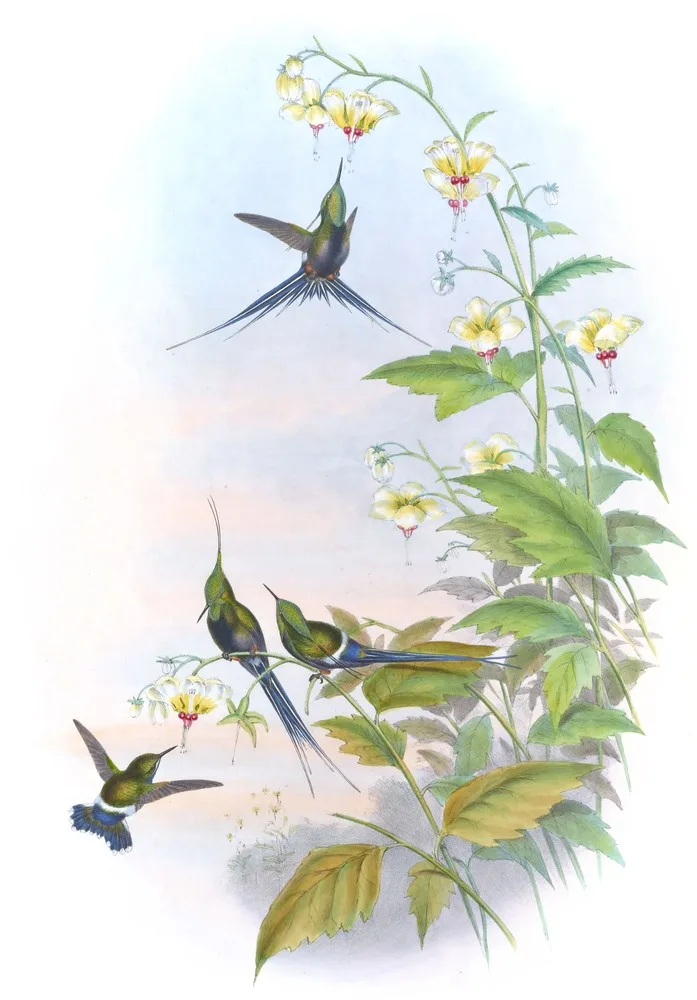
Like the other members of the genus, to which the name of Gouldia has been given by Prince Charles Lucien Bonaparte, it is distinguished by the elegance of its form and by the beauty of its markings, to which in this case is added a graceful attenuated crest formed of lengthened hair-like plumes, two of which, as will be seen on reference to the accompanying Plate, extend far beyond the rest. The honour of first recording the existence of this species, is due to the Vicomte Du Bus of Brussels, who, when describing and figuring it some few years since in his “Esquisses Ornithologiques” above referred to, named it Trochilus Popelairii, in honour of the Baron Popelaire de Terloo, who had discovered it in Peru and enriched the Museum at Brussels with this and many other interesting objects obtained during his explorations in South America. The specimen from which M. Du Bus took his description remained for some time unique, but I have since obtained specimens procured in Peru by M. Warszewicz, more recently examples have been sent me from the neighbourhood of Popayan, and I am indebted to Mr. Mark, Her Majesty’s Consul at Bogota, for a specimen collected in the vicinity of that city: it is clear then that the species enjoys a very wide range, extending over six or eight degrees of latitude in the elevated regions of Peru and Columbia. Mr. Mark tells me that the hot districts of Gramalote, an almost uninhabited part of the country to the eastward of Bogota, is one of the localities in which it is found; M. Warszewicz killed it at a considerable elevation among the Andes of Quindios; and M. Parzudaki, of Paris, informs me that it is met with in the Llanos de San Martins in New Grenada. This, I regret to say, is all the information I have been able to obtain respecting this little gem; we must therefore await the result of future explorations for an account of its habits, actions and economy. That it is a quick flier I am certain, from the conformation of its wings and its general structure.
The female offers the same difference in form from her mate that is found to exist in the sexes of Gouldia Langsdorffi; but the bright red hue of her legs and thighs at once indicates her specific relationship.
The male has the crown of the head, the shorter feathers of the crest, face and throat shining yellowish grass-green; lengthened filamentous feathers of the crest black; wings purplish brown; upper surface, wing- and upper tail-coverts golden green, across the rump a band of white expanding into a large patch on each flank, and overhanging the thighs, below this band the golden green deepens into blackish brown; centre of the abdomen black; flanks brown, with darker centres; under tail-coverts greyish white; upper surface of the tail steel-blue, passing into brown on the apical portion of the external feather; the shafts of the middle feathers white, those of the remainder white at the base and brown for the remainder of their length; on the under surface the tail-feathers are of a more lively steel-blue, and the shafts are white throughout their entire length; thighs and tarsi rust-red.
The female has the upper surface, wing-coverts, flanks and tail-coverts dark bronzy green, the bronzy hue predominating on the back; rump crossed by a band of white, below which the feathers are of a darker hue as in the male; chin and a stripe down each side of the neck from the angle of the mouth greyish white; centre of the throat and abdomen bluish black; tail-feathers deep steel-blue, grey at the base and tipped with white, the white increasing in extent as the feathers recede from the centre; thighs rust-red.
The figures represent the two sexes of the natural size. The pretty flower, Loasa picta, which, like the bird, is a native of the Andes, is copied with permission from the Botanical Magazine, a work of great merit and usefulness, whether we regard the scientific descriptions by Sir William J. Hooker and Mr. Smith, or the artistic figures by Mr. Fitch.
References
- Trochilus Popelairii, Du Bus, Esquisses Orn., pl. 6.
- Mellisuga Popelairii, Gray and Mitch. Gen. of Birds, vol. i. p. 113, Mellisuga, sp. 70.
- Gouldia popelairi, Bonap. Consp. Gen. Av., p. 86, Gouldia, sp. 2.—Ib. Consp. Troch. in Rey. et Mag. de Zool. 1854, p: 297.