Heliangelus strophianus
领蜂鸟
Heliangelus strophianus
Gorgeted Sun Angel
About this plate
Ecuador
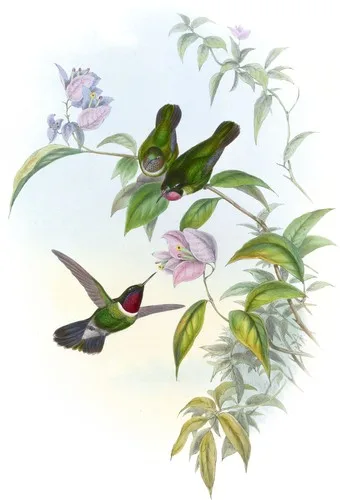
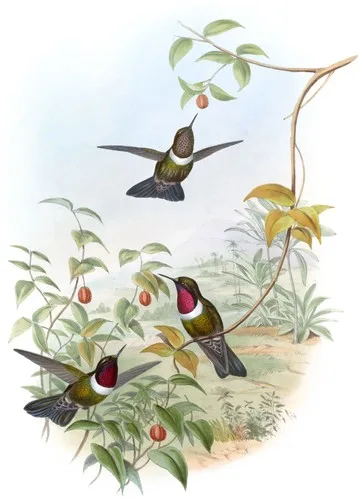
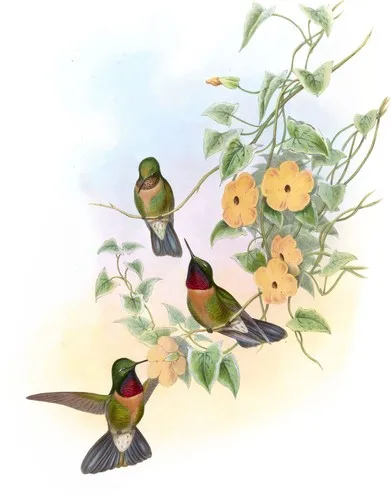
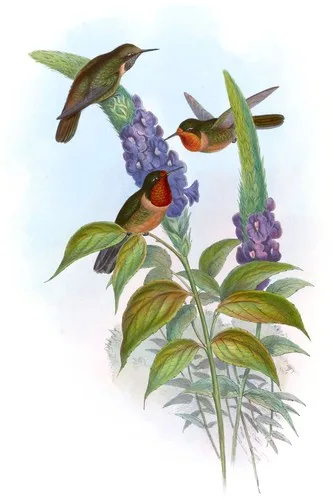
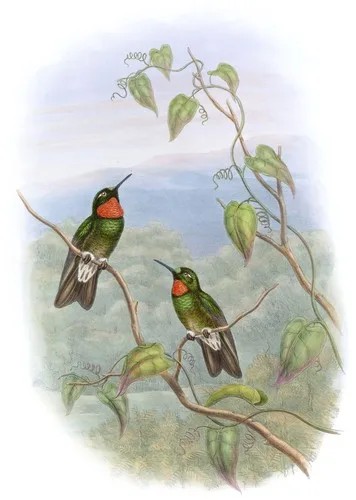
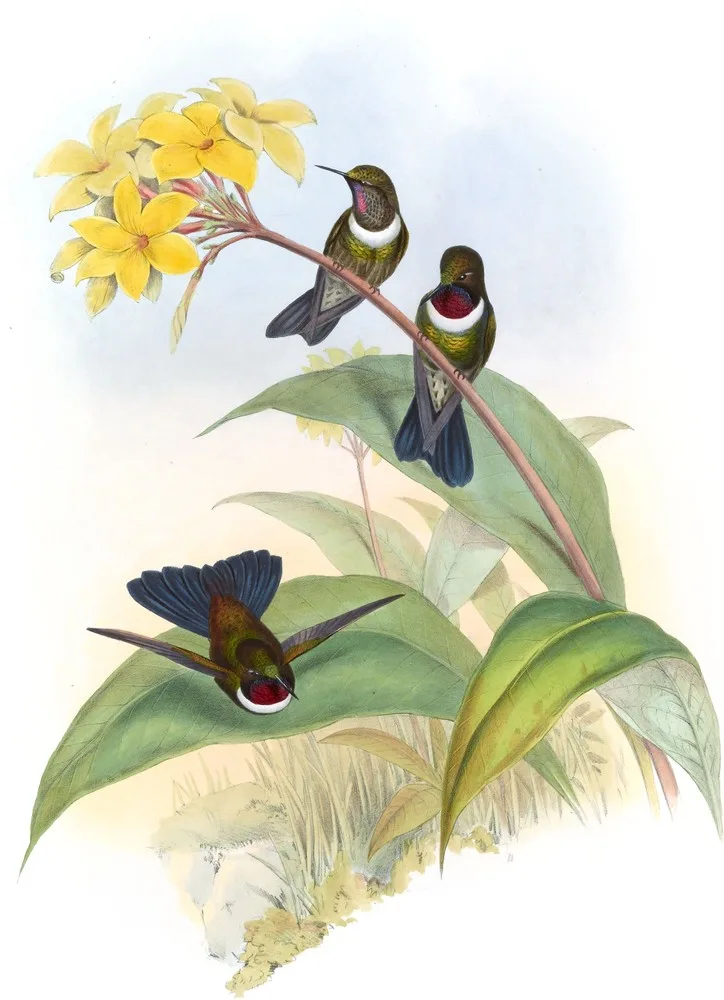
Although the Heliangelus strophianus presents the general appearance of H. Clarissæ, it nevertheless possesses several peculiarities by which it may be at once distinguished from that species: thus, it is a larger and more powerful bird; has a shorter bill; a more distinctly defined and whiter gorget; the tail entirely steel-black, with elongated outer feathers, giving that organ a forked form; the crown of the head green; the lower part of the back strongly tinged with brown; and the sides of the chest and lower part of the abdomen of a deeper grass-green.
The native country of this fine species is Ecuador and Northern Peru, to which it appears to be confined; for I have never seen an example from Bogota, its place there being supplied by H. Clarissæ, and in Bolivia by H. amethysticollis. Many specimens were brought to Europe by M. Bourcier, and some fine male examples have been transmitted to me by my friend Professor Jameson, who collected them in the neighbourhood of Quito, which I regard as the head-quarters of the species.
The male has a spot of luminous green on the forehead; the crown of the head, all the upper surface and abdomen dull green; behind the eye a small spot of white; chin black; throat rich violet-red or pucecolour, the blue or violet hue slightly increased on the upper and lateral margins; below this a clearly defined gorget of white; rump and upper tail-coverts greenish brown; centre of the back, wing-coverts and under surface green; lores and sides of the neck black; wings purplish black; tail steel- or bluish black; under tail-coverts white, streaked with dark brown; bill black; feet brown.
The female has a faint indication of the luminous mark on the forehead; head, upper surface and two central tail-feathers bronzy green, lateral tail-feathers black; throat dull mottled black and brown, and a slight indication of the white gorget.
The figures are of the natural size. The plant is the Plumieria Jamesoni.
References
- Trochilus (———?) strophianus, Gould in Proc. of Zool. Soc., part xiv. p. 45.
- Mellisuga strophiana, Gray and Mitch. Gen. of Birds, vol. i. p. 112, Mellisuga, sp. 39.
- Heliangelus strophianus, Bonap. Consp. Gen. Av., p. 76, Heliangelus, sp. 5.—Ib. Rev. et Mag. de Zool. 1854, p. 252.
- Anactoria Strophiana, Reichenb. Aufz. der Colibris, p. 12.
Ten ways of seeing
- upright 1.38 : 1
- published 1854
- Pl. 243, Vol. IV
First Look
论画以形似,见与儿童邻。
—— 宋·苏轼《书鄢陵王主簿所画折枝》
To judge painting by likeness alone is the view of a child.
The sheet is vertical: the eye climbs and settles on the bird. Take the posture before the plumage. Then step in close: watch where colour meets line, and whether the line ever breaks. Third, find the darkest small patch: the whole tonal order is measured from there.
Name and Thing
The binomial is Heliangelus strophianus: the first word is the genus it belongs among, the second the epithet that sets it apart. Two words carry a whole provenance. The Chinese name 领蜂鸟 is a modern rendering of the Latin, not an old garden name.
Form and Colour
The smallest of birds: a needle-fine bill, a forked tubular tongue, wings beating so fast the bird hovers and even flies backwards. Its colour is not pigment but structure — light bent by feather barbules, changing with the angle.No colour group is recorded. A single plant, laid out with nothing hidden.
Composition
Tall and narrow, the bird perched mid-branch with generous margins above and below. (about 1.38 : 1) No details are appended: a plate for looking, not for keying out. Cover the margins with your thumb and the plate suffocates; uncover them and the flower breathes again.
Line and Colour
In the later nineteenth century chromolithography took over: colour printed rather than painted, line demoted. Craft leaves franker evidence than inscriptions. If you mean to copy it: block in the broad shapes and colours first, detail last; lithographic softness comes from thin washes — two or three pale layers will get you close.
Poetic Resonance
穿花蛱蝶深深见,点水蜻蜓款款飞。
—— 唐·杜甫《曲江二首》
Butterflies thread the flowers, seen deep within; dragonflies touch the water and fly on, slow and deliberate.
The poem gives the mood first and the picture supplies the form; set the line beside the plate and the bird itself becomes its resting point.
Symbolism
For the Aztecs the hummingbird was warrior and sun; for Victorian Europe it was the ultimate ornament, millions killed for breast jewellery. China has no tradition here — and that blank is itself a history of exchange. In a flora it is a species first and a symbol second; the order is worth keeping.
Season and Place
temperate hummingbirds follow the bloom north and back, thousands of kilometres a year. Americas only, from southern Alaska to Tierra del Fuego, richest in the Andes. China has no hummingbirds and no classical record of them. The year 1854 on the plate is that of publication, not of flowering — the gathering came a year or two earlier. The bud and the ripe fruit on one branch tell the season; the name in the title often tells the journey.
The Book and the Hand
“Gould's Hummingbirds” was drawn by John Gould and published 1849-1887. This plate is Pl. 243, Vol. IV, book page 243. The image is public domain; the hand-colouring is still one person's hand.
What to Take Away
Carry three rules away: whole before detail; line before colour; picture before book. The flower of that year is dust, yet its image on paper has outlived every living cousin.