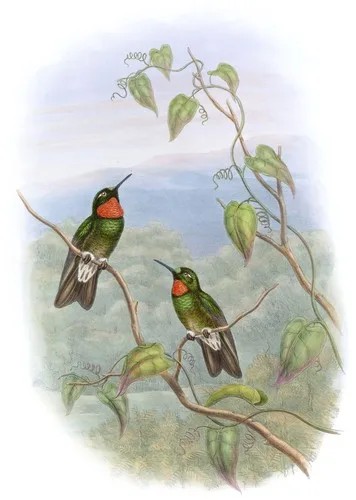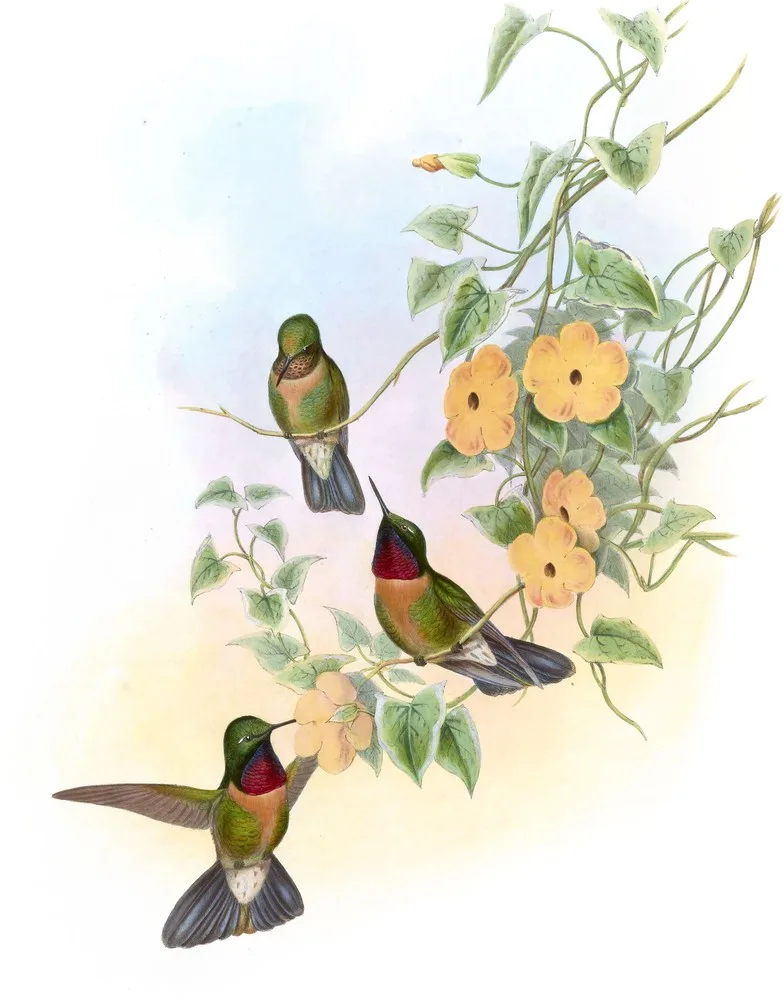
Heliangelus amethysticollis
辉喉领蜂鸟
Heliangelus amethysticollis
Amethystine Sun Angel
About this plate
Peru
This beautiful Humming Bird was first made known to science by M. D’Orbigny, who procured a single example of it during his journey into Bolivia.
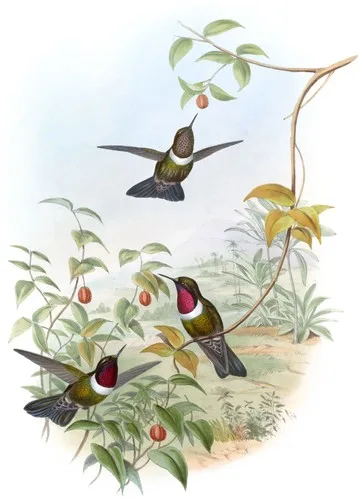
It was subsequently found by Mr. Bridges in the same country, and it is from that source that the specimens in my own collection were obtained; I also’received a single example from M. Warszewicz, who killed it in Northern Peru. Peru and Bolivia, then, evidently constitute the true habitat of this species, which may be regarded as the southern representative of the well-defined genus to which the appellation of Heliangelus has been given. In size and in the semi-rounded form of its tail it assimilates to H. Clarissæ; but it differs from that, as well as from every other member of the genus, in the buff colouring of its gorget, in the central line of the abdomen being’ buff, and in the under tail-coverts being of a darker hue; a marked difference from all its congeners is also presented in the greater size of the glittering green spot on the forehead, which, instead of being confined to the front, extends towards the crown. The female offers the usual difference in the colouring of the plumage, but preserves the buff band across the breast so characteristic of the male.
The specimen of this bird procured by M. D’Orbigny was obtained on the eastern slope of the Cordilleras in the country of the Yuracares near Cochabamba, at the upper limit of the woody vegetation. Its stomach contained numerous grubs and the larve of hemipterous insects.
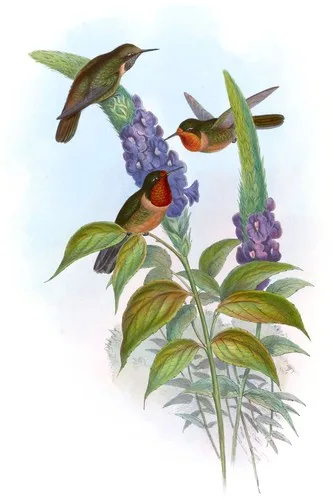
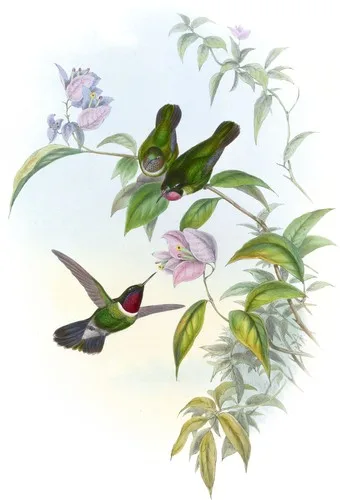
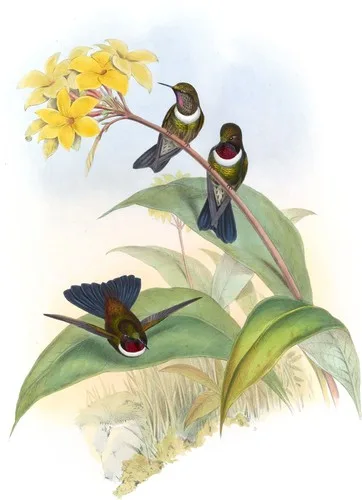
The male has a large mark of luminous green on the forehead; chin black; throat rich luminous violetred or puce colour, the blue or violaceous hue prevailing on the upper and lateral margins; below this a wide gorget of buff, succeeded by a series of green feathers, very narrow in the centre, broad on the sides, and blending with the bronzy green of the flanks; head, upper surface and wing-coverts bronzy green; the head, however, when viewed in front, appears black; lores and sides of the neck velvety black, separating the colours of the upper and under surface of the head and neck; immediately behind the eye a very small spot of buffy white; wings chocolate-brown; two central tail-feathers bronzy green; lateral tailfeathers dull black, the three outermost on each side tipped with brownish grey; abdomen mottled buff and bronzy green; under tail-coverts greyish white; bill black; feet brown.
The female has a faint indication of the luminous green on the forehead; head, upper surface and central tail-feathers bronzy green; lateral tail-feathers black; throat mottled buff and black; the buff gorget not so decided, and the luminous green feathers*below far less conspicuous than in the male.
The figures are of the natural size.
References
- Orthorhynchus amethysticollis, D’Orb. et LaFres. Syn. Av., p. 31.—D’Orb. Voy. dans l’Amér. Mér., tom. iv. p. 576, tom. viii. pl. 60. fig. 2.
- Mellisuga amethysticollis, Gray and Mitch. Gen. of Birds, vol. i. p. 112, Mellisuga, sp. 40.
- Trochilus amethysticollis, Tschudi, Consp. Av., no. 207.
- Lampornis amethysticollis, Tschudi, Faun. Per., p. 246.
- Heliangelus amethysticollis, Bonap. Consp. Gen. Av., p. 76, Heliangelus, sp. 6.—Ib. Rey. et Mag. de Zool. 1854, p. 252.
- Anactoria amethysticollis, Reichenb. Aufz. der Colibris, p. 12.
Twelve ways of seeing
- slightly upright 1.28 : 1
- published 1854
- Pl. 245, Vol. IV
Not a catalogue entry but a way of looking: how to stand, what to notice, how the line was cut, when it flowers, where it came from, who made it — and then the poems and the classics that taught China to see the same flower. Read the twelve in order and the plate opens.
-
First Look
搜尽奇峰打草稿。
—— 清·石涛《苦瓜和尚画语录》
Exhaust the strange peaks, and then make the sketch.
Slightly taller than wide; the eye lands above centre. Then step in close: watch where colour meets line, and whether the line ever breaks. Third, find the darkest small patch: the whole tonal order is measured from there.
-
Name and Thing
The binomial is Heliangelus amethysticollis: the first word is the genus it belongs among, the second the epithet that sets it apart. Two words carry a whole provenance. The Chinese name 辉喉领蜂鸟 is a modern rendering of the Latin, not an old garden name.
-
Form and Colour
A bulb of overlapping fleshy scales gives the lily its Chinese name, 'hundred-fold'; six tepals reflex as the flower opens, around six stamens with long, T-shaped anthers.No colour group is recorded. Read the outline, then the colour layers, then the brush.
-
Composition
Slightly taller than wide, the plant set a little above centre. (about 1.28 : 1) No details are appended: a plate for looking, not for keying out. Cover the margins with your thumb and the plate suffocates; uncover them and the flower breathes again.
-
Line and Colour
In the later nineteenth century chromolithography took over: colour printed rather than painted, line demoted. Craft leaves franker evidence than inscriptions.
-
Season
Early to high summer, June and July; the flowers last only days, so artists drew them just as they opened. The year 1854 on the plate is that of publication, not of flowering — the gathering came a year or two earlier. The plate records ten days of peak; the other three hundred are leaf, fruit and rest.
-
Provenance
Temperate north — China, Japan, Europe. Long used in Chinese medicine, lilies were hunted in East Asia by nineteenth-century collectors and transformed European gardens. The localities on the plate are those of a century ago; plants travel and places change their names.
-
The Book and the Hand
“Gould's Hummingbirds” was drawn by John Gould and published 1849-1887. This plate is Pl. 245, Vol. IV, book page 245. The image is public domain; the hand-colouring is still one person's hand.
-
Poetic Resonance
更乞两丛香百合,老翁七十尚童心。
—— 宋·陆游《窗前作小土山蓻兰及玉簪最后得香百合并种之戏作》
The poem gives the mood first and the picture supplies the form; set the line beside the plate and the corolla becomes its resting point.
-
The Written Tradition
百合之根,以众瓣合成也。
—— 明·李时珍《本草纲目·菜部》
The root of the lily is many scales gathered into one — hence the name bai he, “a hundred joined”.
The Bencao Gangmu describes the bulb as garlic-like, edible and medicinal; Song writers already noted that the leaves vary while the flowers stay white. The difference is not of quality but of question: Europe asks what it is, China asks whom it resembles.
-
Symbolism
In the West the white lily is Marian purity, held by the angel of the Annunciation; in China the name sounds like 'a hundred years in harmony', a wedding wish. Meanings change their tune: the same flower can say opposite things within a century.
-
What to Take Away
If you keep one line, keep Guo Xi's: from afar its momentum, up close its texture. A flora exists to be consulted; look long enough and you forget to consult — someone in 1854 gave a whole day to a single flower.