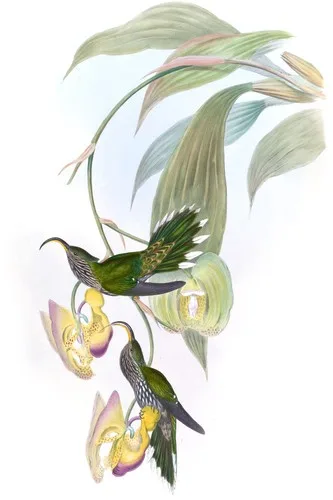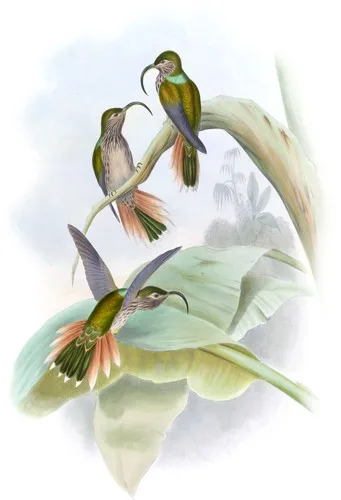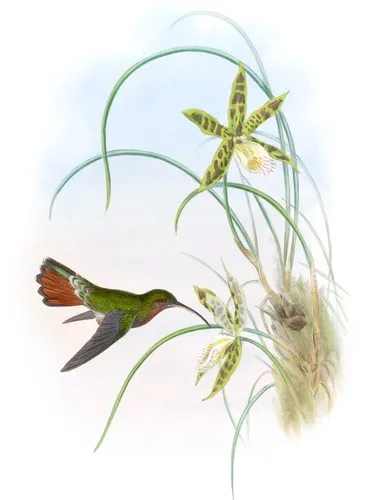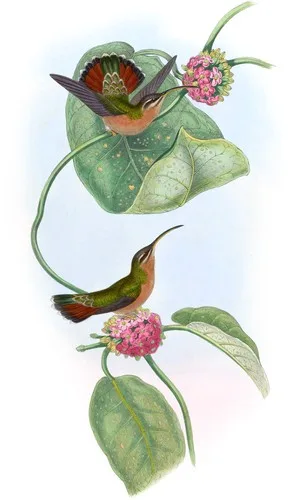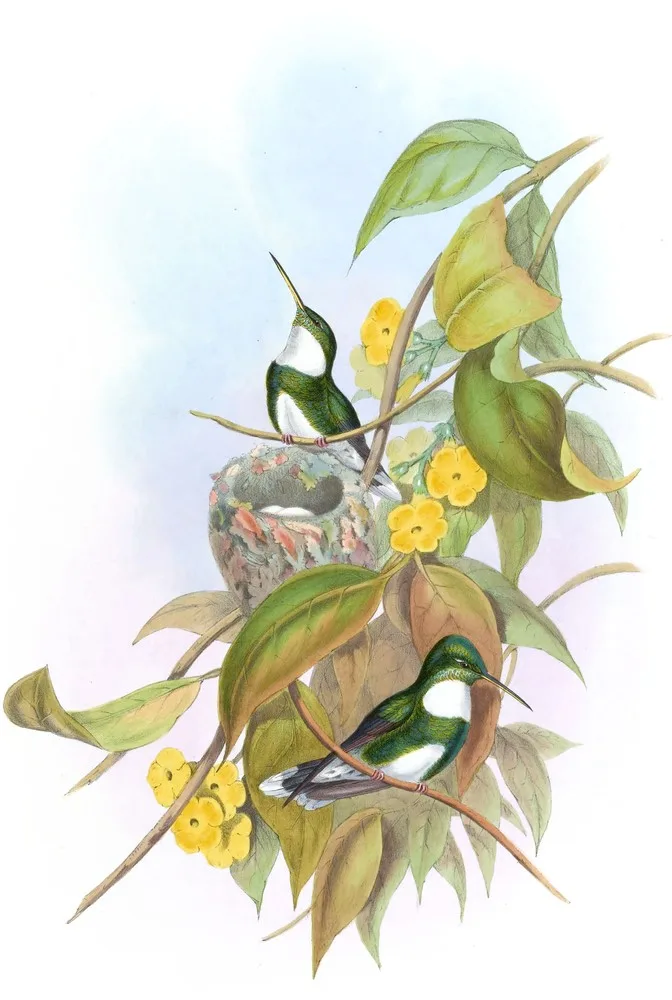
Leucochloris albicollis
白喉蜂鸟
Leucochloris albicollis
White-throat
About this plate
Brazil; and Tucuman, according to Dr. Burmeister
The southern part of Brazil alone, so far as we yet know, is the native country of this very pretty and wellmarked species, and numerous are the specimens that from time to time are sent to Europe from that great emporium of bird skins, Rio de Janeiro.
In some notes kindly transmitted to me by Mr. Reeves, that gentleman states that it inhabits the Provinces of Rio de Janeiro, Santa Catharina and Bahia; that it may be seen in the neighbourhood of Rio from May until November, but never very near the city, and that at the same period it is equally abundant at Novo Friburgo.
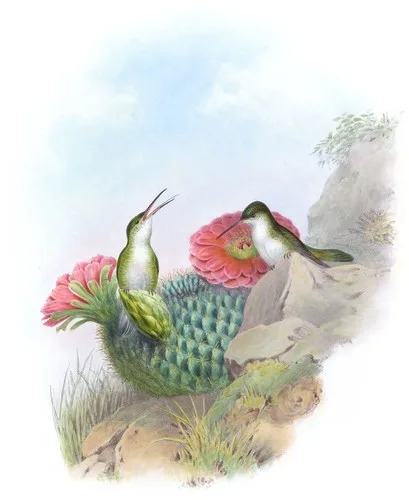
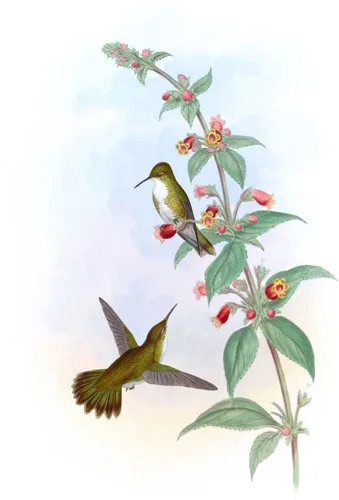
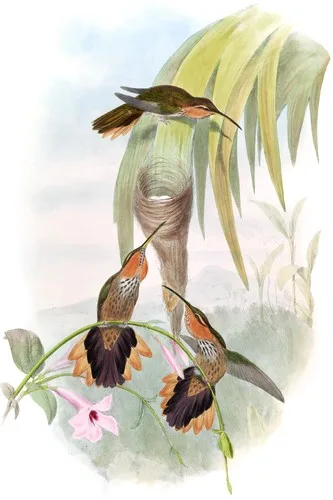
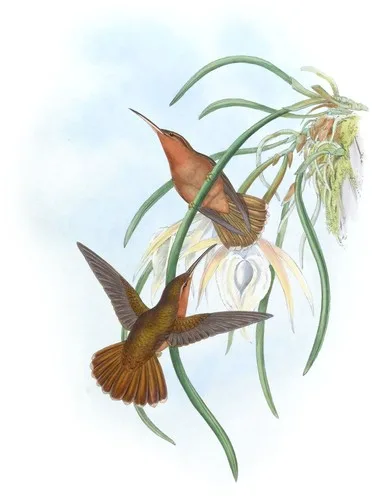
The markings of this species are so distinct and so different from those of every other Humming Bird, that it is impossible to confound it with either of them. The sexes closely resemble each other in their markings and in the colouring of their plumage, and the young at an early age assume the adult livery.
The nest, which is of a rather large cup-shaped form, is a very beautiful structure, inwardly composed of thistle-down, and outwardly of moss thickly interwoven with strong cobwebs, over which it is coated with flat pieces of reddish-orange and buffy-white lichens, with occasionally the additional decoration of soft downy feathers. It is generally placed in the forked branch of a shrub. The eggs, as usual, are two in number, oblong in form and of a snowy whiteness.
Mr. Reeves states that the local name of the bird is Papa branca, and that it utters two different cries: one on the wing, which resembles Jack, Jack, Jack; and another when at rest, like Klaw, klaw, jip, jip.
Head, all the upper surface, wing-coverts, chin and sides of the neck, abdomen and flanks deep shining grass-green; on the centre of the throat and breast a large patch of white; lower part of the abdomen and under tail-coverts white; wings purplish brown; two middle tail-feathers deep shining grass-green, the remainder bluish black, the three outer ones tipped with white; upper mandible black; basal two-thirds of the lower mandible fleshy, apical third brown; feet brown.
The figures are of the natural size.
References
- Trochilus albicollis, Vieill. 2nde Edit. du Nouv. Dict. d’Hist. Nat., tom. xxiii. p. 426.—Ib. Ency. Méth. Orn., part i. p. 558.—Temm. Pl. Col. 203. fig. 2.—Jard. Nat. Lib. Humming Birds, vol. 11. p. 93.
- Ornismya albicollis, Less. Man. d’Orn., tom. ii. p. 78.—Ib. Hist. Nat. des Ois. Mou., pp. xxxiii et 184. pl. 63.
- Lamporms albicollis, Less. Traité d’Orn., p. 282.
- Basilinna albicollis, Less. Ind. Gen. et Syn. des Ois. du Genre Trochilus, p. xxv.
- Colibri albogularis, Spix, Av. Sp. Nov. Bras., tom. i. p. 81. tab. lxxxii. fig. 1.
- Polytmus albicollis, Gray and Mitch. Gen. of Birds, vol. i. p. 108, Polytmus, sp. 43.
- Thaumatias albicolls, Bonap. Consp. Gen. Av., p. 78, Thaumatias, sp. 7.
- Thaumantias albicollis, Bonap. Rev. et Mag. de Zool. 1854, p. 255.
- Leucochloris albicollis, Reichenb. Aufz. der Colibris, p. 10.
Ten ways of seeing
- yellow key
- upright 1.49 : 1
- published 1861
- Pl. 291, Vol. V
First Look
夫象物必在于形似,形似须全其骨气。
—— 唐·张彦远《历代名画记》
Likeness is the threshold; bone-and-breath is the point.
The sheet is vertical: the eye climbs and settles in the upper half. Let the plant stand before you look for detail. Then step in close: watch where colour meets line, and whether the line ever breaks. Third, find where the yellow is deepest: the whole tonal order is measured from that patch.
Name and Thing
The binomial is Leucochloris albicollis: the first word is the genus it belongs among, the second the epithet that sets it apart. Two words carry a whole provenance. The Chinese name 白喉蜂鸟 is a modern rendering of the Latin, not an old garden name.
Form and Colour
A bulb of overlapping fleshy scales gives the lily its Chinese name, 'hundred-fold'; six tepals reflex as the flower opens, around six stamens with long, T-shaped anthers. Filed under yellow — a honey-yellow, built in washes from a pale ground. Read the outline, then the colour layers, then the brush.
Composition
Tall and narrow, the plant rising in one movement with generous margins — the upright format of most floras. (about 1.49 : 1) No details are appended: a plate for looking, not for keying out. Old plates set the plant slightly off centre, with unequal margins — that small imbalance is what keeps it alive.
Line and Colour
In the later nineteenth century chromolithography took over: colour printed rather than painted, line demoted. Craft leaves franker evidence than inscriptions. If you mean to copy it: block in the broad shapes and colours first, detail last; lithographic softness comes from thin washes — two or three pale layers will get you close.
Poetic Resonance
梨花淡白柳深青,柳絮飞时花满城。
—— 宋·苏轼《东栏梨花》
Pear blossoms pale white, willows deep green; when the catkins fly, flowers fill the town.
The poem gives the mood first and the picture supplies the form; set the line beside the plate and the yellow the corolla becomes its resting point.
Symbolism
In the West the white lily is Marian purity, held by the angel of the Annunciation; in China the name sounds like 'a hundred years in harmony', a wedding wish. This plate leans yellow, which in flower language adds one more degree of feeling. Flower language was added later; the flower knows nothing of it, and that innocence is part of its power.
Season and Place
Early to high summer, June and July. Temperate north — China, Japan, Europe. Long used in Chinese medicine, lilies were hunted in East Asia by nineteenth-century collectors and transformed European gardens. The year 1861 on the plate is that of publication, not of flowering — the gathering came a year or two earlier. Read the locality and the flowering season both with a discount: one is hearsay, the other a ten-day peak.
The Book and the Hand
“Gould's Hummingbirds” was drawn by John Gould and published 1849-1887. This plate is Pl. 291, Vol. V, book page 291. The image is public domain; the hand-colouring is still one person's hand.
What to Take Away
Carry three rules away: whole before detail; line before colour; picture before book. Two centuries on, the plant may still flower in some garden; the one on this sheet stopped in the season of 1861.