白喉蜂鸟
Leucochloris albicollis
Leucochloris albicollis
White-throat
- 中文名
- 白喉蜂鸟
- 学名
- Leucochloris albicollis
- 合集
- 古尔德蜂鸟图谱
- 绘者
- John Gould(约翰·古尔德)
- 年代
- 1861
- 图版号
- Pl. 291, Vol. V
- 原书页码
- p.291
- 主色
- 黄
- 授权
- CC0 1.0 Universal (Public domain)
十观
- 黄色主调
- 纵幅 1.49∶1
第一眼
夫象物必在于形似,形似须全其骨气。
—— 唐·张彦远《历代名画记》
形似只是门槛,骨气才是要害。看一株植物,先看它立不立得住——这就是骨气。这一幅是竖的:眼睛从下往上走,落点在上半部。先让整株立起来,再看细节。第二步凑近一寸:看线与色的交界,色有没有压住线,线有没有断。第三步,找黄色最重的一小块:整幅的明暗秩序,是从那里排开的。
名与实
学名 Leucochloris albicollis:前一词是属,管它归在哪一类;后一词是种加词,管它在这一类里凭什么与众不同。双名制的好处是唯一:全世界叫这个名字的,只能是这一种。中文名“白喉蜂鸟”是后人据学名回译的通行叫法,与古书里的旧名未必对得上——名与物之间,总隔着一层翻译。
形与色
鳞茎由多数肉质鳞片抱合而成,故名“百合”;茎直立,叶披针或轮生,花被六片,盛开时向外反卷,雄蕊六枚,花药长大如丁字。此幅属黄一路,黄如蜜蜡,浅处几乎透光。上色时先铺一层淡底,再在瓣基与背光处加深——层次是这样一层层叠出来的。画幅高而窄,形与色的关系因此看得格外清楚:先读轮廓,再读色层,最后才看笔触。
构图与呼吸
画幅高而窄,主株一路向上,上下留白多,是图谱中最常见的立轴式构图。全幅只画一株,不作解剖附图——这类图更近于“观赏”,而非“鉴定”。老图谱爱把主株摆在偏中线的位置,左右留得不一样多:这一点偏心,正是画面活起来的原因。
一刀一色
十九世纪后半叶,石版与彩色石印渐成主流:颜色可以直接印出,不再依赖手工,线条反倒退居其次。图像的“准确”提高了,手性却淡了。还有一种证据在纸背:铜版压进纸里的那道痕、上色处微微凸起的颜料、再版时磨浅的线。扫描件里也能看出七分。想动笔临它的人记住一句:先铺大块的形与色,干后再收细部;石印的柔和层次来自薄涂与网点,水彩分两三遍淡铺即可逼近。
诗境
梨花淡白柳深青,柳絮飞时花满城。
—— 宋·苏轼《东栏梨花》
百合无专咏之名篇,姑借梨花之境:同是素白,一在春寒,一在夏暑;白得清冷,是这一路花的共同语气。诗以气行,画以形立;两种“看”叠在一起,才是看画的意思。
花语
西方以白百合为圣母之洁,天使报喜时手持者即是;中国取其“百年好合”之谐音,婚仪用之,是世俗的祝福而非宗教的纯洁。此幅偏黄,在花语里总要再加重一分情绪。象征会随世道改口:同一株植物,在一个世纪里可以说完全相反的话。
时与地
初夏至盛夏,六七月间开。百合花期短,三五日即谢,故画者多取初开之态。北半球温带,中国、日本与欧洲山地皆有。中国百合入药已久,十九世纪欧洲又从东亚引去数十种,一时百合育种大盛。图上所记的 1861 年是刊行之年,不是花期;真正的花藏在原书的采集记录里,通常比出版早一两年。看这类图最好的时候是花期,见过一次活的花,再看图就不会只看颜色。
书与人
《古尔德蜂鸟图谱》只署了约翰·古尔德一个人的名字。图版今属公有领域,可以自由取用;但纸上那层手工上色,仍是两百年前某一个人的手。
带走一双眼睛
把这三件事带走:先整体后细节;先线后色;先看画再翻书。任何一张老图版,都可以用这三条读。1861 年的那朵花早已化作尘土,它留在纸上的样子,却比任何一株活着的同类都长寿。
关于本图版
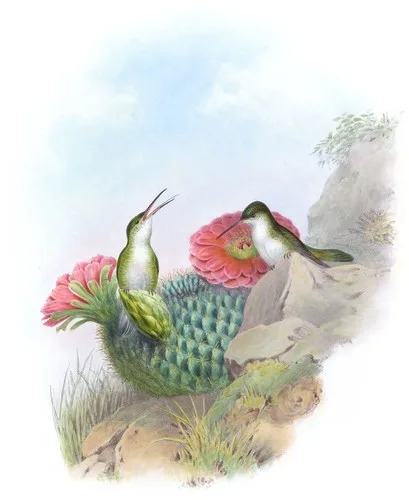
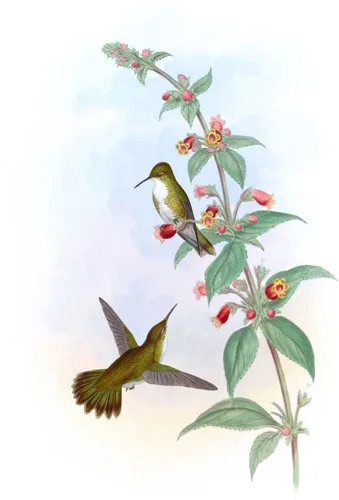
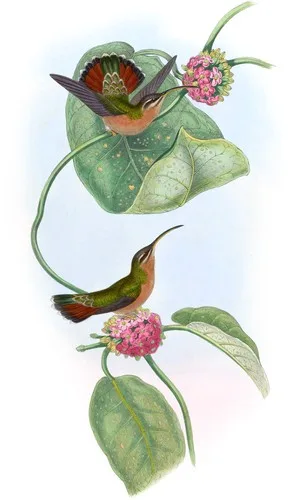
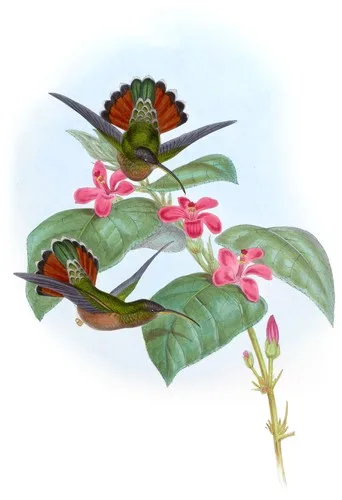
此图原刊于《古尔德蜂鸟图谱》(Gould's Hummingbirds),绘者为约翰·古尔德,成书于 1849—1887 年间。图中描绘的是白喉蜂鸟,学名 Leucochloris albicollis,归入蜂鸟科(Trochilidae)。
全编共收录 421 幅图版,本图是其中一幅,原书将其列为 Pl. 291, Vol. V,见第 291 页,版式为纵幅,画面以橙为主色。图为公有领域原件的修复扫描,构图与设色未经改动。
原书文字(英文 / 法文)
Brazil; and Tucuman, according to Dr. Burmeister
The southern part of Brazil alone, so far as we yet know, is the native country of this very pretty and wellmarked species, and numerous are the specimens that from time to time are sent to Europe from that great emporium of bird skins, Rio de Janeiro.
In some notes kindly transmitted to me by Mr. Reeves, that gentleman states that it inhabits the Provinces of Rio de Janeiro, Santa Catharina and Bahia; that it may be seen in the neighbourhood of Rio from May until November, but never very near the city, and that at the same period it is equally abundant at Novo Friburgo.
The markings of this species are so distinct and so different from those of every other Humming Bird, that it is impossible to confound it with either of them. The sexes closely resemble each other in their markings and in the colouring of their plumage, and the young at an early age assume the adult livery.
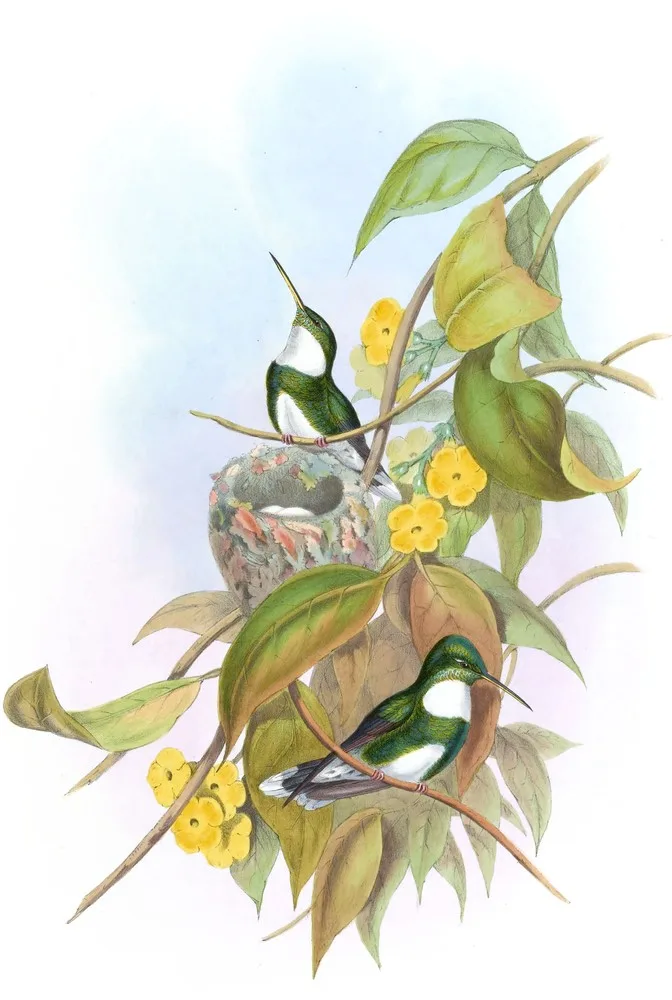
The nest, which is of a rather large cup-shaped form, is a very beautiful structure, inwardly composed of thistle-down, and outwardly of moss thickly interwoven with strong cobwebs, over which it is coated with flat pieces of reddish-orange and buffy-white lichens, with occasionally the additional decoration of soft downy feathers. It is generally placed in the forked branch of a shrub. The eggs, as usual, are two in number, oblong in form and of a snowy whiteness.
Mr. Reeves states that the local name of the bird is Papa branca, and that it utters two different cries: one on the wing, which resembles Jack, Jack, Jack; and another when at rest, like Klaw, klaw, jip, jip.
Head, all the upper surface, wing-coverts, chin and sides of the neck, abdomen and flanks deep shining grass-green; on the centre of the throat and breast a large patch of white; lower part of the abdomen and under tail-coverts white; wings purplish brown; two middle tail-feathers deep shining grass-green, the remainder bluish black, the three outer ones tipped with white; upper mandible black; basal two-thirds of the lower mandible fleshy, apical third brown; feet brown.
The figures are of the natural size.
References
- Trochilus albicollis, Vieill. 2nde Edit. du Nouv. Dict. d’Hist. Nat., tom. xxiii. p. 426.—Ib. Ency. Méth. Orn., part i. p. 558.—Temm. Pl. Col. 203. fig. 2.—Jard. Nat. Lib. Humming Birds, vol. 11. p. 93.
- Ornismya albicollis, Less. Man. d’Orn., tom. ii. p. 78.—Ib. Hist. Nat. des Ois. Mou., pp. xxxiii et 184. pl. 63.
- Lamporms albicollis, Less. Traité d’Orn., p. 282.
- Basilinna albicollis, Less. Ind. Gen. et Syn. des Ois. du Genre Trochilus, p. xxv.
- Colibri albogularis, Spix, Av. Sp. Nov. Bras., tom. i. p. 81. tab. lxxxii. fig. 1.
- Polytmus albicollis, Gray and Mitch. Gen. of Birds, vol. i. p. 108, Polytmus, sp. 43.
- Thaumatias albicolls, Bonap. Consp. Gen. Av., p. 78, Thaumatias, sp. 7.
- Thaumantias albicollis, Bonap. Rev. et Mag. de Zool. 1854, p. 255.
- Leucochloris albicollis, Reichenb. Aufz. der Colibris, p. 10.