Lophornis Verreauxi
Lophornis Verreauxi
Peruvian Coquette
Ten ways of seeing
- upright 1.31 : 1
First Look
真山水之川谷,远望之以取其势,近看之以取其质。
—— 宋·郭熙《林泉高致·山水训》
Mountains and valleys: from afar take their momentum, up close take their texture — the two distances from which any picture is read.
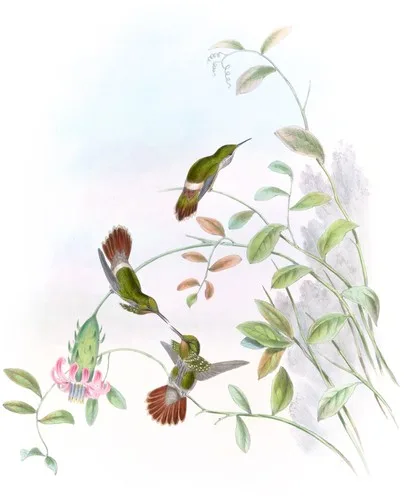
The sheet is vertical: the eye climbs and settles on the bird. Take the posture before the plumage. Then step in close: watch where colour meets line, and whether the line ever breaks. Third, find the darkest small patch: the whole tonal order is measured from there.
Name and Thing
The binomial is Lophornis verreauxi: the first word is the genus it belongs among, the second the epithet that sets it apart. Two words carry a whole provenance. No established Chinese name exists, so it is cited by its binomial alone.
Form and Colour
The smallest of birds: a needle-fine bill, a forked tubular tongue, wings beating so fast the bird hovers and even flies backwards. Its colour is not pigment but structure — light bent by feather barbules, changing with the angle.No colour group is recorded. Read the outline, then the colour layers, then the brush.
Composition
Tall and narrow, the bird perched mid-branch with generous margins above and below. No details are appended: a plate for looking, not for keying out. Cover the margins with your thumb and the plate suffocates; uncover them and the flower breathes again.
Line and Colour
In the later nineteenth century chromolithography took over: colour printed rather than painted, line demoted. Craft leaves franker evidence than inscriptions. If you mean to copy it: block in the broad shapes and colours first, detail last; lithographic softness comes from thin washes — two or three pale layers will get you close.
Poetic Resonance
夫列子御风而行,泠然善也,旬有五日而后反。
—— 《庄子·逍遥游》
Liezi rode the wind and came back after fifteen days, so light was his going.
The poem gives the mood first and the picture supplies the form; set the line beside the plate and the bird itself becomes its resting point.
Symbolism
For the Aztecs the hummingbird was warrior and sun; for Victorian Europe it was the ultimate ornament, millions killed for breast jewellery. China has no tradition here — and that blank is itself a history of exchange. Flower language was added later; the flower knows nothing of it, and that innocence is part of its power.
Season and Place
In tropical America they are present all year, their season set by flowers. the name arrives with late-Qing travel writing. The year 1852 on the plate is that of publication, not of flowering — the gathering came a year or two earlier. Much of what that generation knew of such birds came from specimens and cages; read locality and season both as hearsay.
The Book and the Hand
“Gould's Hummingbirds” carries only John Gould's name. A plate is collective work: drawer, engraver and colourist were different hands, and the unnamed ones decided how good it looks.
What to Take Away
Carry three rules away: whole before detail; line before colour; picture before book. A flora exists to be consulted; look long enough and you forget to consult — someone in 1852 gave a whole day to a single flower.
About this plate
Peru
This species may be justly regarded as one of the most precious of the Humming-Birds, and it consequently ranks most highly in my estimation.
It is a native of Peru, and the only specimens I have ever seen are in the collection of my friend M. Edouard Verreaux of Paris, after whom the bird has been named, as a just compliment to that gentleman’s zeal for the promotion of natural science, particularly Ornithology. M. Verreaux has, with the utmost kindness and confidence, allowed me the use of these rarities in London for the purpose of enriching the present work; and I trust that both myself and my readers are duly sensible of his liberality in so doing.
The discovery of this bird will, I am sure, sufficiently bear out what I have so often said in other parts of this work respecting the little we yet know of the natural productions of those great ranges of mountains, the Cordilleras and the Andes, where, between the line of perpetual congelation and the hot valleys at their bases, so much diversity of country and climate occurs, that an area of a hundred leagues is almost equal to a continent in other parts of the globe. It is in some one of these hot valleys that in all probability this bird finds a congenial habitat, the confines of which it may possibly never leave: I am led to surmise this from the circumstance of some of the extinct volcanos having a fauna and a flora almost peculiar to themselves, and from the evidence afforded by the fact that the great snow-covered peaks of Chimborazo, Pichincha, Cotopaxi, &c., have their sides, immediately below their snow-lines, tenanted by species not to be found elsewhere. How longa time must elapse before we can become acquainted with all the productions of the great back-bone, so to call it, of the vast continent of America, stretching along its western side from Cape Horn to the Rocky Mountains!
The bird most nearly allied to this species is the Lophornis chalybeus of Brazil; but that bird, beautiful as it is, must give place to the L. Verreauxi, which, besides being more richly coloured, is adorned with a fine crest,—a character which appears to be common to both sexes, unless the specimen from which I have figured should prove to be a young male. I possess a skin from Bogota without a crest, which I have for a long time regarded as a female L. Verreauxi; if this should not be the case, there is yet another fine species, the male of which is unknown to us.
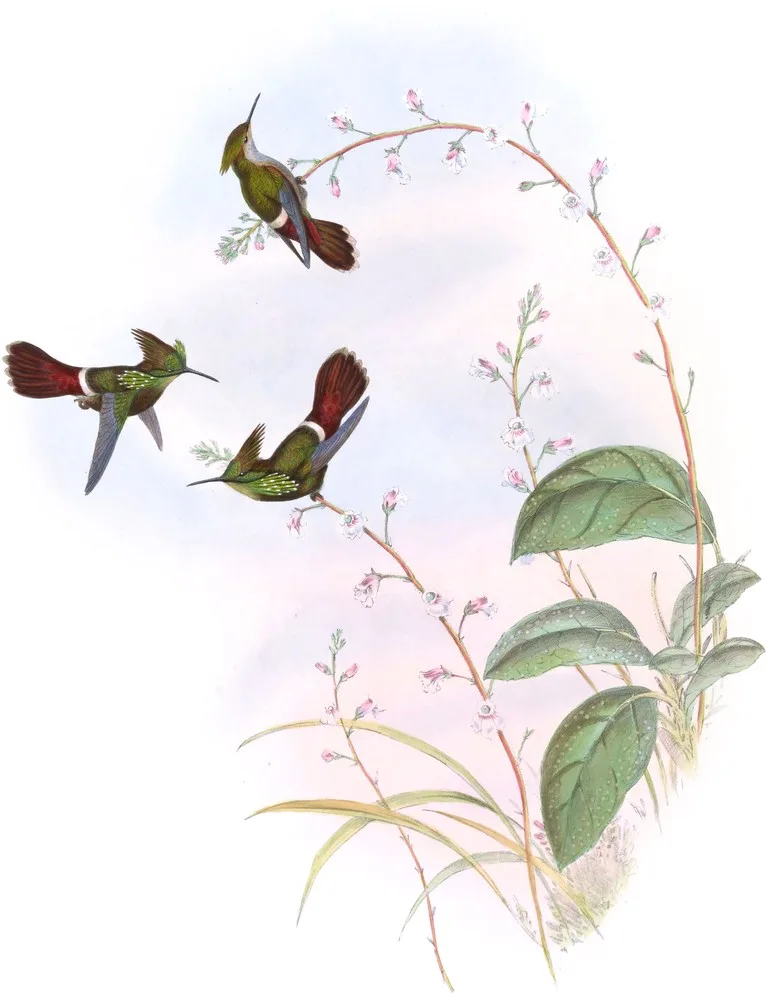
Forehead and patch below the eye glittering metallic grass-green; crest, back of the neck, wing-coverts, and abdomen deep oil-green, darkest on the latter; wings purplish brown; at the lower part of the back a narrow band of white; upper tail-coverts and tail deep chestnut-red, becoming darker towards the end, and slightly tipped with a greyish buff; throat and tuft on each side of the neck pale green, each feather of the latter with an oval spot of white at the tip.
The female has the head and crest brown; the general plumage paler than in the male; the band across the lower part of the back buffy white; the throat grey, and the tail more largely tipped with buffy white.
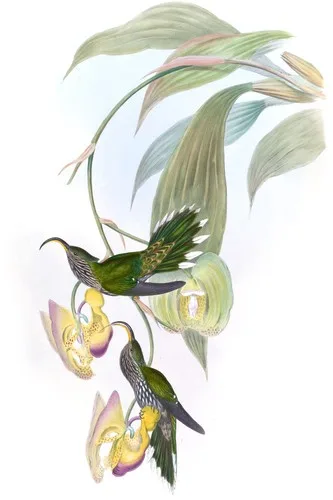
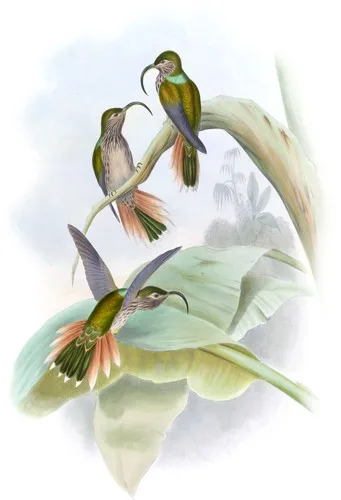
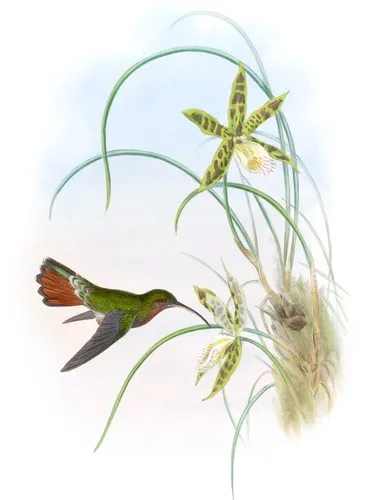
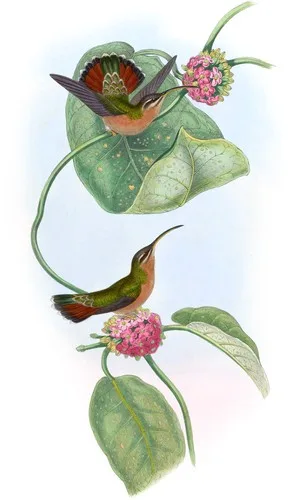
The Plate represents the male in two positions and the female, all of the natural size. The plant is the Achimenes argyrostigma.
References
- Trochilus Verreauai, Bourc. Rey. Zool. 1853, p. 193.
- Lophornis Verreauxi, Reichenb. Auf. der Col., p. 12.
- Bellatriz verreauxi, Bonap. Rev. et Mag. de Zool. 1854, p. 257.