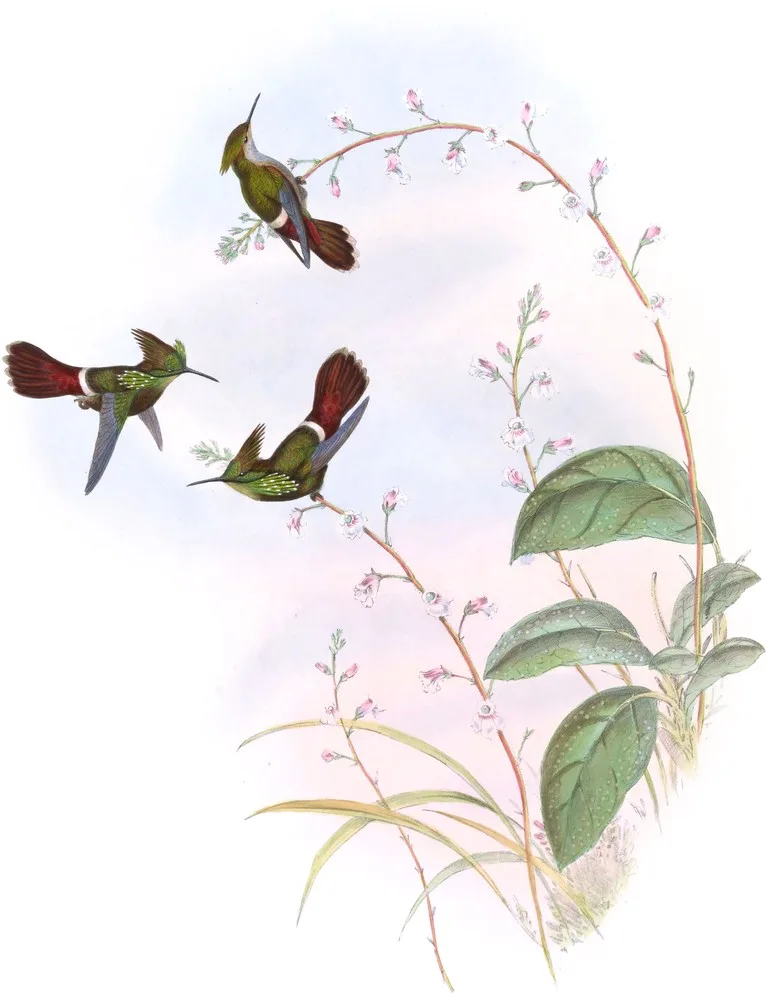
Lophornis Verreauxi
Lophornis Verreauxi
Peruvian Coquette
- 学名
- Lophornis Verreauxi
- 合集
- 古尔德蜂鸟图谱
- 绘者
- John Gould(约翰·古尔德)
- 年代
- 1852
- 图版号
- Pl. 125, Vol. III
- 原书页码
- p.125
- 授权
- CC0 1.0 Universal (Public domain)
十观
- 纵幅 1.31∶1
第一眼
真山水之川谷,远望之以取其势,近看之以取其质。
—— 宋·郭熙《林泉高致·山水训》
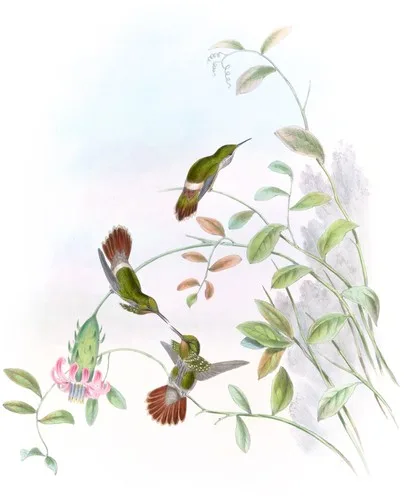
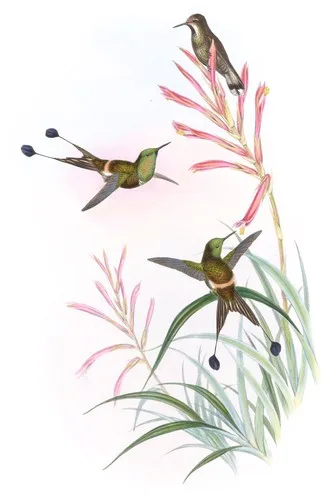
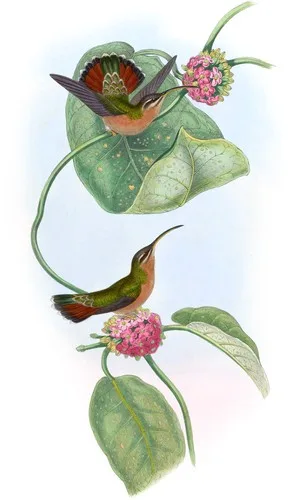
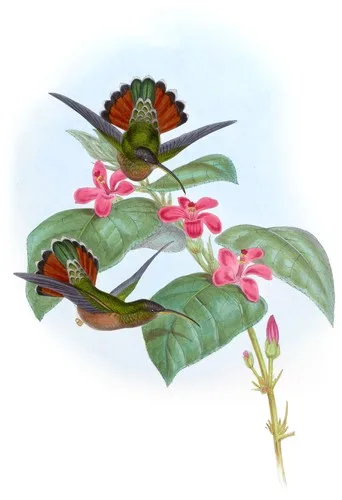
远看取其气势,近看取其质地。八个字,就是看画的两步:先退后看整体,再凑近看笔与色。看花鸟图版一样管用。这一幅是竖的:眼睛从下往上走,落点在中段那只鸟身上。先别急着看羽毛,让姿态先立起来。第二步凑近一寸:看线与色的交界,色有没有压住线,线有没有断。第三步,把视线放到最深的那一小块:整幅的用色秩序,都是从那里排开的。
名与实
学名 Lophornis verreauxi:前一词是属,管它归在哪一类;后一词是种加词,管它在这一类里凭什么与众不同。名字是通行证,也是懒办法——记住两个词,就抓住了一整个物种。此幅尚无通行中文名,姑以学名相称;在没有本地名字的地方,学名就是它唯一的身份证。
形与色
翼小而振频极高,能悬停、能倒飞;羽色非颜料所致,是羽枝结构折射的光,随角度而变。此幅未作色相归档,只能就形制论。别只看花:叶脉的走向、萼片的长短、甚至茎上的毛,都是画家用来区分物种的证据。
构图与呼吸
画幅高而窄,鸟栖在枝的中段,上下留白多——十九世纪鸟谱的标准版式,留给它飞走的余地。全幅只画一只,不作解剖附图——这类图更近于“观赏”,而非“鉴定”。老图谱爱把主株摆在偏中线的位置,左右留得不一样多:这一点偏心,正是画面活起来的原因。
一刀一色
十九世纪后半叶,石版与彩色石印渐成主流:颜色可以直接印出,不再依赖手工,线条反倒退居其次。图像的“准确”提高了,手性却淡了。拿放大镜(或手机微距)看三处:喙缘、覆羽、题名。线若连续不断,是刻的;色若越过轮廓半毫米,是手涂的。想动笔临它的人记住一句:先铺大块的形与色,干后再收细部;石印的柔和层次来自薄涂与网点,水彩分两三遍淡铺即可逼近。
诗境
夫列子御风而行,泠然善也,旬有五日而后反。
—— 《庄子·逍遥游》
蜂鸟悬停于空,不落不飞,最近于“御风”。庄子说的是一种自由的姿态,蜂鸟把它做成了生理事实。诗以气行,画以形立;两种“看”叠在一起,才是看画的意思。
花语
阿兹特克以蜂鸟为战神与太阳的化身;欧洲维多利亚时代则以蜂鸟为收藏与装饰的极致,百万只羽毛被做成胸饰。中国旧籍无此鸟,故无象征——这空白本身,就是一部博物学交流史。象征会随世道改口:同一只鸟,在一个世纪里可以说完全相反的话。
时与地
温带种类的蜂鸟则随花北迁,一年往返数千公里。仅产美洲,自阿拉斯加南部至火地岛,以安第斯山最为繁盛。中土无蜂鸟,汉籍不载,晚清海外游记始见其名。图上所记的 1852 年是刊行之年,不是采到那只鸟的年份;真正的观察记录通常比出版早一两年。看叶的老嫩、花与果是否同在枝上,季节便八九不离十;看题名里藏着的地名,来路也猜得出七分。
书与人
《古尔德蜂鸟图谱》只署了约翰·古尔德一个人的名字。版画是集体工程:绘图、刻版、上色各有其人,真正决定这幅图好不好看的,常是没留下名字的刻工与上色师。
带走一双眼睛
下次看鸟,别急着认名:先看它停的姿态,再看羽色在哪一段最深,最后才翻图鉴——顺序一换,看鸟就从“对答案”变成了“看画”。图谱的用意是“以备查考”,看久了却会忘记查考:1852 年的一个人,为一只鸟花了整整一天。
关于本图版
《古尔德蜂鸟图谱》(Gould's Hummingbirds)由约翰·古尔德绘制,1849—1887 年间印行,本图即其中一幅。原书题作“Lophornis Verreauxi”,在分类体系中列于蜂鸟科(Trochilidae)。
该合集全编共 421 幅图版,此图为其中之一,图版编号 Pl. 125, Vol. III,对应原书第 125 页,版式为纵幅。扫描件取自公有领域原件,经高分辨率修复与色彩校正,可按原大放大查看线条与设色。
原书文字(英文 / 法文)
Peru
This species may be justly regarded as one of the most precious of the Humming-Birds, and it consequently ranks most highly in my estimation.
It is a native of Peru, and the only specimens I have ever seen are in the collection of my friend M. Edouard Verreaux of Paris, after whom the bird has been named, as a just compliment to that gentleman’s zeal for the promotion of natural science, particularly Ornithology. M. Verreaux has, with the utmost kindness and confidence, allowed me the use of these rarities in London for the purpose of enriching the present work; and I trust that both myself and my readers are duly sensible of his liberality in so doing.
The discovery of this bird will, I am sure, sufficiently bear out what I have so often said in other parts of this work respecting the little we yet know of the natural productions of those great ranges of mountains, the Cordilleras and the Andes, where, between the line of perpetual congelation and the hot valleys at their bases, so much diversity of country and climate occurs, that an area of a hundred leagues is almost equal to a continent in other parts of the globe. It is in some one of these hot valleys that in all probability this bird finds a congenial habitat, the confines of which it may possibly never leave: I am led to surmise this from the circumstance of some of the extinct volcanos having a fauna and a flora almost peculiar to themselves, and from the evidence afforded by the fact that the great snow-covered peaks of Chimborazo, Pichincha, Cotopaxi, &c., have their sides, immediately below their snow-lines, tenanted by species not to be found elsewhere. How longa time must elapse before we can become acquainted with all the productions of the great back-bone, so to call it, of the vast continent of America, stretching along its western side from Cape Horn to the Rocky Mountains!
The bird most nearly allied to this species is the Lophornis chalybeus of Brazil; but that bird, beautiful as it is, must give place to the L. Verreauxi, which, besides being more richly coloured, is adorned with a fine crest,—a character which appears to be common to both sexes, unless the specimen from which I have figured should prove to be a young male. I possess a skin from Bogota without a crest, which I have for a long time regarded as a female L. Verreauxi; if this should not be the case, there is yet another fine species, the male of which is unknown to us.
Forehead and patch below the eye glittering metallic grass-green; crest, back of the neck, wing-coverts, and abdomen deep oil-green, darkest on the latter; wings purplish brown; at the lower part of the back a narrow band of white; upper tail-coverts and tail deep chestnut-red, becoming darker towards the end, and slightly tipped with a greyish buff; throat and tuft on each side of the neck pale green, each feather of the latter with an oval spot of white at the tip.
The female has the head and crest brown; the general plumage paler than in the male; the band across the lower part of the back buffy white; the throat grey, and the tail more largely tipped with buffy white.
The Plate represents the male in two positions and the female, all of the natural size. The plant is the Achimenes argyrostigma.
References
- Trochilus Verreauai, Bourc. Rey. Zool. 1853, p. 193.
- Lophornis Verreauxi, Reichenb. Auf. der Col., p. 12.
- Bellatriz verreauxi, Bonap. Rev. et Mag. de Zool. 1854, p. 257.