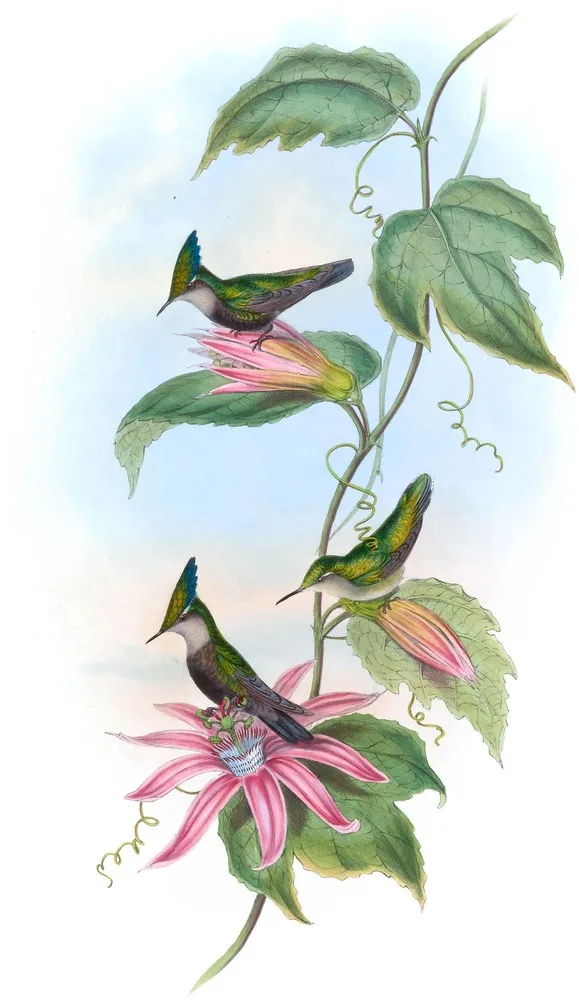
Orthorhynchus ornatus
Orthorhynchus ornatus
Green and Blue Crest
Ten ways of seeing
- upright 1.73 : 1
First Look
六法者何?一、气韵生动是也;二、骨法用笔是也;三、应物象形是也;四、随类赋彩是也;五、经营位置是也;六、传移模写是也。
—— 南齐·谢赫《古画品录》
The six laws: spirit resonance alive; bone-method in the brush; matching form; colour by kind; planning the placing; copying the masters.
The sheet is vertical: the eye climbs and settles on the bird. Take the posture before the plumage. Then step in close: watch where colour meets line, and whether the line ever breaks. Third, find the darkest small patch: the whole tonal order is measured from there.
Name and Thing
The binomial is Orthorhynchus ornatus: the first word is the genus it belongs among, the second the epithet that sets it apart. Two words carry a whole provenance. No established Chinese name exists, so it is cited by its binomial alone.
Form and Colour
The smallest of birds: a needle-fine bill, a forked tubular tongue, wings beating so fast the bird hovers and even flies backwards. Its colour is not pigment but structure — light bent by feather barbules, changing with the angle.No colour group is recorded. Three things fix the habit: leaf arrangement, tepal count, and how the flower is borne.
Composition
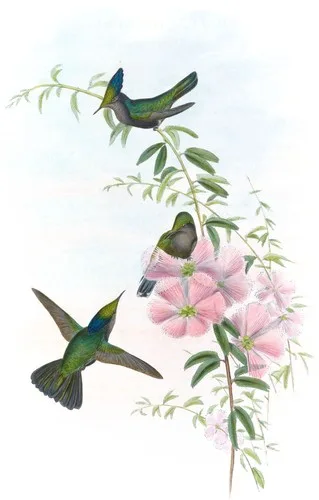
Tall and narrow, the bird perched mid-branch with generous margins above and below. No details are appended: a plate for looking, not for keying out. Old plates set the plant slightly off centre, with unequal margins — that small imbalance is what keeps it alive.
Line and Colour
In the later nineteenth century chromolithography took over: colour printed rather than painted, line demoted. There is evidence on the back too: the plate mark pressed into the paper, the slight relief of the pigment, lines worn shallow in a later printing. If you mean to copy it: block in the broad shapes and colours first, detail last; lithographic softness comes from thin washes — two or three pale layers will get you close.
Poetic Resonance
夫列子御风而行,泠然善也,旬有五日而后反。
—— 《庄子·逍遥游》
Liezi rode the wind and came back after fifteen days, so light was his going.
The poem gives the mood first and the picture supplies the form; set the line beside the plate and the bird itself becomes its resting point.
Symbolism
For the Aztecs the hummingbird was warrior and sun; for Victorian Europe it was the ultimate ornament, millions killed for breast jewellery. China has no tradition here — and that blank is itself a history of exchange. In a flora it is a species first and a symbol second; the order is worth keeping.
Season and Place
In tropical America they are present all year, their season set by flowers. the name arrives with late-Qing travel writing. The year 1854 on the plate is that of publication, not of flowering — the gathering came a year or two earlier. The bud and the ripe fruit on one branch tell the season; the name in the title often tells the journey.
The Book and the Hand
“Gould's Hummingbirds” carries only John Gould's name. The image is public domain; the hand-colouring is still one person's hand.
What to Take Away
Carry three rules away: whole before detail; line before colour; picture before book. A flora exists to be consulted; look long enough and you forget to consult — someone in 1854 gave a whole day to a single flower.
About this plate
One of the Windward Islands ; but which of them, is unknown
Independently of examples of Orthorynchus cristatus and O. exilis, specimens of a third species somewhat intermediate in the form and colouring of the crest have for many years been contained in the Loddigesian collection at Hackney, and in my own; but from which of the West India Islands they were sent, is unknown.
For this bird I propose the name of O. ornatus. Its crest is longer than that of either of its allies, and the point, and point only, is blue; whereas in the O. cristatus the blue and green colouring is nearly equally divided, and in O. exilis the crest is wholly green. In the colouring of their bodies the three species are very similar. This is the bird alluded to in my account of O. exilis as being intermediate between that species and O. cristatus.
The following remark and description have already appeared in the Introduction, but I cannot perhaps do better than reproduce them here.
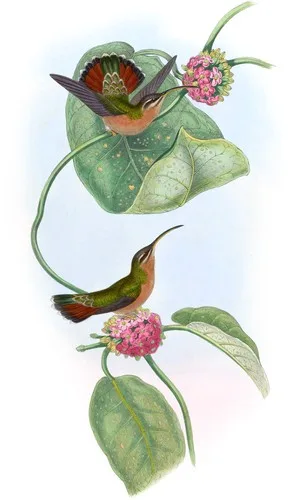
This species bears a general resemblance to the O. cristatus, but differs from that bird in being of a somewhat smaller size, and in having the basal two-thirds of the crest glittering green and the tip only blue; the crest is also longer and more elegant in form than that of O. cristatus or O. exilis. With the latter it can never be confounded, while the former may always be distinguished from it by the truncate form of the green portion of its crest. It is just possible that the birds represented on the 31st and 32nd plates of Lesson’s ‘Histoire Naturelle des Oiseaux-mouches’ may have reference to this bird.
Basal two-thirds of the crest green, the apical third blue; upper surface deep grass-green; throat dark smoky grey, becoming much darker on the abdomen; flanks glossed with green; wings and tail purplish black; bill black.
Total length 3
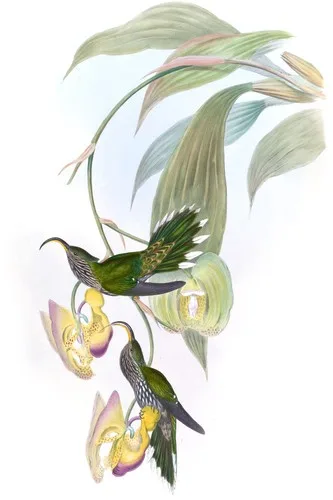
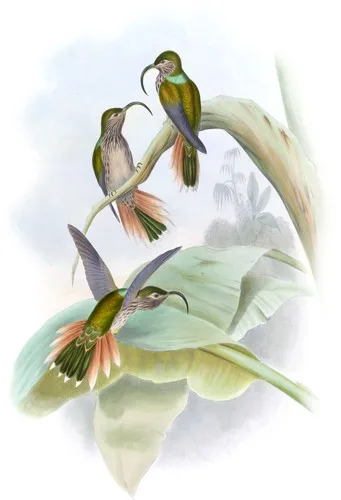
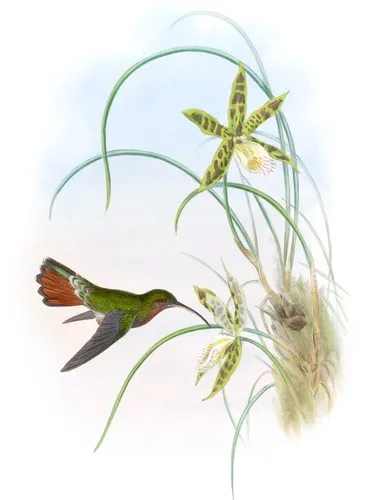
The figures are of the natural size. The plant is the Tacsonia sanguinea.
References
- L’Oiseau-mouche huppé, Less. Hist. Nat. des Ois.-Mou., p. 113. pls. 31, 32?