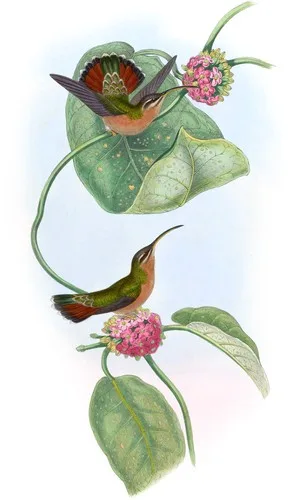
Orthorhynchus christatus
Orthorhynchus christatus
Blue-Crest
Ten ways of seeing
- upright 1.57 : 1
First Look
凡画山水,意在笔先。
—— 唐·王维《山水论》
In painting, the intention precedes the brush.
The sheet is vertical: the eye climbs and settles on the bird. Take the posture before the plumage. Then step in close: watch where colour meets line, and whether the line ever breaks. Third, find the darkest small patch: the whole tonal order is measured from there.
Name and Thing
The binomial is Orthorhynchus christatus: the first word is the genus it belongs among, the second the epithet that sets it apart. Two words carry a whole provenance. No established Chinese name exists, so it is cited by its binomial alone.
Form and Colour
The smallest of birds: a needle-fine bill, a forked tubular tongue, wings beating so fast the bird hovers and even flies backwards. Its colour is not pigment but structure — light bent by feather barbules, changing with the angle.No colour group is recorded. A single plant, laid out with nothing hidden.
Composition
Tall and narrow, the bird perched mid-branch with generous margins above and below. No details are appended: a plate for looking, not for keying out. Blank paper is not unfinished work: it is where the eye rests.
Line and Colour
In the later nineteenth century chromolithography took over: colour printed rather than painted, line demoted. There is evidence on the back too: the plate mark pressed into the paper, the slight relief of the pigment, lines worn shallow in a later printing. If you mean to copy it: block in the broad shapes and colours first, detail last; lithographic softness comes from thin washes — two or three pale layers will get you close.
Poetic Resonance
夫列子御风而行,泠然善也,旬有五日而后反。
—— 《庄子·逍遥游》
Liezi rode the wind and came back after fifteen days, so light was his going.
The poem gives the mood first and the picture supplies the form; set the line beside the plate and the bird itself becomes its resting point.
Symbolism
For the Aztecs the hummingbird was warrior and sun; for Victorian Europe it was the ultimate ornament, millions killed for breast jewellery. China has no tradition here — and that blank is itself a history of exchange. Flower language was added later; the flower knows nothing of it, and that innocence is part of its power.
Season and Place
In tropical America they are present all year, their season set by flowers. the name arrives with late-Qing travel writing. The year 1854 on the plate is that of publication, not of flowering — the gathering came a year or two earlier. The bud and the ripe fruit on one branch tell the season; the name in the title often tells the journey.
The Book and the Hand
“Gould's Hummingbirds” carries only John Gould's name. The image is public domain; the hand-colouring is still one person's hand.
What to Take Away
Next time you watch a bird: posture first, then where the plumage is deepest, and only then the field guide. The flower of that year is dust, yet its image on paper has outlived every living cousin.
About this plate
Barbadoes, and St. Vincent
It will have been noticed, while perusing the pages of the present work, that many species of Hummingbirds are confined to very small areas of country, some to the cones of lofty mountains, and some to the craters of extinct volcanos, while others are migratory, and extend their range over vast regions.
A similar law appears to govern some at least of the species inhabiting the West Indian Islands: for instance, two species are found in Jamaica, which up to the present time have not been detected in St. Domingo; on the other hand, of the St. Domingo species two at least are not found in Jamaica: and not only does this law appear to prevail on those two islands alone, the largest of the West Indian group, but to extend to the smaller islands also, most of them being inhabited by a species peculiarly its own; hence it becomes a matter of much interest to ascertain to which of the islands the numerous species of the West Indian Humming-birds really belong. I am aware that in making the above remarks I am digressing from the more immediate subject of the present paper—the history of Orthorhynchus cristatus; but I have done so intentionally, in order to point out the utter confusion which exists with regard to the localities given by the older authors, whose errors, I regret to say, have been perpetuated by most of the more recent writers on the Trochilidæ; thus, one and all of them give St. Domingo as the habitat of the present bird, while, so far as I have been able to ascertain, it is not found within hundreds of miles of that island; and, although I am unable to give the extent of its range, or how many of the islands it frequents, I can positively state that it is a native of Barbadoes, and I believe of St. Vincent’s also. In Martinique its place appears to be occupied by a nearly allied species—the Orthorhynchus exilis. A complete survey of the Windward and Leeward Islands, furnishing an account of the fauna of each, by some competent person, would, in a scientific point of view, be attended with the most interesting results; and I trust the time is not far distant when such a task will be undertaken and accomplished. Up to the present time, numerous examples of this bird, its nest and eggs, have been sent to Europe, but hitherto not one word has been recorded respecting its peculiar actions and habits; an account of which would doubtless prove highly interesting, as they probably differ as much from those of the members of the group as the bird does in its form and colouring.
As is very commonly the case among the Trochilide, the sexes present a marked difference in appearance, the beautiful crest which adorns the male being entirely wanting in the opposite sex.
Sir Robert Schomburgk found this bird in Barbadoes, and specimens collected by him are contained in the Collection at the British Museum. As will be seen on reference to his “History of Barbadoes,” it is the only Humming-bird observed by him in that island.
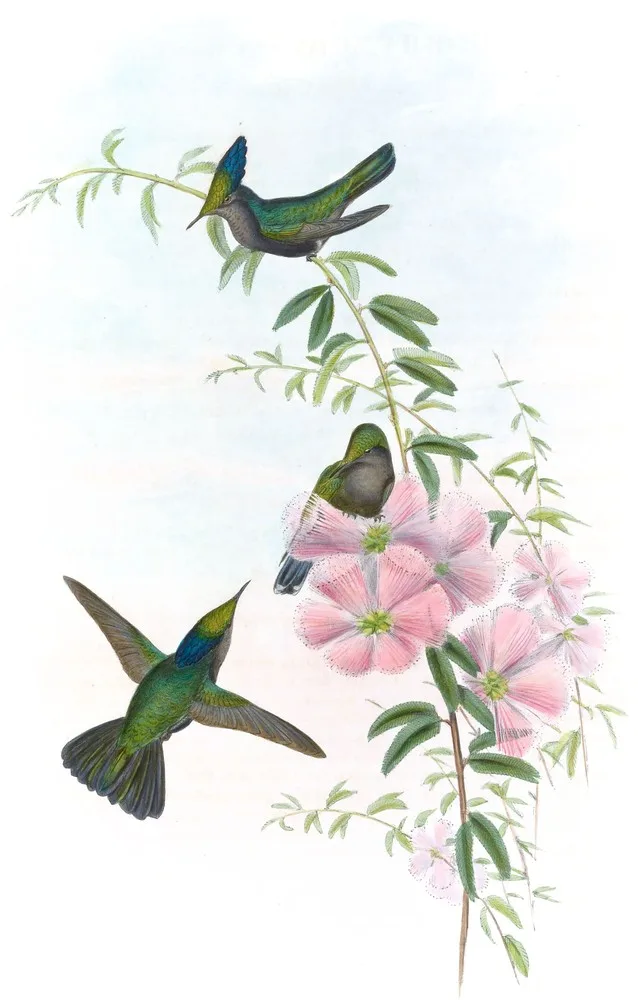
The male has the forehead and crown rich golden-green, blending into the rich deep blue of the elongated crest-feathers; sides and back of the head, upper surface of the body, wing- and tail-coverts dark grassgreen; wings purplish-brown; two centre tail-feathers dark purplish-green, the remainder purplish-black; under surface dull black, with a wash of grey on the throat; bill and feet blackish-brown.
The female has the head, all the upper surface, wing- and tail-coverts bronzy-green; wings purplishbrown; central tail-feathers dark bronzy-green, the remainder purplish-black, the two outer on each side slightly tipped with grey; under surface dark smoky-grey, somewhat lighter on the throat.
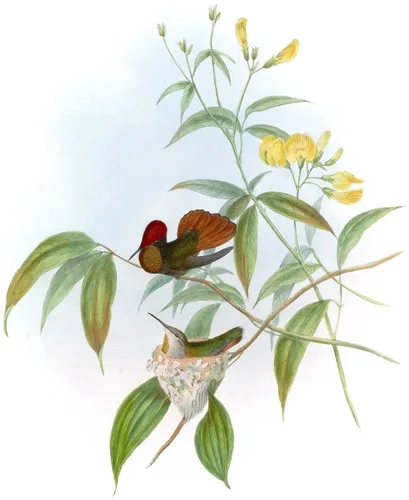
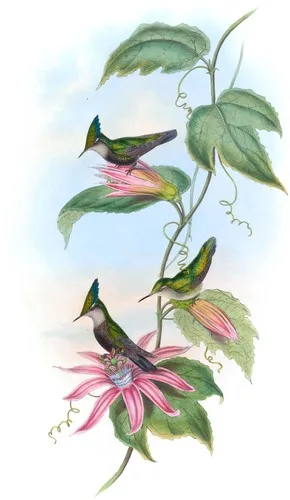
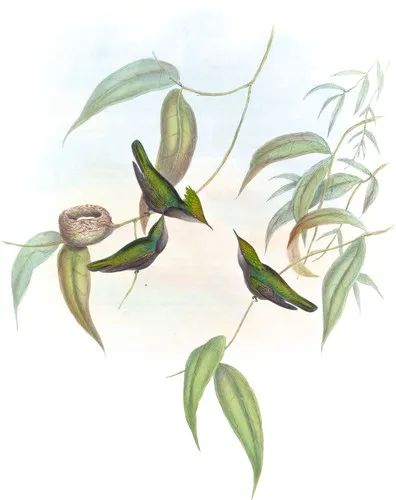
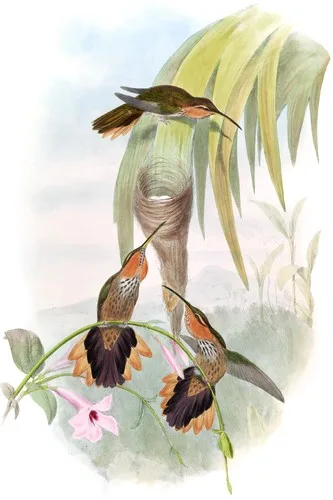
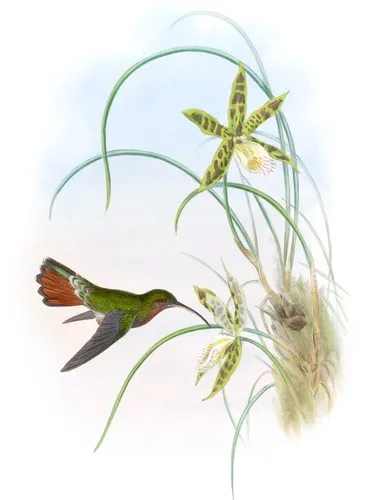
The accompanying Plate represents two males and a female, of the size of life. The plant is the Calliandra brevipes.
References
- Trochilus cristatus, Linn. Syst. Nat., tom. i. p. 192.—Ib. Gmel. Edit., tom. i. p. 498.—Lath. Ind. Orn., tom. i. p. 317.—Swains. Birds of Brazil, pl. 21.—Vieill. Ency. Méth. Orn., part 2. p. 565. pl. 131. fig. 3.—Schomb. Hist. of Barbadoes, p. 681.
- Mellisuga cristata, Briss. Orn., tom. iii. p. 714. pl. xxxvii. fig. 2.—Id. 8vo, tom. ii. p. 35.—Gray and Mitch. Gen. of Birds, vol. i. p. 1138, Mellisuga, sp. 98.
- L’Oiseau-mouche huppé, Buff. Hist. Nat. des Ois., tom. vi. p. 22.—Ib. Sonn. Edit., tom. xvii. p. 173.
- L'Oiseau-mouche huppé de Cayenne, Buff. Pl. Enl. 227. fig. 1.
- Crested Humming-bird, Edw. Nat. Hist. of Birds, vol. i. p. 37. pl. 37.
- Crested Green Humming-bird, Lath. Gen. Syn., vol. ti. p. 783.—Shaw, Gen. Zool., vol. viii. p. 352. pl. 44.—Lath. Gen. Hist., vol. iv. p. 339.
- Orthorhynchus cristatus, Bonap. Consp. Gen. Av., p. 83, Orthorhynchus, sp. 1—Reichenb. Aufz. der Colibris, p. 11.—Bonap. Rev. et Mag. de Zool. 1854, p. 256.
- Ornismya cristata, Less. Les Troch., p. 20. pl. 4.—Ib. Traité d’Orn., p. 285.—Ib. Ind. Gen. et Syn. des Ois. du Gen. Trochilus, p. xxx.
- Trochilus pileatus, Lath. Ind. Orn., vol. i. p. 318.
- Trochilus puniceus, Gmel. Edit. Linn. Syst. Nat., tom. i. p. 497.
- L’Oiseau-mouche à huppé bleue, Aud. et Vieill. Ois. dor., tom. i. p. 112. pl. 63.
- Crested Brown Humming-bird, Lath. Gen. Syn., vol. u. p. 784.—Shaw, Gen. Zool., vol. viii. p. 354.—Lath. Gen. Hist., vol. iv. p. 340.