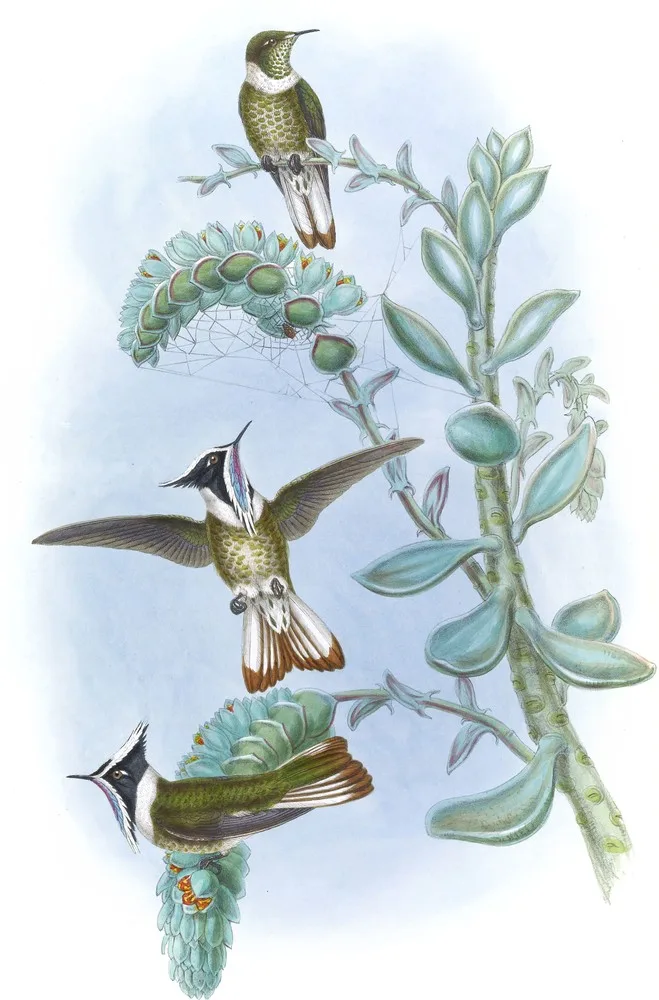
Oxypogon cyanolæmus
Oxypogon cyanolæmus
Blue-throated Helmet-crest
Ten ways of seeing
- upright 1.52 : 1
First Look
江馆清秋,晨起看竹,烟光日影露气,皆浮动于疏枝密叶之间。
—— 清·郑板桥《题画竹》
On an autumn morning at the river lodge I looked at the bamboo: mist, sunlight, dew, all drifting among the sparse and dense leaves.
The sheet is vertical: the eye climbs and settles on the bird. Take the posture before the plumage. Then step in close: watch where colour meets line, and whether the line ever breaks. Third, find the darkest small patch: the whole tonal order is measured from there.
Name and Thing
Only the genus Oxypogon is given; species-level names came later. No established Chinese name exists, so it is cited by its binomial alone.
Form and Colour
The smallest of birds: a needle-fine bill, a forked tubular tongue, wings beating so fast the bird hovers and even flies backwards. Its colour is not pigment but structure — light bent by feather barbules, changing with the angle.No colour group is recorded. Three things fix the habit: leaf arrangement, tepal count, and how the flower is borne.
Composition
Tall and narrow, the bird perched mid-branch with generous margins above and below. No details are appended: a plate for looking, not for keying out. Blank paper is not unfinished work: it is where the eye rests.
Line and Colour
In the later nineteenth century chromolithography took over: colour printed rather than painted, line demoted. There is evidence on the back too: the plate mark pressed into the paper, the slight relief of the pigment, lines worn shallow in a later printing. If you mean to copy it: block in the broad shapes and colours first, detail last; lithographic softness comes from thin washes — two or three pale layers will get you close.
Poetic Resonance
夫列子御风而行,泠然善也,旬有五日而后反。
—— 《庄子·逍遥游》
Liezi rode the wind and came back after fifteen days, so light was his going.
The poem gives the mood first and the picture supplies the form; set the line beside the plate and the bird itself becomes its resting point.
Symbolism
For the Aztecs the hummingbird was warrior and sun; for Victorian Europe it was the ultimate ornament, millions killed for breast jewellery. China has no tradition here — and that blank is itself a history of exchange. Flower language was added later; the flower knows nothing of it, and that innocence is part of its power.
Season and Place
temperate hummingbirds follow the bloom north and back, thousands of kilometres a year. the name arrives with late-Qing travel writing. The year 1887 on the plate is that of publication, not of flowering — the gathering came a year or two earlier. Much of what that generation knew of such birds came from specimens and cages; read locality and season both as hearsay.
The Book and the Hand
“Gould's Hummingbirds” carries only John Gould's name. The image is public domain; the hand-colouring is still one person's hand.
What to Take Away
Appreciation is not knowledge but habit — one more look each time. The flower of that year is dust, yet its image on paper has outlived every living cousin.
About this plate
This may be considered one of the finest of the Humming-birds described since the conclusion of my ‘Monograph,’ and it forms an interesting addition to the genus Oxypogon.
It was found by Mr. Simons on the 18th and 19th of July 1879, on the Sierra Nevada of Santa Marta, in Colombia, at an altitude of from 10,000 to 14,000 feet above the sea.
Messrs. Salvin and Godman remark that the present bird is like Oxypogon guerini, but may be distinguished at a glance by the long plumes of the throat being blue instead of green, and by its having the inner web of the lateral tail-feathers entirely creamy-white except at the tips. They write:—
The species is perfectly distinct from O. guerini of the high mountain-ranges of Colombia, and also from O. lindeni from the high lands of Merida. Besides other differences, the colouring of the middle of the throat at once distinguishes these beautiful birds, that of O. lindeni being white, of O. guerini green, and of our new species blue. In having a large amount of white in the tail, O. cyanolæmus approaches more nearly O. guerini.
The following is a translation of the original description given by Messrs. Salvin and Godman:—
Above dull green, the sides of the neck and the nape white, the whole of the head black, washed with green; an elongated black crest, with a central streak of white, divided into two towards the nostrils; underneath whitish, the middle of the throat ornamented with elongated blue plumes, the sides of the body spotted with dull green; tail bronzy-green, the three outer tail-feathers on each side creamy white excepting the tips and the outer web (the outermost excepted).
The female is similar to the male, but the head uniform with the back, the elongated crest and blue throat being absent; bill and feet black. Total length 4·5 inches, wing 2·7, outer tail-feather 3·2, centre tail-feather 2·9, bill from gape 0·6.
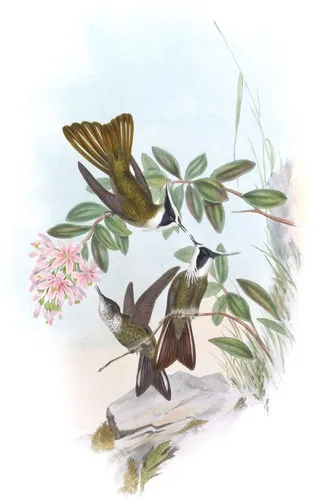
The figures in the Plate are drawn from the typical specimens lent to me by Messrs. Salvin and Godman, and represent two adult males and a female.
References
- Oxypogon cyanolæmus, O. Salvin & F. D. Godman, Ibis, 1880, p. 172, pl. iv. fig. 2.