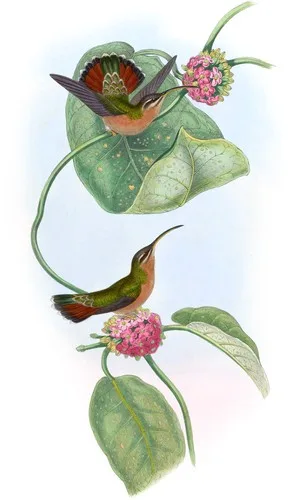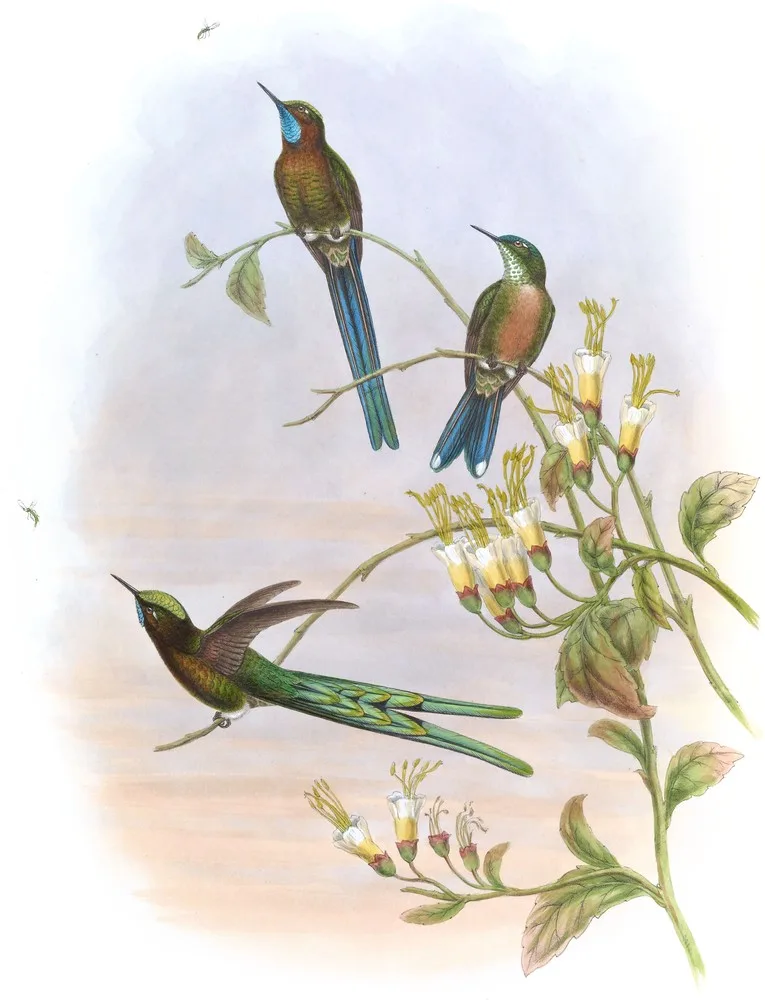
Cynanthus bolivianus
阔嘴蜂鸟属
Cynanthus bolivianus
Bolivian Sylph
Ten ways of seeing
- upright 1.31 : 1
First Look
搜尽奇峰打草稿。
—— 清·石涛《苦瓜和尚画语录》
Exhaust the strange peaks, and then make the sketch.
The sheet is vertical: the eye climbs and settles on the bird. Take the posture before the plumage. Then step in close: watch where colour meets line, and whether the line ever breaks. Third, find the darkest small patch: the whole tonal order is measured from there.
Name and Thing
The binomial is Cynanthus bolivianus: the first word is the genus it belongs among, the second the epithet that sets it apart. Two words carry a whole provenance. The Chinese name 阔嘴蜂鸟属 is a modern rendering of the Latin, not an old garden name.
Form and Colour
The smallest of birds: a needle-fine bill, a forked tubular tongue, wings beating so fast the bird hovers and even flies backwards. Its colour is not pigment but structure — light bent by feather barbules, changing with the angle.No colour group is recorded. Read the outline, then the colour layers, then the brush.
Composition
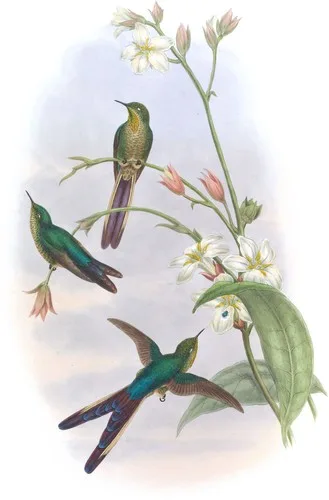
Tall and narrow, the bird perched mid-branch with generous margins above and below. No details are appended: a plate for looking, not for keying out. Cover the margins with your thumb and the plate suffocates; uncover them and the flower breathes again.
Line and Colour
In the later nineteenth century chromolithography took over: colour printed rather than painted, line demoted. Decide first whether it was printed or painted; only then discuss whether it is beautiful. If you mean to copy it: block in the broad shapes and colours first, detail last; lithographic softness comes from thin washes — two or three pale layers will get you close.
Poetic Resonance
穿花蛱蝶深深见,点水蜻蜓款款飞。
—— 唐·杜甫《曲江二首》
Butterflies thread the flowers, seen deep within; dragonflies touch the water and fly on, slow and deliberate.
The poem gives the mood first and the picture supplies the form; set the line beside the plate and the bird itself becomes its resting point.
Symbolism
For the Aztecs the hummingbird was warrior and sun; for Victorian Europe it was the ultimate ornament, millions killed for breast jewellery. China has no tradition here — and that blank is itself a history of exchange. Flower language was added later; the flower knows nothing of it, and that innocence is part of its power.
Season and Place
In tropical America they are present all year, their season set by flowers. Americas only, from southern Alaska to Tierra del Fuego, richest in the Andes. China has no hummingbirds and no classical record of them. The year 1887 on the plate is that of publication, not of flowering — the gathering came a year or two earlier. The bud and the ripe fruit on one branch tell the season; the name in the title often tells the journey.
The Book and the Hand
“Gould's Hummingbirds” carries only John Gould's name. A plate is collective work: drawer, engraver and colourist were different hands, and the unnamed ones decided how good it looks.
What to Take Away
Next time you watch a bird: posture first, then where the plumage is deepest, and only then the field guide. Two centuries on, the plant may still flower in some garden; the one on this sheet stopped in the season of 1887.
About this plate
All the species of this genus inhabit the high lands of tropical districts, such as the temperate regions of Columbia, Ecuador, Peru, and Bolivia.
These flying gems neither ascend to the summit of the mountains nor descend to the hot plains below, but keep to the hills and secluded valleys. In such situations vegetation reigns supreme, and insect life, both in genera and species, is lavishly bestowed.
The present species, according to Mr. Buckley, goes further south than any other of the Sylphs. It is a bird (delicate as it may appear) which braves the cold of the mountains—so severe, in fact, that it was with difficulty he succeeded in procuring specimens. He obtained, however, examples of both sexes in fine condition, these birds having just completed their moult. Mr. Buckley, about five years ago, offered me the green-tailed Sylphs which he had collected in Bolivia, and I was pleased to find in them a species I had not met with before.
I described the bird, therefore, in the ‘Annals of Natural History’ for June 1880, and I have no doubt that the species will be found to be a perfectly distinct one. The following is the description which I contributed to the ‘Annals’:—
Mr. Clarence Buckley, who has distinguished himself by his zoological researches in South America, passed, as is well known, some considerable time in Bolivia some few years ago. On his return to this country I became the fortunate possessor of many of his specimens of Humming-birds; but, owing to the illness which has afflicted me for a considerable time, I have not been able, till lately, to incorporate Mr. Buckley’s specimens in my collection of Trochilidæ. Having now been able to examine my series more closely, I have come to the conclusion that two species, at least, are new to science.
Cynanthus bolivianus, sp. n.—Similar to C. mocoa from Ecuador, but much smaller and of a brighter metallic green, and with the tail more of a brilliant steel-blue than a vivid green. Total length 6·3 inches, culmen 0·7, wing 2·6, tail 4·1, tarsus 0·2.
I possess several males of this new species, as well as of the allied C. mocoa; so that it is not without ample material before me that I describe the Bolivian bird as new to science.
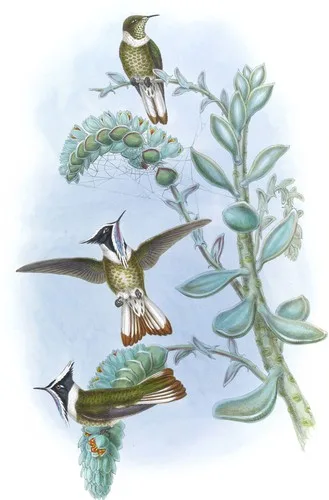
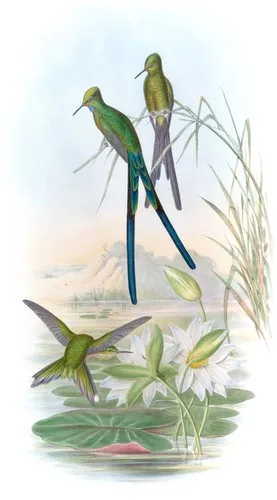
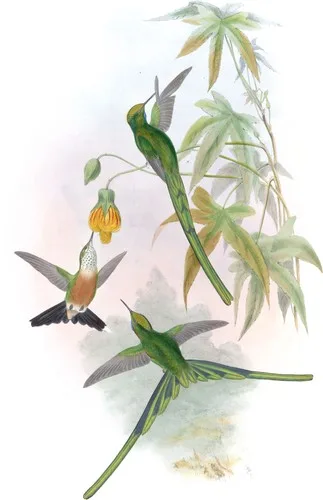
The Plate represents two males and one female.
References
- Cynanthus bolivianus, Gould, Annals of Nat. Hist., vol. v., June 1880.