Petasophora cyanotis
Petasophora cyanotis
Little Violet-Ear
About this plate
New Granada and Venezuela
Compared with P. Anais and P. Iolata this is a small species, and it may, moreover, be distinguished from these, as well as all the other upland members of the genus, by the total absence of blue colouring on the chin and abdomen; I believe the bird figured by Lesson on the 57th plate of his “Hist. Nat. des Trochilidées” to be identical with the one here represented, and not, as he states it to be, the female of P. Anais.
The P. cyanotis enjoys a wide range over the Andes, extending from Ecuador throughout Columbia northward to Veragua and Costa Rica, from all of which countries I possess examples. Mr. Dyson collected numerous specimens in the Caraccas, and M. Warszewicz has sent others in all the collections made by him in Peru. In all these countries it inhabits the temperate and warmer regions, wherever flowers and insect life abound. The usual diversity of size occurs in this as in the other members of the genus, the female being very much smaller than the male. A rich golden tint prevails in some specimens, while others are dark glossy green. Some individuals, particularly those brought by M. De Lattre, are so much smaller than those from Bogota and other districts, as to induce the opinion that they may be distinct; but this is a point which can only be determined when we have had opportunities for more accurate investigation of the subject than are at present afforded us.
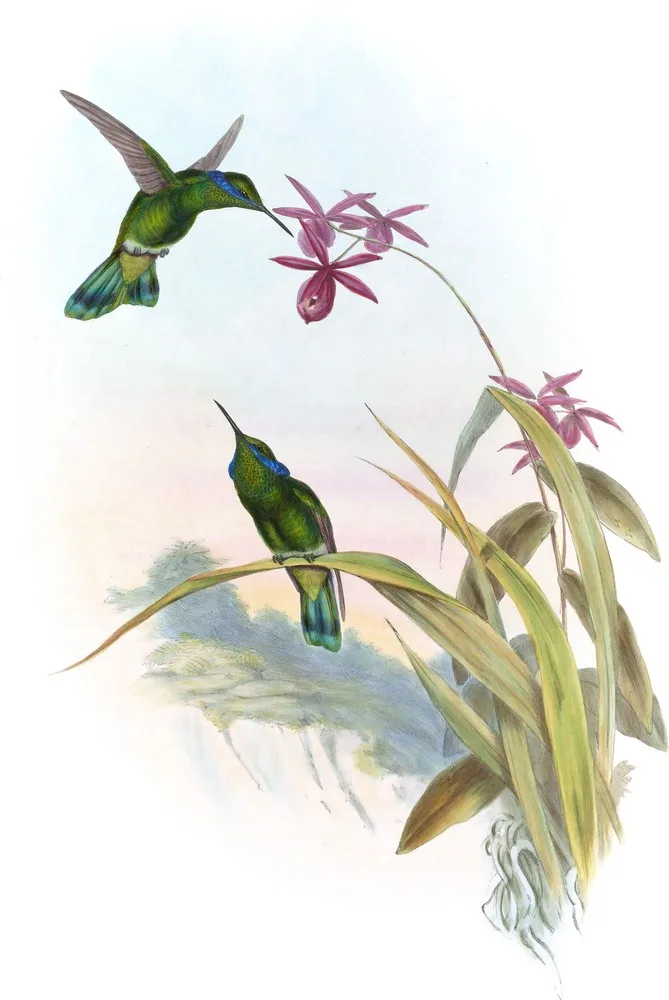
In most specimens the head, upper surface and wing-coverts, abdomen and flanks are dark bronzy green, while others have the same parts of a nearly uniform dark shining grass-green; line under the eye and earcoverts rich purplish blue; wings purplish brown; tail dark shining green, crossed near the tip by a broad chalybeate band and the two central feathers washed with bronze; chin, throat and breast luminous tessellated green, as in the other species, but not quite so brilliant in some examples as in others; the hue too varies, being pure green in some and of a golden green in others; under tail-coverts buff, washed with green in the centre; bill black; feet blackish brown.
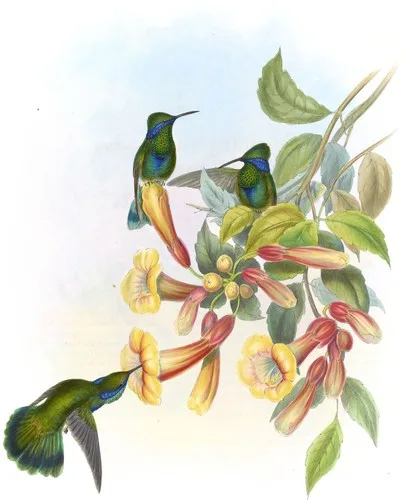
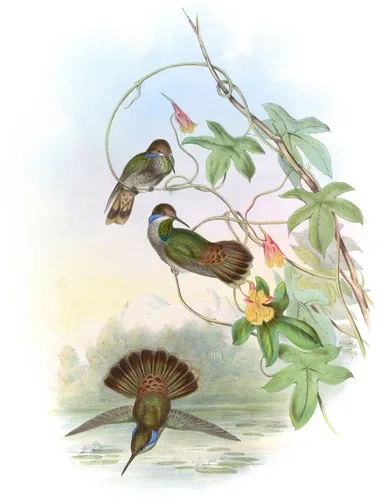
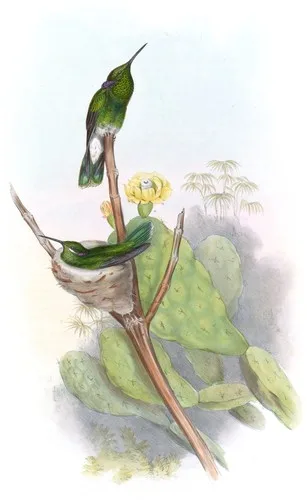
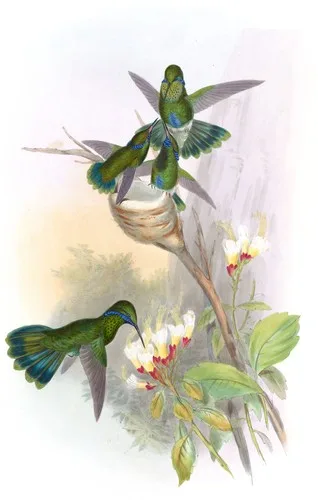
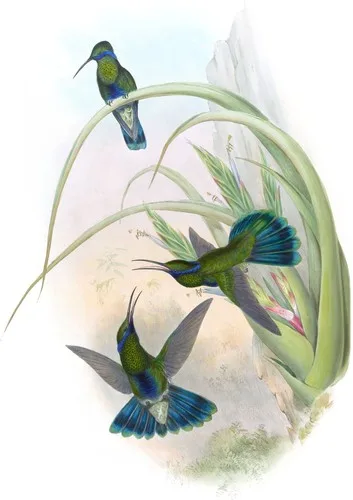
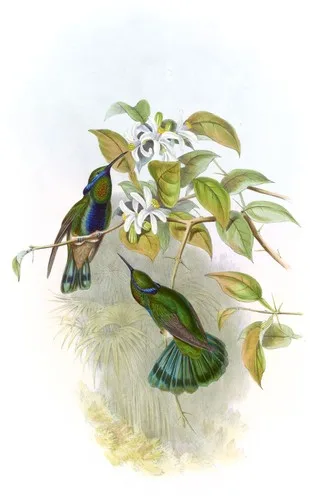
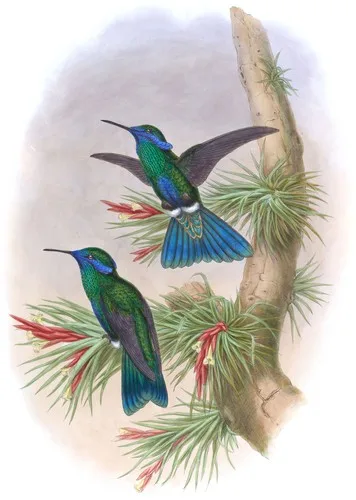
The Plate represents a male and a female of the natural size; the plant is the Barkeria Lindleyana.
References
- Trochilus cyanotus, Bourc. Rev. Zool. 18438, p. 101.—Ib. Ann. Sci. et Phys. de Lyons, tom. vi. p. 41.
- Petasophora cyanotus, Gould in Proce. of Zool. Soc., Part xv. p. 8.
- Polytmus cyanotus, Gray and Mitch. Gen. of Birds, vol. i. p. 108, Polytmus, sp. 25.
- Colibri cyanotus, Bonap. Consp. Gen. Av., p. 69, Colibri, sp. 1.
- Ormsmya Anais, Less. Hist. Nat. des Troch., p. 151. pl. 57?
Twelve ways of seeing
- upright 1.49 : 1
- published 1854
- Pl. 228, Vol. IV
Not a catalogue entry but a way of looking: how to stand, what to notice, how the line was cut, when it flowers, where it came from, who made it — and then the poems and the classics that taught China to see the same flower. Read the twelve in order and the plate opens.
-
First Look
夫象物必在于形似,形似须全其骨气。
—— 唐·张彦远《历代名画记》
Likeness is the threshold; bone-and-breath is the point.
The sheet is vertical: the eye climbs and settles on the bird. Take the posture before the plumage. Then step in close: watch where colour meets line, and whether the line ever breaks. Third, find the darkest small patch: the whole tonal order is measured from there.
-
Name and Thing
The binomial is Petasophora cyanotis: the first word is the genus it belongs among, the second the epithet that sets it apart. Two words carry a whole provenance. No established Chinese name exists, so it is cited by its binomial alone.
-
Form and Colour
The smallest of birds: a needle-fine bill, a forked tubular tongue, wings beating so fast the bird hovers and even flies backwards. Its colour is not pigment but structure — light bent by feather barbules, changing with the angle.No colour group is recorded. A single plant, laid out with nothing hidden.
-
Composition
Tall and narrow, the bird perched mid-branch with generous margins above and below. (about 1.49 : 1) No details are appended: a plate for looking, not for keying out. Blank paper is not unfinished work: it is where the eye rests.
-
Line and Colour
In the later nineteenth century chromolithography took over: colour printed rather than painted, line demoted. Decide first whether it was printed or painted; only then discuss whether it is beautiful.
-
Season
In tropical America they are present all year, their season set by flowers; temperate hummingbirds follow the bloom north and back, thousands of kilometres a year. The year 1854 on the plate is that of publication, not of flowering — the gathering came a year or two earlier. Note the season. Phenology is the most practical tool of appreciation.
-
Provenance
Americas only, from southern Alaska to Tierra del Fuego, richest in the Andes. China has no hummingbirds and no classical record of them; the name arrives with late-Qing travel writing. The volume was made in 1849-1887, when most of this knowledge came from living plants under glass.
-
The Book and the Hand
“Gould's Hummingbirds” was drawn by John Gould and published 1849-1887. This plate is Pl. 228, Vol. IV, book page 228. The image is public domain; the hand-colouring is still one person's hand.
-
Poetic Resonance
夫列子御风而行,泠然善也,旬有五日而后反。
—— 《庄子·逍遥游》
Liezi rode the wind and came back after fifteen days, so light was his going.
The poem gives the mood first and the picture supplies the form; set the line beside the plate and the bird itself becomes its resting point.
-
The Written Tradition
宁古无时,宁朴无巧,宁俭无俗。
—— 明·文震亨《长物志》
Better old than fashionable, better plain than clever, better spare than vulgar.
Gould's Hummingbirds (1849–1887) used hand-coloured lithography over gold leaf so the iridescence survived on paper — a monument to Victorian printing and collecting alike. You need not parse every word: take the line, and the flower acquires a second face.
-
Symbolism
For the Aztecs the hummingbird was warrior and sun; for Victorian Europe it was the ultimate ornament, millions killed for breast jewellery. China has no tradition here — and that blank is itself a history of exchange. Flower language was added later; the flower knows nothing of it, and that innocence is part of its power.
-
What to Take Away
Carry three rules away: whole before detail; line before colour; picture before book. Two centuries on, the plant may still flower in some garden; the one on this sheet stopped in the season of 1854.