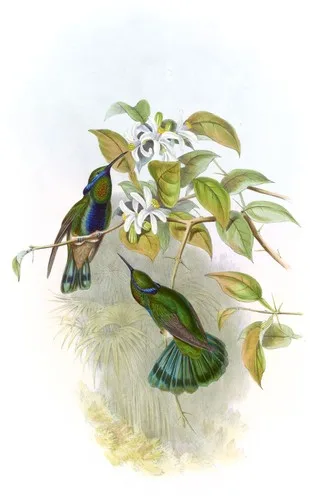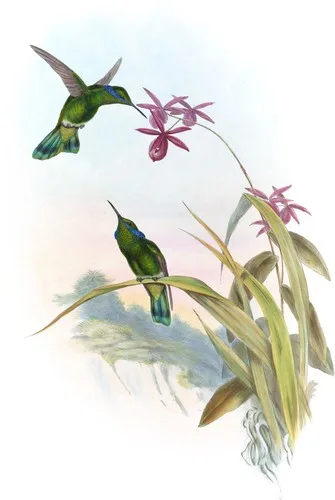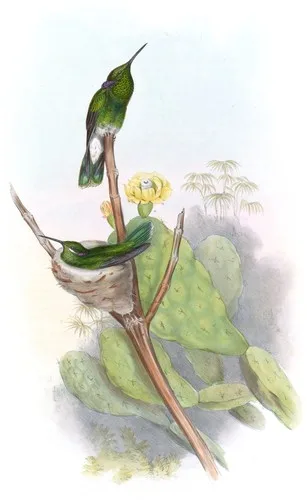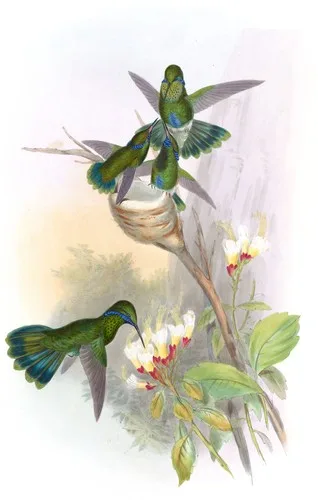
Petasophora thalassina
Petasophora thalassina
Mexican Violet-Ear
Ten ways of seeing
- yellow key
- slightly upright 1.23 : 1
First Look
夫象物必在于形似,形似须全其骨气。
—— 唐·张彦远《历代名画记》
Likeness is the threshold; bone-and-breath is the point.
Slightly taller than wide; the eye lands on the bird's head, a little above centre. Then step in close: watch where colour meets line, and whether the line ever breaks. Third, find where the yellow is deepest: the whole tonal order is measured from that patch.
Name and Thing
The binomial is Petasophora thalassina: the first word is the genus it belongs among, the second the epithet that sets it apart. Two words carry a whole provenance. No established Chinese name exists, so it is cited by its binomial alone.
Form and Colour
The smallest of birds: a needle-fine bill, a forked tubular tongue, wings beating so fast the bird hovers and even flies backwards. Its colour is not pigment but structure — light bent by feather barbules, changing with the angle. Filed under yellow — a honey-yellow. Feather colour is structure, not pigment: light bent by barbules. A single plant, laid out with nothing hidden.
Composition
Slightly taller than wide, the bird set a little above centre, the eye landing at head and bill. No details are appended: a plate for looking, not for keying out. Old plates set the plant slightly off centre, with unequal margins — that small imbalance is what keeps it alive.
Line and Colour
In the later nineteenth century chromolithography took over: colour printed rather than painted, line demoted. Craft leaves franker evidence than inscriptions. If you mean to copy it: block in the broad shapes and colours first, detail last; lithographic softness comes from thin washes — two or three pale layers will get you close.
Poetic Resonance
穿花蛱蝶深深见,点水蜻蜓款款飞。
—— 唐·杜甫《曲江二首》
Butterflies thread the flowers, seen deep within; dragonflies touch the water and fly on, slow and deliberate.
The poem gives the mood first and the picture supplies the form; set the line beside the plate and the yellow the bird itself becomes its resting point.
Symbolism
For the Aztecs the hummingbird was warrior and sun; for Victorian Europe it was the ultimate ornament, millions killed for breast jewellery. China has no tradition here — and that blank is itself a history of exchange. This plate leans yellow, which in flower language adds one more degree of feeling. In a flora it is a species first and a symbol second; the order is worth keeping.
Season and Place
temperate hummingbirds follow the bloom north and back, thousands of kilometres a year. the name arrives with late-Qing travel writing. The year 1854 on the plate is that of publication, not of flowering — the gathering came a year or two earlier. Read the locality and the flowering season both with a discount: one is hearsay, the other a ten-day peak.
The Book and the Hand
“Gould's Hummingbirds” carries only John Gould's name. A plate is collective work: drawer, engraver and colourist were different hands, and the unnamed ones decided how good it looks.
What to Take Away
Carry three rules away: whole before detail; line before colour; picture before book. A flora exists to be consulted; look long enough and you forget to consult — someone in 1854 gave a whole day to a single flower.
About this plate
Mexico and Guatemala
Mexico may claim this species as strictly its own; for although it is found in the States of Guatemala, Costa Rica and Veragua, Mexico proper would seem to be its chief habitat, and it is certainly not found to the southward of the Isthmus of Panama.
It presents a singular combination of characters in its colouring, uniting P. cyanotus with P. Anais, but it is quite distinct from both; the blue mark on the breast at all times distinguishing it from the former, and the almost total absence of the blue mark on the chin, and its smaller size, from the latter. It will be seen that I have thought it likely that two of the birds figured by Lesson, under the name of Anais, are identical with the present species, and indeed I can refer them to no other; at the same time his figures are by no means correct representations.
To Mr. Swainson pertains the credit of characterizing this bird as distinct from all the other species of the family then known, he having assigned to a specimen procured at Temiscaltipec the appellation of thalassinus in his ‘‘ Synopsis of the Birds of Mexico,” published in the “Philosophical Magazine” as long since as June 1827.
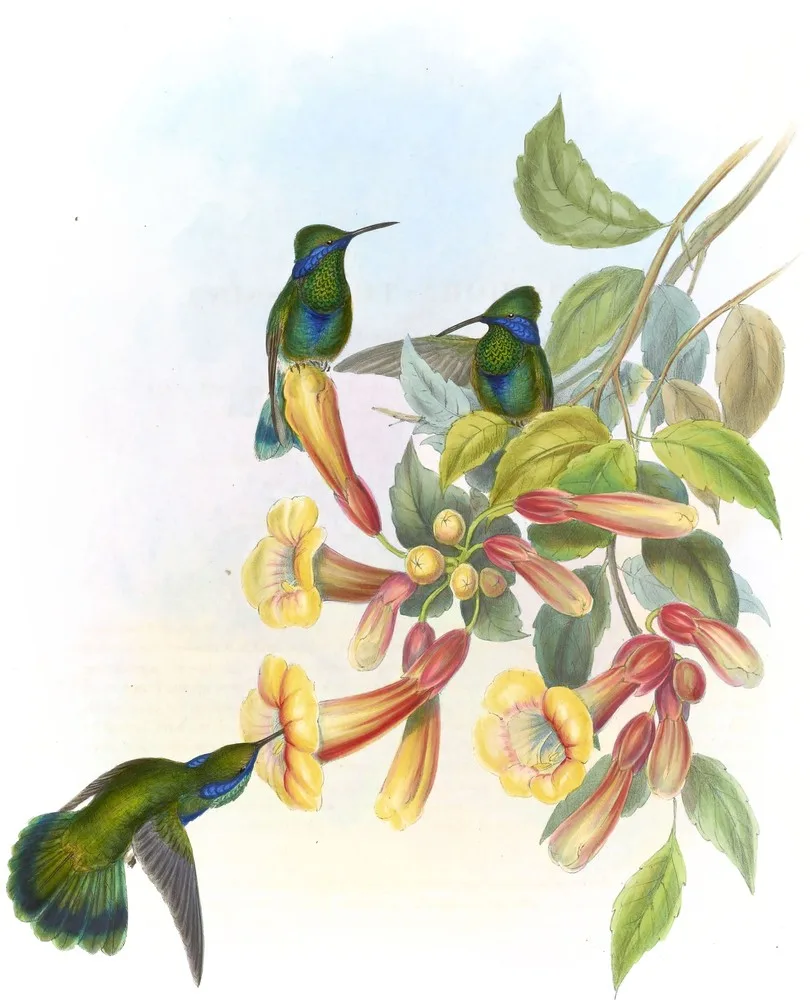
Head, all the upper surface, wing-coverts and flanks yellowish green; a narrow line commencing on the centre of the chin and extending under the eye and the ear-coverts purplish blue; throat and chest tessellated luminous green, as in the other species; centre of the abdomen deep blue; tail deep green, crossed near the tip by a broad chalybeate band; two central feathers slightly washed with bronze; wings purplish brown; bill dull black; feet blackish brown.
The figures are of the natural size, on one of the beautiful Bignonias of the country it inhabits.
References
- Trochilus thalassinus, Swains. Syn. Birds of Mexico in Phil. Mag., June 1827, p. 441.
- Ormsmya Anais, Less. Hist. Nat. des Col., p. 104.—Ib. Supp. des Ois. Mou., pl. 3?
- Ramphodon Anais, Less. Hist. Nat. des Troch., p. 148. pl. 56?
- Polytmus thalassinus, Gray and Mitch. Gen. of Birds, vol. i. p. 108, Polytmus, sp. 26.
- Petasophora thalassinus, Gould in Proce. of Zool. Soc., Part xv. p. 8.
- Colibri thalassinus, Bonap. Consp. Gen. Av., p. 69, Colibri, sp. 2.
- Trochilus Anais, Jard. Nat. Lib. Humming Birds, vol. ii. p. 2?