Saucerottia cyanifrons
青顶蜂鸟
Saucerottia cyanifrons
Blue-capped Saucerottia
Ten ways of seeing
- upright 1.35 : 1
First Look
凡画山水,意在笔先。
—— 唐·王维《山水论》
In painting, the intention precedes the brush.
The sheet is vertical: the eye climbs and settles on the bird. Take the posture before the plumage. Then step in close: watch where colour meets line, and whether the line ever breaks. Third, find the darkest small patch: the whole tonal order is measured from there.
Name and Thing
The binomial is Saucerottia cyanifrons: the first word is the genus it belongs among, the second the epithet that sets it apart. Two words carry a whole provenance. The Chinese name 青顶蜂鸟 is a modern rendering of the Latin, not an old garden name.
Form and Colour
The smallest of birds: a needle-fine bill, a forked tubular tongue, wings beating so fast the bird hovers and even flies backwards. Its colour is not pigment but structure — light bent by feather barbules, changing with the angle.No colour group is recorded. A single plant, laid out with nothing hidden.
Composition
Tall and narrow, the bird perched mid-branch with generous margins above and below. No details are appended: a plate for looking, not for keying out. Old plates set the plant slightly off centre, with unequal margins — that small imbalance is what keeps it alive.
Line and Colour
In the later nineteenth century chromolithography took over: colour printed rather than painted, line demoted. Take a loupe to three places: petal edge, leaf vein, caption. An unbroken line means engraving; colour crossing the outline means a hand. If you mean to copy it: block in the broad shapes and colours first, detail last; lithographic softness comes from thin washes — two or three pale layers will get you close.
Poetic Resonance
穿花蛱蝶深深见,点水蜻蜓款款飞。
—— 唐·杜甫《曲江二首》
Butterflies thread the flowers, seen deep within; dragonflies touch the water and fly on, slow and deliberate.
The poem gives the mood first and the picture supplies the form; set the line beside the plate and the bird itself becomes its resting point.
Symbolism
For the Aztecs the hummingbird was warrior and sun; for Victorian Europe it was the ultimate ornament, millions killed for breast jewellery. China has no tradition here — and that blank is itself a history of exchange. Meanings change their tune: the same flower can say opposite things within a century.
Season and Place
temperate hummingbirds follow the bloom north and back, thousands of kilometres a year. the name arrives with late-Qing travel writing. The year 1861 on the plate is that of publication, not of flowering — the gathering came a year or two earlier. The bud and the ripe fruit on one branch tell the season; the name in the title often tells the journey.
The Book and the Hand
“Gould's Hummingbirds” carries only John Gould's name. From drawing to plate the sheet passed through several hands — the engraver aimed at accuracy, the colourist at speed, and between them lies each plate's unevenness.
What to Take Away
Next time you watch a bird: posture first, then where the plumage is deepest, and only then the field guide. A flora exists to be consulted; look long enough and you forget to consult — someone in 1861 gave a whole day to a single flower.
About this plate
New Granada
On perusing the pages of the present work, it will be seen that ornithologists have occasionally selected the names of individuals celebrated for their scientific attainments to designate some of the many genera into which they have found it necessary to subdivide this great family of birds.
Among these, that of Saucerottia will always stand as the memorial of a gentleman of varied acquirements, and possessing an intimate acquaintance with the Trochilidæ; the selection of his name as a designation for one of these groups is therefore a just and more than usually appropriate tribute.
Although I admit that the present bird is allied to the type of the genus, it nevertheless differs considerably in its colouring, particularly in the rich blue cap which surmounts the head—a character which has not yet been found to exist in any other species of the form. A superficial observer might be inclined to place this bird in some other group—perhaps that of Cyanomyia,—but that would not be its proper situation; its peculiarly formed tail, its broad and rigid under tail-feathers, its white and rather thickly clothed thighs, are characters which naturally indicate its true position.
Every collector, both in this country and on the Continent, is so abundantly supplied with examples of Fis bird, that it would not become rare even were no more killed for the next hundred years. From Bogota it is sent in great numbers; and it is also found in nearly every part of Columbia, wherever regions occur of similar altitude and temperature: M. Bourcier’s typical specimen was obtained at Ybague, in New Grenada. I have not yet seen it from any place to the northward of the Isthmus of Panama.
In ten specimens now lying before me, the colouring of the body is so very similar, that they can scarcely be distinguished the one from the other; but much difference is observable in the intensity of the blue on the crown, varying as it does from a beautiful deep indigo to a greenish blue, and a green but slightly tinged with blue: this latter state may probably be characteristic of the female; if it be not, I am unable to define that sex, but I am pretty certain that it is.
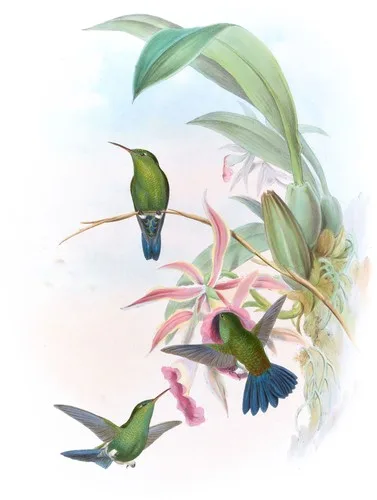
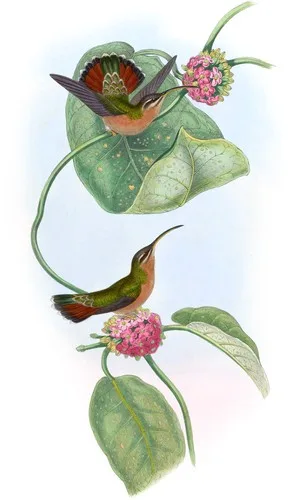
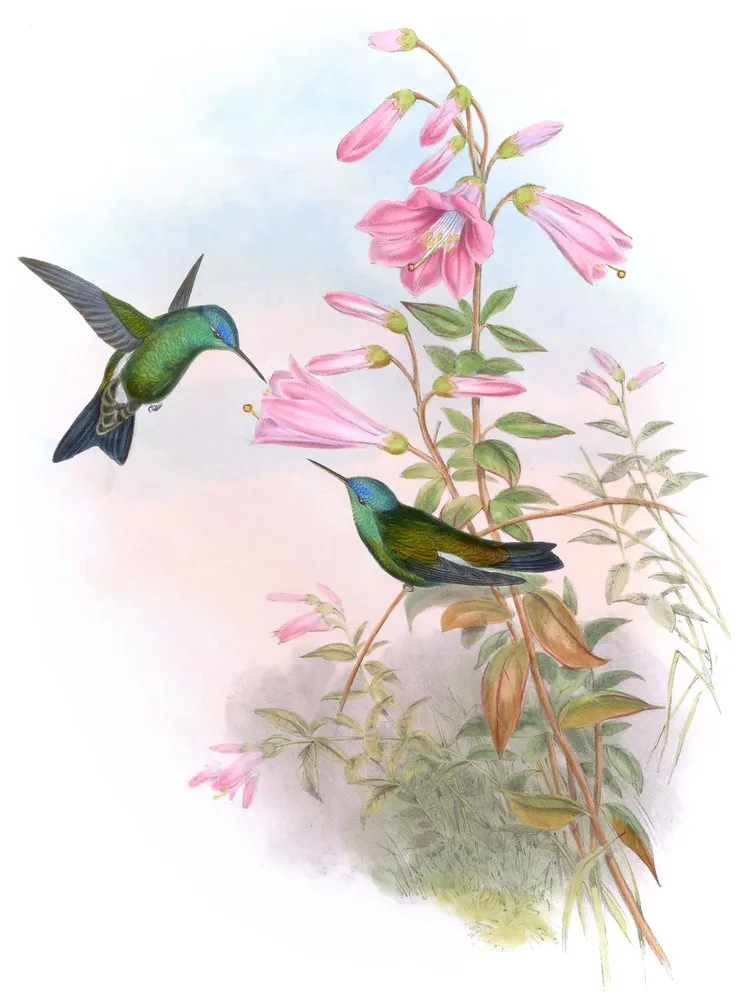
Crown of the head deep blue, varying in different specimens, as above described, to greenish blue and bluish green; upper surface and wing-coverts bronzy green, the bronzy hue predominating on the rump and upper tail-coverts; wings purplish blue; tail very dark purple or bluish black; the whole of the under surface shining grass-green; under tail-coverts purplish olive, fringed with greyish white; upper mandible and tip of the lower black; the remainder of the under mandible either yellowish or flesh-colour.
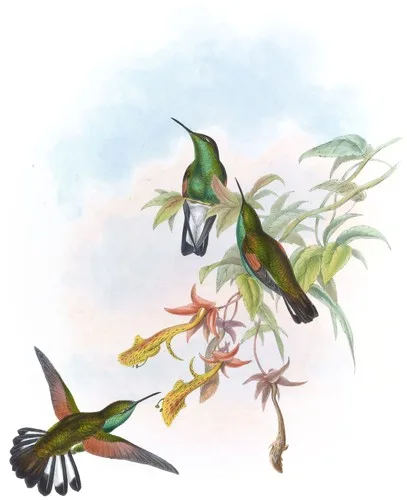
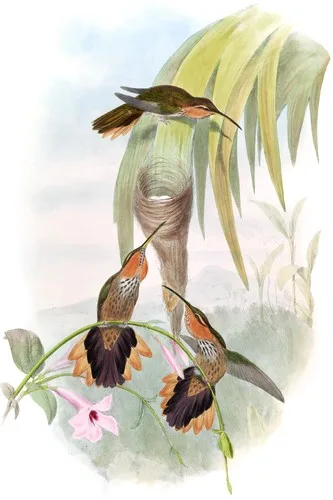
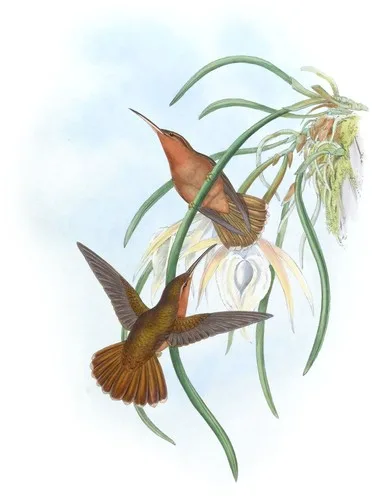
The Plate represents what I believe to be the two sexes, of the natural size. The plant is the Befaria æstuans.
References
- Trochilus cyanifrons, Bourc. Rey. Zool. 1843, p. 100.—Ib. Ann. de la Soc. Sci. de Lyons, 1848, p. 42.
- Polytmus cyanifrons, Gray and Mitch. Gen. of Birds, vol. i. p. 108, Polytmus, sp. 66.
- Thalurania cyanifrons, Bonap. Consp. Gen. Av., p. 77, Thalurania, sp. 8.
- Saucerottia cyanifrons, Bonap. Rev. et Mag. de Zool. 1854, p. 255.—Reichenb. Aufz. der Colibris, p. 8.
- Chlorestes cyanifrons, Reichenb. Troch. enumer., p. 4. pl. dcci. figs. 4571, 4572.