青顶蜂鸟
Saucerottia cyanifrons
Saucerottia cyanifrons
Blue-capped Saucerottia
- 中文名
- 青顶蜂鸟
- 学名
- Saucerottia cyanifrons
- 合集
- 古尔德蜂鸟图谱
- 绘者
- John Gould(约翰·古尔德)
- 年代
- 1861
- 图版号
- Pl. 323, Vol. V
- 原书页码
- p.323
- 授权
- CC0 1.0 Universal (Public domain)
十观
- 纵幅 1.35∶1
第一眼
凡画山水,意在笔先。
—— 唐·王维《山水论》
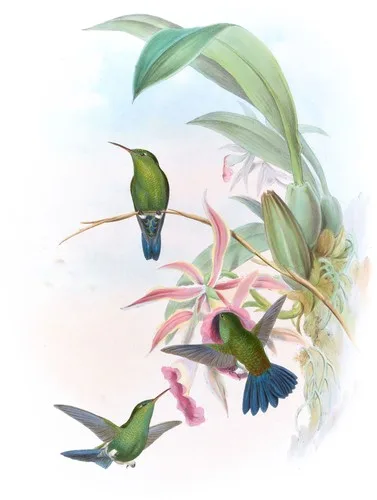
下笔之前,心里已经有了整幅画。看画时可以反过来推:画家先定了什么,后添了什么。这一幅是竖的:眼睛从下往上走,落点在中段那只鸟身上。先别急着看羽毛,让姿态先立起来。第二步凑近一寸:看线与色的交界,色有没有压住线,线有没有断。第三步,把视线放到最深的那一小块:整幅的用色秩序,都是从那里排开的。
名与实
学名 Saucerottia cyanifrons:前一词是属,管它归在哪一类;后一词是种加词,管它在这一类里凭什么与众不同。一百多年前的命名者,把一种植物的来历压进了两个词。中文名“青顶蜂鸟”是后人据学名回译的通行叫法,与古书里的旧名未必对得上——名与物之间,总隔着一层翻译。
形与色
蜂鸟为美洲最小之鸟,喙细长如针,舌分叉成管,可伸入花心吸蜜;翼小而振频极高,能悬停、能倒飞。此幅未作色相归档,只能就形制论。别只看花:叶脉的走向、萼片的长短、甚至茎上的毛,都是画家用来区分物种的证据。
构图与呼吸
画幅高而窄,鸟栖在枝的中段,上下留白多——十九世纪鸟谱的标准版式,留给它飞走的余地。全幅只画一只,不作解剖附图——这类图更近于“观赏”,而非“鉴定”。试着用拇指遮住空白处——画面立刻变闷;放开,它才重新“喘上气”。留白,是给主体让出的气口。
一刀一色
十九世纪后半叶,石版与彩色石印渐成主流:颜色可以直接印出,不再依赖手工,线条反倒退居其次。图像的“准确”提高了,手性却淡了。先判断它是“印”的还是“画”的,再谈好不好看——这是看老版画最实用的一条规矩。想动笔临它的人记住一句:先铺大块的形与色,干后再收细部;石印的柔和层次来自薄涂与网点,水彩分两三遍淡铺即可逼近。
诗境
穿花蛱蝶深深见,点水蜻蜓款款飞。
—— 唐·杜甫《曲江二首》
中土无蜂鸟,然“穿花”之态,杜甫早已写过:贴着花心走,是采蜜者的共同姿态。古人写到这一层,已不只是赏花,是借花说人;画面则只负责把那朵花留住。
花语
阿兹特克以蜂鸟为战神与太阳的化身;欧洲维多利亚时代则以蜂鸟为收藏与装饰的极致,百万只羽毛被做成胸饰。中国旧籍无此鸟,故无象征——这空白本身,就是一部博物学交流史。象征多半来自形状与气味:像杯的、像泪的、香的、臭的——先有形状,后有意义。
时与地
温带种类的蜂鸟则随花北迁,一年往返数千公里。仅产美洲,自阿拉斯加南部至火地岛,以安第斯山最为繁盛。中土无蜂鸟,汉籍不载,晚清海外游记始见其名。图上所记的 1861 年是刊行之年,不是采到那只鸟的年份;真正的观察记录通常比出版早一两年。那一代人对这类鸟的知识,多半来自标本与笼养。看这一类图,不妨把产地和季节都当“据说”来读。
书与人
《古尔德蜂鸟图谱》只署了约翰·古尔德一个人的名字。版画是集体工程:绘图、刻版、上色各有其人,真正决定这幅图好不好看的,常是没留下名字的刻工与上色师。
带走一双眼睛
把这三件事带走:先整体后细节;先线后色;先看画再翻书。任何一张老图版,都可以用这三条读。图谱的用意是“以备查考”,看久了却会忘记查考:1861 年的一个人,为一只鸟花了整整一天。
关于本图版
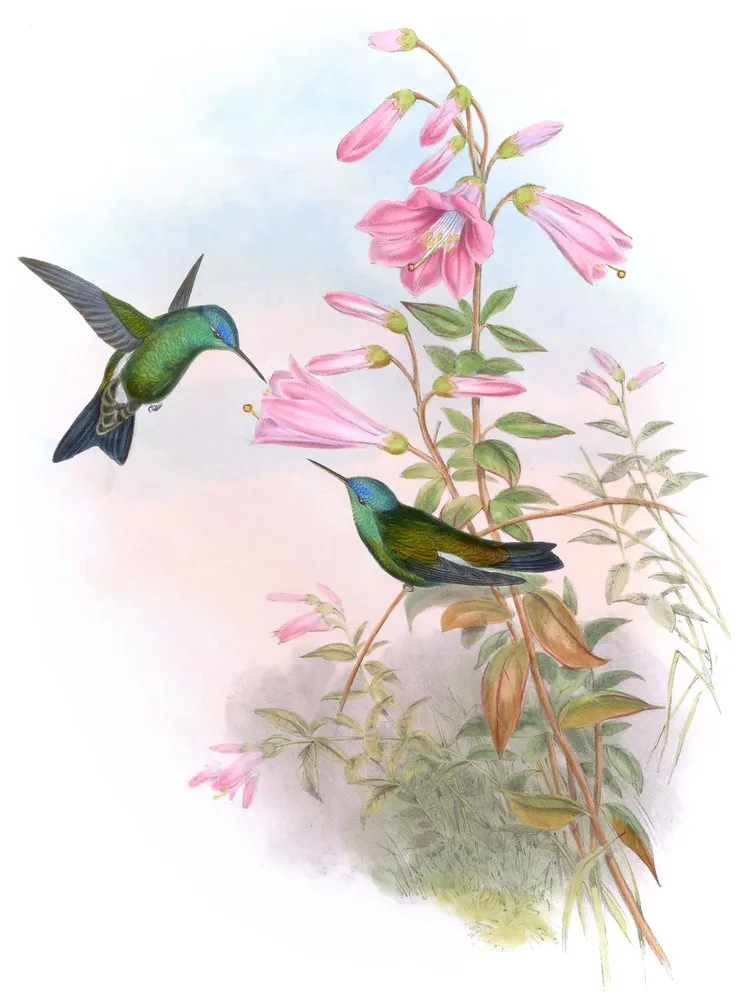
此图原刊于《古尔德蜂鸟图谱》(Gould's Hummingbirds),绘者为约翰·古尔德,成书于 1849—1887 年间。画面主体是青顶蜂鸟(Saucerottia cyanifrons),归入蜂鸟科(Trochilidae)。
全编共收录 421 幅图版,本图是其中一幅,原书将其列为 Pl. 323, Vol. V,见第 323 页,版式为纵幅。图为公有领域原件的修复扫描,构图与设色未经改动。
原书文字(英文 / 法文)
New Granada
On perusing the pages of the present work, it will be seen that ornithologists have occasionally selected the names of individuals celebrated for their scientific attainments to designate some of the many genera into which they have found it necessary to subdivide this great family of birds.
Among these, that of Saucerottia will always stand as the memorial of a gentleman of varied acquirements, and possessing an intimate acquaintance with the Trochilidæ; the selection of his name as a designation for one of these groups is therefore a just and more than usually appropriate tribute.
Although I admit that the present bird is allied to the type of the genus, it nevertheless differs considerably in its colouring, particularly in the rich blue cap which surmounts the head—a character which has not yet been found to exist in any other species of the form. A superficial observer might be inclined to place this bird in some other group—perhaps that of Cyanomyia,—but that would not be its proper situation; its peculiarly formed tail, its broad and rigid under tail-feathers, its white and rather thickly clothed thighs, are characters which naturally indicate its true position.
Every collector, both in this country and on the Continent, is so abundantly supplied with examples of Fis bird, that it would not become rare even were no more killed for the next hundred years. From Bogota it is sent in great numbers; and it is also found in nearly every part of Columbia, wherever regions occur of similar altitude and temperature: M. Bourcier’s typical specimen was obtained at Ybague, in New Grenada. I have not yet seen it from any place to the northward of the Isthmus of Panama.
In ten specimens now lying before me, the colouring of the body is so very similar, that they can scarcely be distinguished the one from the other; but much difference is observable in the intensity of the blue on the crown, varying as it does from a beautiful deep indigo to a greenish blue, and a green but slightly tinged with blue: this latter state may probably be characteristic of the female; if it be not, I am unable to define that sex, but I am pretty certain that it is.
Crown of the head deep blue, varying in different specimens, as above described, to greenish blue and bluish green; upper surface and wing-coverts bronzy green, the bronzy hue predominating on the rump and upper tail-coverts; wings purplish blue; tail very dark purple or bluish black; the whole of the under surface shining grass-green; under tail-coverts purplish olive, fringed with greyish white; upper mandible and tip of the lower black; the remainder of the under mandible either yellowish or flesh-colour.
The Plate represents what I believe to be the two sexes, of the natural size. The plant is the Befaria æstuans.
References
- Trochilus cyanifrons, Bourc. Rey. Zool. 1843, p. 100.—Ib. Ann. de la Soc. Sci. de Lyons, 1848, p. 42.
- Polytmus cyanifrons, Gray and Mitch. Gen. of Birds, vol. i. p. 108, Polytmus, sp. 66.
- Thalurania cyanifrons, Bonap. Consp. Gen. Av., p. 77, Thalurania, sp. 8.
- Saucerottia cyanifrons, Bonap. Rev. et Mag. de Zool. 1854, p. 255.—Reichenb. Aufz. der Colibris, p. 8.
- Chlorestes cyanifrons, Reichenb. Troch. enumer., p. 4. pl. dcci. figs. 4571, 4572.