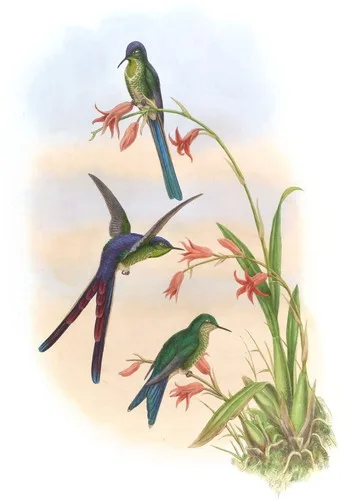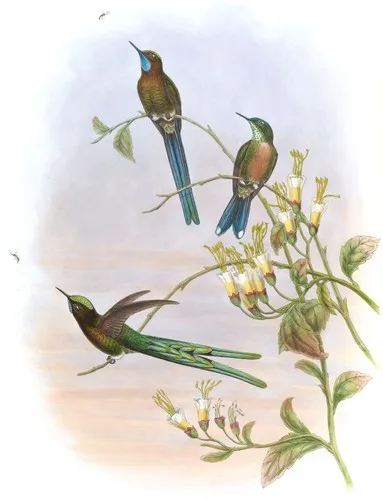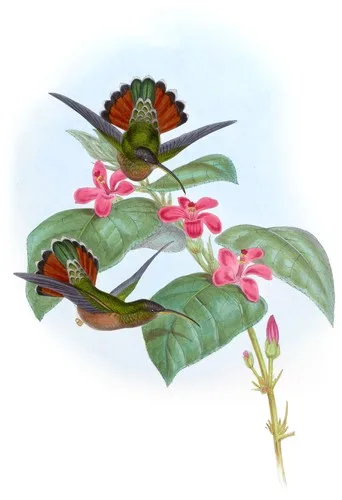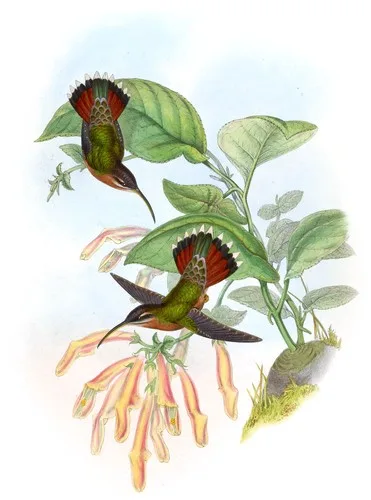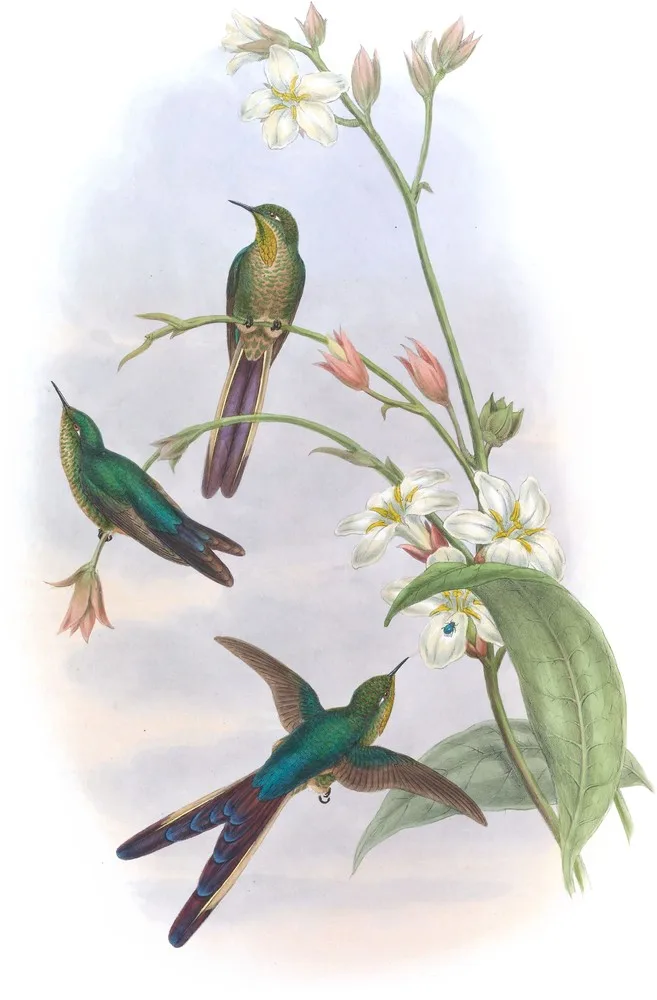
Sparganura glyceria
红尾慧星蜂鸟
Sparganura glyceria
Purple-tailed Comet
Ten ways of seeing
- upright 1.52 : 1
First Look
论画以形似,见与儿童邻。
—— 宋·苏轼《书鄢陵王主簿所画折枝》
To judge painting by likeness alone is the view of a child.
The sheet is vertical: the eye climbs and settles on the bird. Take the posture before the plumage. Then step in close: watch where colour meets line, and whether the line ever breaks. Third, find the darkest small patch: the whole tonal order is measured from there.
Name and Thing
The binomial is Sparganura glyceria: the first word is the genus it belongs among, the second the epithet that sets it apart. Two words carry a whole provenance. The Chinese name 红尾慧星蜂鸟 is a modern rendering of the Latin, not an old garden name.
Form and Colour
The smallest of birds: a needle-fine bill, a forked tubular tongue, wings beating so fast the bird hovers and even flies backwards. Its colour is not pigment but structure — light bent by feather barbules, changing with the angle.No colour group is recorded. A single plant, laid out with nothing hidden.
Composition
Tall and narrow, the bird perched mid-branch with generous margins above and below. No details are appended: a plate for looking, not for keying out. Old plates set the plant slightly off centre, with unequal margins — that small imbalance is what keeps it alive.
Line and Colour
In the later nineteenth century chromolithography took over: colour printed rather than painted, line demoted. Decide first whether it was printed or painted; only then discuss whether it is beautiful. If you mean to copy it: block in the broad shapes and colours first, detail last; lithographic softness comes from thin washes — two or three pale layers will get you close.
Poetic Resonance
夫列子御风而行,泠然善也,旬有五日而后反。
—— 《庄子·逍遥游》
Liezi rode the wind and came back after fifteen days, so light was his going.
The poem gives the mood first and the picture supplies the form; set the line beside the plate and the bird itself becomes its resting point.
Symbolism
For the Aztecs the hummingbird was warrior and sun; for Victorian Europe it was the ultimate ornament, millions killed for breast jewellery. China has no tradition here — and that blank is itself a history of exchange. In a flora it is a species first and a symbol second; the order is worth keeping.
Season and Place
In tropical America they are present all year, their season set by flowers. the name arrives with late-Qing travel writing. The year 1887 on the plate is that of publication, not of flowering — the gathering came a year or two earlier. Read the locality and the flowering season both with a discount: one is hearsay, the other a ten-day peak.
The Book and the Hand
“Gould's Hummingbirds” carries only John Gould's name. From drawing to plate the sheet passed through several hands — the engraver aimed at accuracy, the colourist at speed, and between them lies each plate's unevenness.
What to Take Away
Carry three rules away: whole before detail; line before colour; picture before book. The flower of that year is dust, yet its image on paper has outlived every living cousin.
About this plate
Being in possession of a female specimen of Sparganura glyceria, I think it advisable, both in the interests of the Trochilidist and of those who study the subject less scientifically, to figure it in this Supplement, and at the same time to associate with the drawing one of the male, back and front, which has already been depicted in the third volume of the ‘Humming-birds.’
Had it been possible, this female would have been figured thirty years ago.
Both Mr. Elliot, of North America, and M. Mulsant, of France, a short time ago completed Monographs of the. Humming-birds. When giving the description of this bird, they both say, in their letterpress, that there was no female known. This they would not have said had they ever seen my beautiful specimen, which I now figure, and which has been lying beside the male for the last five or six years.
In comparing Sparganura (Humming-birds with broad tail-feathers and pointed throat-marks) with Zodalia, the differences between the two genera are apparent. The throat-mark in the latter is rounded, and the tail-feathers narrow; the rich purple colour of the back distinguishes the latter bird from all the species of this great family. A glance at the plates of S. glyceria and Z. ortoni will, I think, convince any one that the two species belong to distinct genera.
Before leaving the subject, I may state that I think it would be well for collectors to go to Popayan, or within a hundred miles of it, if they would supply those at home with the bird they so much admire.
The colouring of the male:—Head, back of the neck, wing-coverts, back, and tail-coverts deep shining green; wings purplish brown; chin and throat metallic light olive-green; sides of the neck and under surface buff, with a spot of deep shining green at the tip of each feather; tail dark reddish purple, passing into deep bluish green at the tip, except on the outer feathers, where the hue is so faint as to be scarcely perceptible; the outer feathers also have the basal three fourths of the shafts and the outer webs buffy white, the base of the shaft paler than the web; basal three fourths of the shaft of the next feathers also buffy white; under tail-coverts buff, with a brown mark in the centre near the tip.
Female. All the crown, back of the neck, and back green; throat, centre of the belly, and under tailcoverts buff; these minutely spotted with green; on the throat more numerous, and larger spottings on the sides, and no such green spots on the buff which covers the under tail-coverts (at least the green is scarcely perceptible); wings above purplish brown; tail coloured with the brightest purple on the upper part, some of the feathers, particularly the short middle ones, tipped with green; the undersides of the plumage precisely like those of the male; bill brown.
Male. Total length 6 inches, tail 3
Female. Total length 4
The Plate represents the male in two positions, and a female, of the natural size.
Habitat. Popayan.
References
- Cometes mossai, Gould, Athen. 1853.
- Cometes? glyceria, Gould, Mon. Troch. vol. iii. p. 104, 1861.
- Lesbia glyceria, Bon. Rey. et Mag. de Zool. 1854, p. 252.
- Zodalia glyceria, Muls. vol. iii. p: 250.—Elliot, Synopsis of the Trochilidæ, p. 150.
- Sparganura mossai, Cab. & Heine, Mus. Hein. 1860, Th. iii. p: 92, note.
- Sparganura glyceria, Selat. & Salv. Nomencl. p. 80, 1873.