Sporadinus? Maugæi
Sporadinus? Maugæi
Maugé’s Humming-Bird
About this plate
Porto Rico
It is very interesting to the ornithologist to observe that most of the West India Islands, particularly those of any extent, are tenanted by species of birds which are not found in the others.
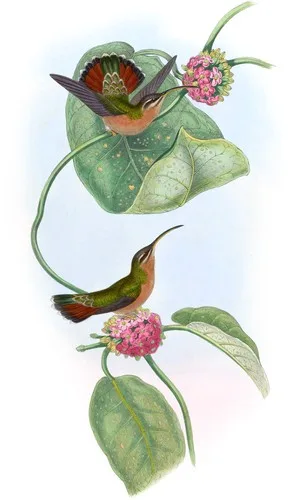
The Sporadinus Maugæi is a native of Porto Rico, and, as far as we yet know, is peculiar to that island; strange to say, however, no other specimens besides the two contained in the Museum of the Jardin des Plantes have ever reached Europe. Here, then, is an island that has not yet been visited by the ornithological collector; had it been, the bird would ere this have become common. As to affinity, the S. Maugæi is more nearly allied to the S. Riccordi than to any other; at the same time it differs in form, being intermediate between it and the long-tailed Mexican species to which I have applied the generic name of Chlorostilbon, or, rather, to those bearing that of Chlorolampis, of which the C. auriceps and C. Caniveti are typical examples. Its tail is still more forked than those of the latter, but not so much so as those of the former; but it differs from both in not having the conspicuous bands at the terminations of the central feathers. I think it necessary to go into these particulars because I have hinted elsewhere that probably some future ornithologist may think it requisite to assign to this bird a distinctive generic appellation.
The following short note and description are translated from Audebert and Vieillot’s ‘Oiseaux dorés,’ above referred to:—
This species has not yet, I believe, been described. Maugé being the first to make it known, I have given it his name. Its only habitat is one of those islands, Porto Rico, which by its position offers to our notice productions similar to those of St. Domingo. It is three inches and seven lines in length; the upper mandible is black, and the lower yellowish; the upper part of the body is of a beautiful golden green; the lower is of the same colour, but more brilliant, with blue and violet reflexions; the lower part of the belly is white; the feathers of the wings and of the tail are of a velvety black which changes into bluish violet; the lateral tail-feathers are fourteen lines in length; the others all diminish in length up to the intermediaries, which are the shortest; the wings when folded somewhat exceed the latter; the feet are black.
The following are my own notes on the colouring, taken during the present year, 1861, from the specimens
in the Jardin des Plantes:—
The male has the crown glittering green; upper surface dull grass-green, inclining to blue on the upper tail-coverts; throat and all the under surface glittering green, with a stain of blue on the chest; wings purplish brown; tail uniform steel-blue; under tail-coverts green; upper mandible black; under mandible reddish flesh-colour with a black tip.
The female has the upper surface green; the under surface greyish white; upper surface, sides of the neck, and flanks green; two centre tail-feathers green, the rest greenish grey at the base, banded with steel-blue near the tip; the two outer feathers tipped with greyish white.
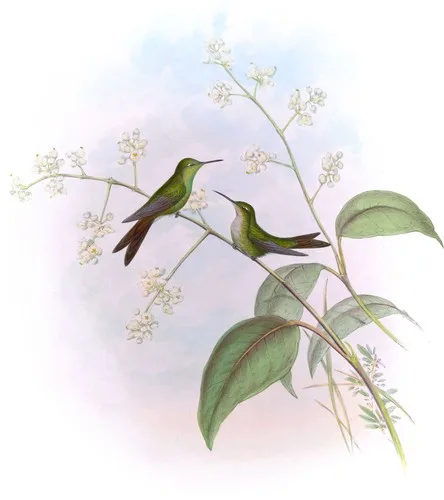
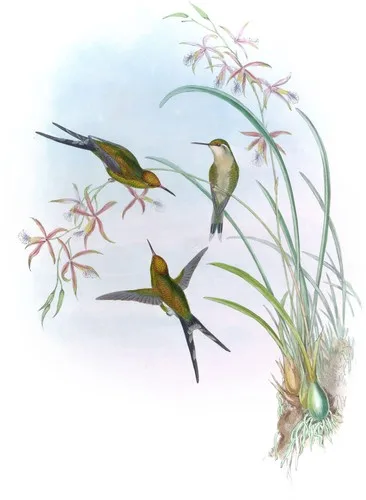
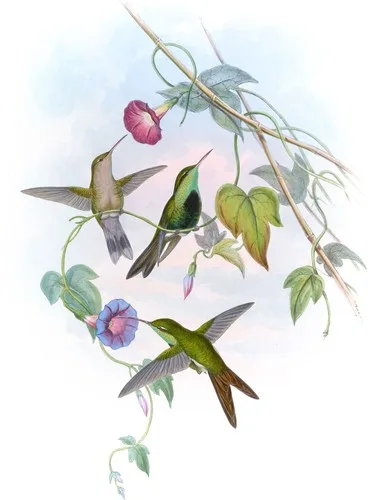
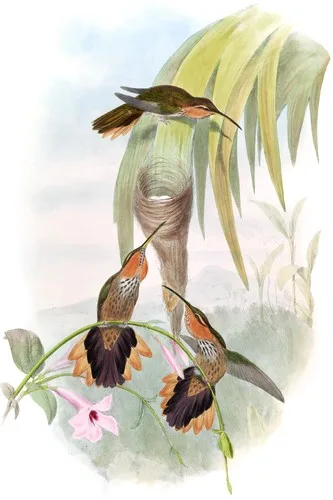
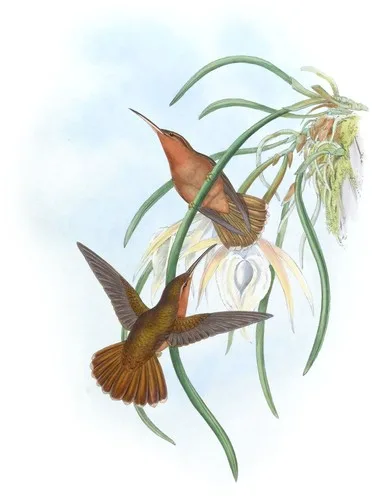
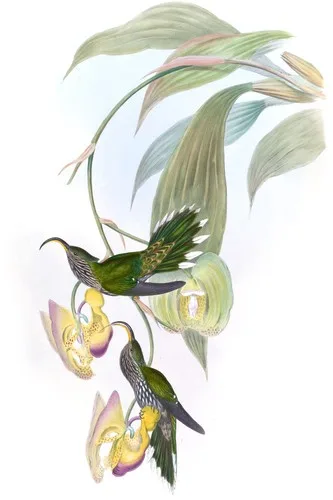
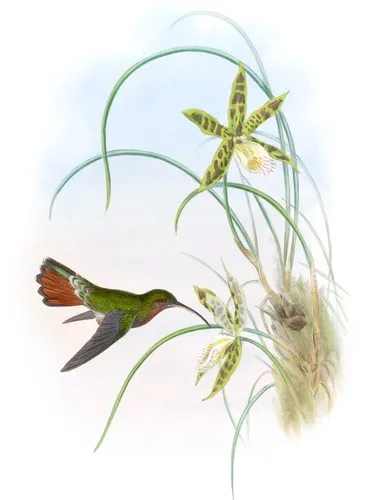
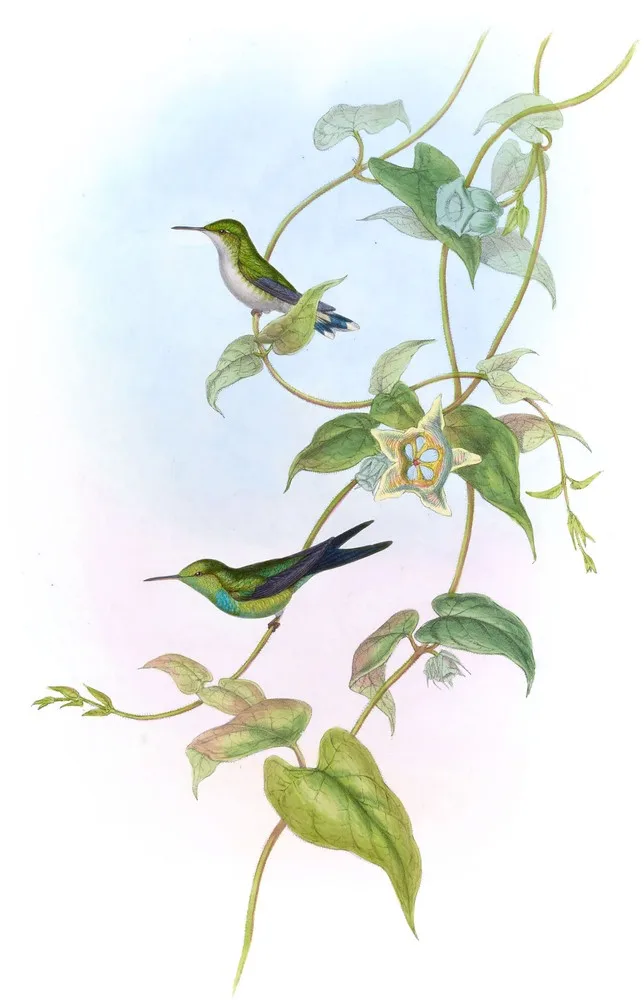
The figures represent the two sexes of the size of life. The plant is the Dictyanthus Pavonii.
References
- Trochilus Maugæus, Vieill. Dict. Hist. Nat., tom. vii. p.—Aud. et Vieill. Ois. dor., tom. i. pp. 77, 79, 80, and pls. 37, 38.— Bonn. et Vieill. Ency. Méth. Orn., part iii, p. 567.—Buff. Hist. Nat. des Ois., Sonn. édit., tom. liii. p. 237.
- Ornismya Maugæi, Less. Hist. Nat. des Ois.-Mou., p. 194, pls. 68, 69.—Ind. Gen. et Syn. des Ois. du Genre Trochilus, p. xxii.
- Trochilus Ourissia, auct.?
Ten ways of seeing
- upright 1.55 : 1
- published 1861
- Pl. 349, Vol. V
Not a catalogue entry but a way of looking: how to stand, what to notice, how the line was cut — then, halfway, a line of Chinese poetry: how the ancients saw this same flower. After it, the flower's language, its season and homeland, its book; and at the end one line of classical prose — and a pair of eyes to take away.
-
First Look
六法者何?一、气韵生动是也;二、骨法用笔是也;三、应物象形是也;四、随类赋彩是也;五、经营位置是也;六、传移模写是也。
—— 南齐·谢赫《古画品录》
The six laws: spirit resonance alive; bone-method in the brush; matching form; colour by kind; planning the placing; copying the masters.
The sheet is vertical: the eye climbs and settles on the bird. Take the posture before the plumage. Then step in close: watch where colour meets line, and whether the line ever breaks. Third, find the darkest small patch: the whole tonal order is measured from there.
-
Name and Thing
No reliable binomial survives, so the printed title must serve. Neither name nor binomial survives: the printed title must do.
-
Form and Colour
The smallest of birds: a needle-fine bill, a forked tubular tongue, wings beating so fast the bird hovers and even flies backwards. Its colour is not pigment but structure — light bent by feather barbules, changing with the angle.No colour group is recorded. A single plant, laid out with nothing hidden.
-
Composition
Tall and narrow, the bird perched mid-branch with generous margins above and below. (about 1.55 : 1) No details are appended: a plate for looking, not for keying out. Blank paper is not unfinished work: it is where the eye rests.
-
Line and Colour
In the later nineteenth century chromolithography took over: colour printed rather than painted, line demoted. Decide first whether it was printed or painted; only then discuss whether it is beautiful. If you mean to copy it: block in the broad shapes and colours first, detail last; lithographic softness comes from thin washes — two or three pale layers will get you close.
-
Poetic Resonance
夫列子御风而行,泠然善也,旬有五日而后反。
—— 《庄子·逍遥游》
Liezi rode the wind and came back after fifteen days, so light was his going.
The poem gives the mood first and the picture supplies the form; set the line beside the plate and the bird itself becomes its resting point.
-
Symbolism
For the Aztecs the hummingbird was warrior and sun; for Victorian Europe it was the ultimate ornament, millions killed for breast jewellery. China has no tradition here — and that blank is itself a history of exchange. Flower language was added later; the flower knows nothing of it, and that innocence is part of its power.
-
Season and Place
temperate hummingbirds follow the bloom north and back, thousands of kilometres a year. Americas only, from southern Alaska to Tierra del Fuego, richest in the Andes. China has no hummingbirds and no classical record of them. The year 1861 on the plate is that of publication, not of flowering — the gathering came a year or two earlier. The bud and the ripe fruit on one branch tell the season; the name in the title often tells the journey.
-
The Book and the Hand
“Gould's Hummingbirds” was drawn by John Gould and published 1849-1887. This plate is Pl. 349, Vol. V, book page 349. The image is public domain; the hand-colouring is still one person's hand.
-
The Written Tradition
庭下如积水空明,水中藻荇交横,盖竹柏影也。
—— 宋·苏轼《记承天寺夜游》
The courtyard seemed flooded with clear water, weeds crossing in it — in fact the shadows of bamboo and cypress.
Gould's Hummingbirds (1849–1887) used hand-coloured lithography over gold leaf so the iridescence survived on paper — a monument to Victorian printing and collecting alike. The difference is not of quality but of question: Europe asks what it is, China asks whom it resembles.
What to Take Away
If you keep one line, keep Guo Xi's: from afar its momentum, up close its texture. Two centuries on, the plant may still flower in some garden; the one on this sheet stopped in the season of 1861.