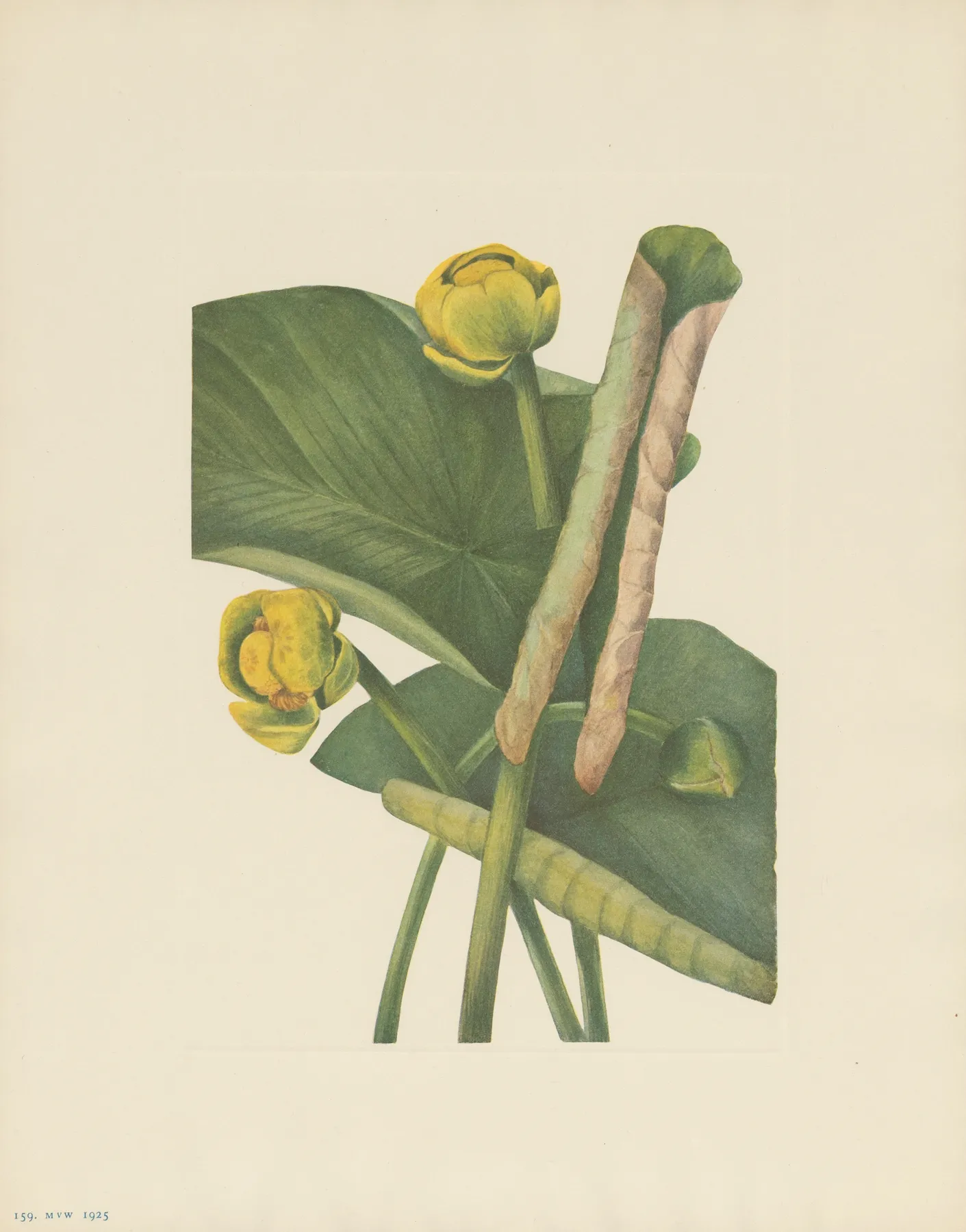
Spatterdock (Nymphaea advena) (1925)
睡莲目
Spatterdock (Nymphaea advena) (1925)
Ten ways of seeing
- measured cast yellow-green
- slightly upright 1.28 : 1
First Look
凡画山水,意在笔先。
—— 唐·王维《山水论》
In painting, the intention precedes the brush.
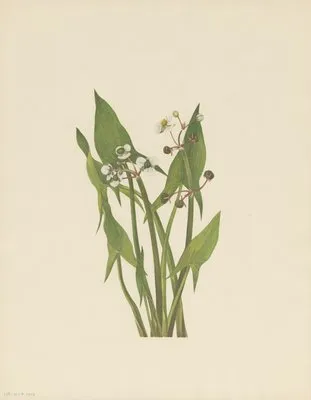
Slightly taller than wide; the eye lands above centre. Then step in close: watch where colour meets line, and whether the line ever breaks. Third, find the darkest small patch: the whole tonal order is measured from there. The pose leans left: the upper half carries 11 points further left than the lower — a living thing, not a diagram.
Name and Thing
Only the genus Nymphaea is given; species-level names came later. The Chinese name 睡莲目 is a modern rendering of the Latin, not an old garden name.
Form and Colour
Measured on this plate: flower colour covers 8.2% of the sheet, foliage 15.9%, the cast yellow-green with a second note of amber. No other plate shares exactly this measure. The sacred lotus lifts shield-shaped leaves above the water with a seed pod standing at the centre; waterlilies float their notched leaves and rest their flowers on the surface.No colour group is recorded. Read the outline, then the colour layers, then the brush.
Composition
The sheet is slightly tall. No details are appended: a plate for looking, not for keying out. The plant covers only 26% of the sheet, centred near the centre; the emptiness is where the eye rests.
Line and Colour
After 1900 photography and colour reproduction ran alongside watercolour: accuracy rose, the cut of the burin disappeared. Craft leaves franker evidence than inscriptions. If you mean to copy it: this is a photomechanical record — match the colours directly, do not imitate the printing grain.
Poetic Resonance
采莲归,绿水芙蓉衣。秋风起浪凫雁飞。
—— 唐·王勃《采莲曲》
The poem gives the mood first and the picture supplies the form; set the line beside the plate and the corolla becomes its resting point.
Symbolism
In China the lotus is the gentleman unstained by mud; in Buddhism it is the seat of the pure land. In a flora it is a species first and a symbol second; the order is worth keeping.
Season and Place
High summer, June to August. The sacred lotus is native to warm Asia and cultivated in China for three millennia. The year 1925 on the plate is that of publication, not of flowering — the gathering came a year or two earlier. The bud and the ripe fruit on one branch tell the season; the name in the title often tells the journey.
The Book and the Hand
“North American wild flowers” carries only Mary Vaux Walcott's name. From drawing to plate the sheet passed through several hands — the engraver aimed at accuracy, the colourist at speed, and between them lies each plate's unevenness.
What to Take Away
Carry three rules away: whole before detail; line before colour; picture before book. Two centuries on, the plant may still flower in some garden; the one on this sheet stopped in the season of 1925.
About this plate
Spatterdock (Nymphaea advena) (1925) is plate 159, from North American wild flowers, drawn by Mary Vaux Walcott. This public-domain plate is reproduced at high resolution, free to view and download. Publication: Washington, D.C., The Smithsonian Institution, 1925.