Gladiolus Lineatus
Glayeul Rayé
Glayeul Rayé
About this plate
Description
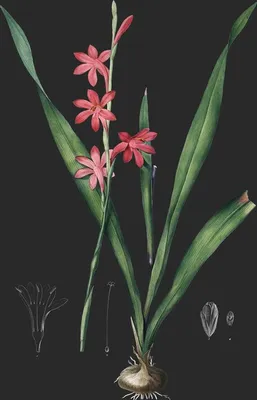
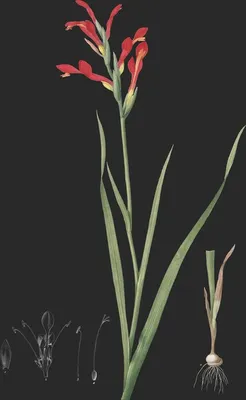
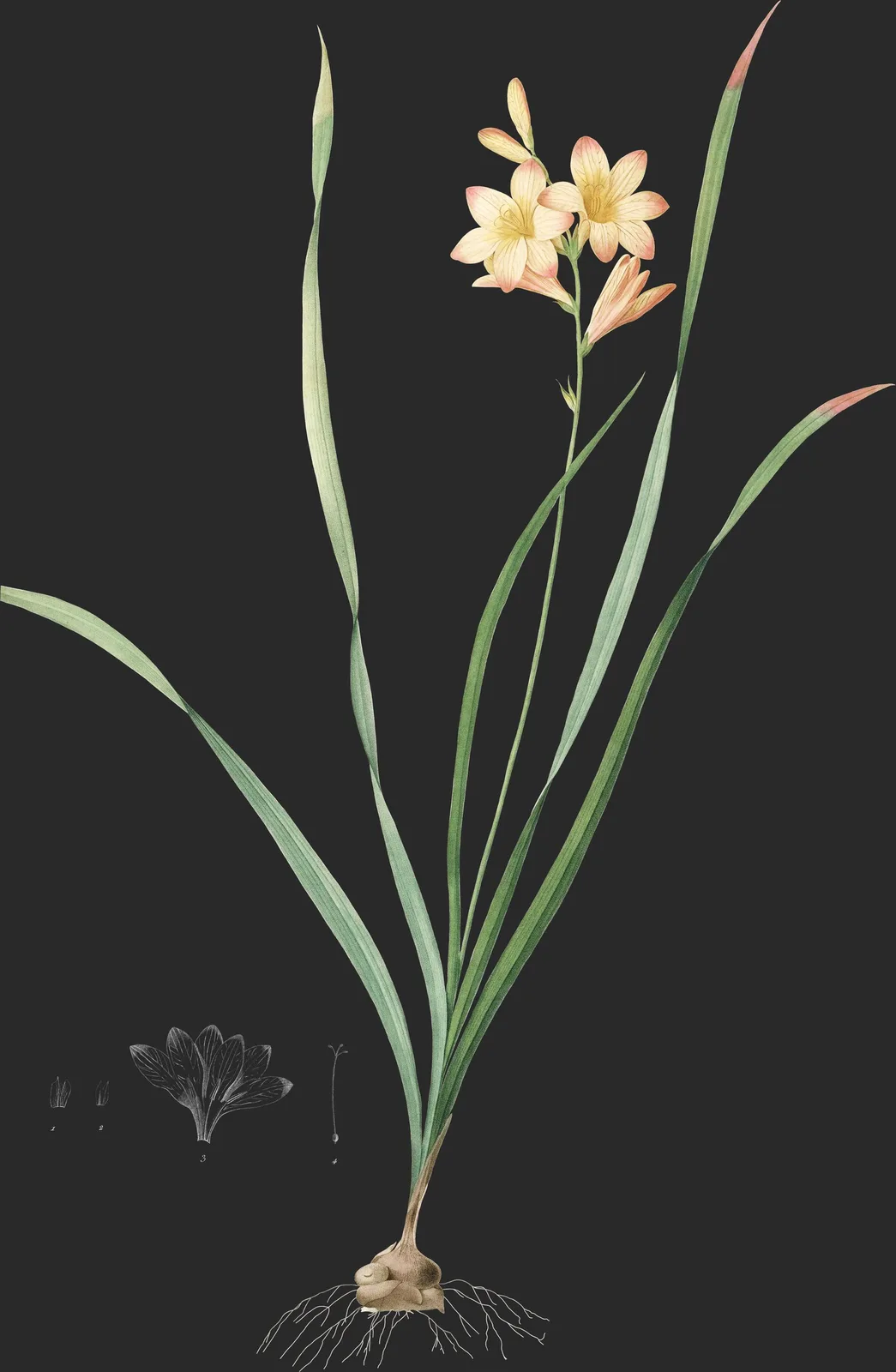
Les caractères précis de cette espèce de Glayeul sont difficiles à tracer; mais on la reconnait sans peine à sa fleur pâle et presque transparente, relevée par des veines noirâtres et anastomosées entre elles. Cette fleur ressemble un peu, par sa forme, à celle de l’Ixia safran: elle est placée sur l’ovaire, légèrement courbée, d’un jaune pale tirant un peu sur le rouge, presque en forme d’entonnoir, et divisée, au-delà du milieu de sa longueur, en six lanières éta-lées; les trois supérieures sont ovales, et celle du milieu est plus large que les deux autres; les trois inférieures sont oblongues et presque pointues.
Si nous ouvrons cette fleur, nous y trouvons trois étamines dont les filaments sont insérés au fond de la corolle, un peu courbes, légèrement com-primés, égaux à la longueur da tube, et d’une couleur jaunatre; les anthères sont droites, brunes, linéaires, et émettent un pollen jaunâtre, par deux fentes placées à leur face externe: entre les étamines sélève un style droit, filiforme, qui dépasse la hauteur des anthères, et qui se divise au sommet en trois stigmates grêles, étalés, pabescents, rougeâtres, et légèrement fourchus à l’extré-mité; ce style tire son origine d’un ovaire placé sous la corolle, caché entre deux bractées membraneuses, à trois angles obtus, et qui se change en une capsule à trois loges et à trois valves.
Les fleurs que nous venons de décrire se trouvent, au nombre de sept ou huit, disposées en épi simple au sommet de la tige; elles sont sessiles, entre deux bractées striées, dont l’une se divise en trois lobes aigus, et l’autre en deux seulement. La tige est cylindrique, grêle, feuillée i sa base, presque nue dans le reste de sa longueur, hante de 8–10 décimètres, flexueuse et presque tombante lorsqu’elle est abandonnée à elle-même; les feuilles naissent de la racine, et atteignent presque la longueur de la tige; leur largeur est de 7–8 millimètres: elles sont linéaires, pointues, glabres, faibles, d’un vert légèrement glauque, engainées à la manière des feuilles d’Iris; les feuilles supérieures sont concaves, et ressemblent à des bractées.
La racine est une bulbe tubéreuse arrondie, brunâtre en dehors, un peu déprimée, et dont la grosseur est à peu près celle d’une petite noix.
Histoire
Le Glayeul rayé est originaire du Cap-de-Bonne-Espérance. ♃.
On le cultive dans quelques jardins de botanique; c’est dans celai du Muséum d’Histoire naturelle que nous avons eu occasion de l’observer.
Il y a lleuri au commencement du printemps dans la serre chaude; sa culture est la même que celle des autres espèces de ce genre.
Observations
Aiton avait regardé cette plante comme une simple variété de l’Axia squalida; Salisbury et Curtis l’en ont séparée avec raison: elle en diffère en effet, parce que les divisions de la corolle sont entières au sommet, nullement tachées à leur base, et que sa fleur est d’un jaune pâle et, plus sensiblement rayée.
Explication de la planche
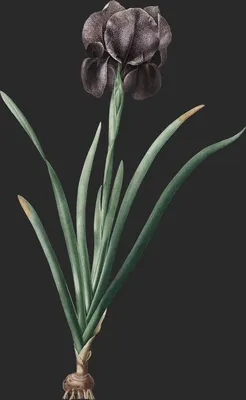
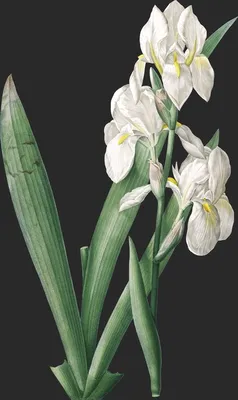
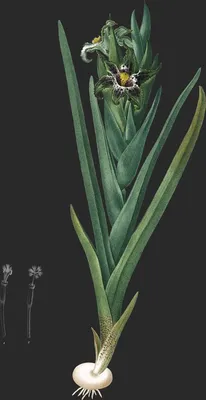
La Plante de grandeur naturelle.
- 2. Les bractées.
- La corolle ouverte.
- Le pistil.
Fam. des Iridées. Juss.—Triandrie monogynie. Lin.
- Gladiolas lineatus. G. corolla limbo tabo quadruplo longiore incurvo patente, laciniis ellipticis extas, lineis tribus parallelis, suprema majore, exterioribus retusis. Salisb. prodr. p. 40. Curt. Bot. mag. t. 487.
- Ixia squalida var. β. stricta. Ait. Kew. 1. p. 61. Wild. Spec. 1. p. 206.
Ten ways of seeing
- measured cast amber
- upright 1.53 : 1
- published 1802
- Plate 55
Not a catalogue entry but a way of looking: how to stand, what to notice, how the line was cut — then, halfway, a line of Chinese poetry: how the ancients saw this same flower. After it, the flower's language, its season and homeland, its book; and at the end one line of classical prose — and a pair of eyes to take away.
-
First Look
竖划三寸,当千仞之高;横墨数尺,体百里之迥。
—— 南朝宋·宗炳《画山水序》
A vertical stroke of three inches stands for a cliff of a thousand fathoms; a few feet of ink holds a hundred li.
The sheet is vertical: the eye climbs and settles in the upper half. Let the plant stand before you look for detail. Then step in close: watch where colour meets line, and whether the line ever breaks. Third, find where the green is deepest: the whole tonal order is measured from that patch. The pose leans right: the upper half carries 12 points further right than the lower — a living thing, not a diagram.
-
Name and Thing
The binomial is Gladiolus lineatus: the first word is the genus it belongs among, the second the epithet that sets it apart. Two words carry a whole provenance. The older system filed it under Iridaceæ by overall affinity; Linnaeus, counting stamens only, placed it in Triandria — two ways of asking what a plant is. No established Chinese name exists, so it is cited by its binomial alone.
-
Form and Colour
Measured on this plate: flower colour covers 2.2% of the sheet, foliage 2.7%, the cast amber with a second note of yellow-green. No other plate shares exactly this measure. Bulbous plants store the year underground — bulb, corm or tuber — then send up a few thick leaves and a single scape, with six tepals in cup, funnel or star. Filed under green — a moss green, a colour that comes mostly from leaf and stem. A single plant, laid out with nothing hidden.
-
Composition
Tall and narrow, the plant rising in one movement with generous margins — the upright format of most floras. (about 1.53 : 1) No details are appended: a plate for looking, not for keying out. The plant covers only 10% of the sheet, centred near the centre; the emptiness is where the eye rests. Cover the margins with your thumb and the plate suffocates; uncover them and the flower breathes again.
-
Line and Colour
The first half of the nineteenth century moved from copper to steel to lithography; stipple could render the softest transition. Take a loupe to three places: petal edge, leaf vein, caption. An unbroken line means engraving; colour crossing the outline means a hand. If you mean to copy it: take its skeleton, its margins and the order of its colours; the burin's hatching is the language of copper — suggest it with pencil density, do not imitate it stroke for stroke.
-
Poetic Resonance
满园花菊郁金黄,中有孤丛色似霜。
—— 唐·白居易《重陽席上賦白菊》
The poem gives the mood first and the picture supplies the form; set the line beside the plate and the green the corolla becomes its resting point.
-
Symbolism
The tulip was an imperial emblem in Istanbul and a speculative bubble in Amsterdam; the hyacinth sprang from a boy's blood in Greek myth. What bulbs share is concealment: next year kept underground. Meanings change their tune: the same flower can say opposite things within a century.
-
Season and Place
Early spring to early summer, genus by genus: tulips and hyacinths first, gladiolus and amaryllis later. South African bulbs filled European glasshouses after 1800. The year 1802 on the plate is that of publication, not of flowering — the gathering came a year or two earlier. The bud and the ripe fruit on one branch tell the season; the name in the title often tells the journey.
-
The Book and the Hand
“The Liliaceae” was drawn by Pierre-Joseph Redouté and published 1802-1816. This plate is Plate 55, book page 55. The image is public domain; the hand-colouring is still one person's hand.
-
The Written Tradition
人无癖不可与交,以其无深情也。
—— 明·张岱《陶庵梦忆》
Never make a friend of a man without an obsession: he has no deep feeling.
Li Bai's 'orchid wine, fragrant with yujin' is often misread as tulips; the Tang yujin was a turmeric-like root used to scent wine — same name, different plant. You need not parse every word: take the line, and the flower acquires a second face.
What to Take Away
Next time you stand before a flowering plant, give it three minutes: leaf arrangement, direction of the flower, the darkest patch. The flower of that year is dust, yet its image on paper has outlived every living cousin.