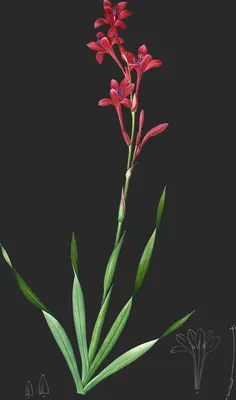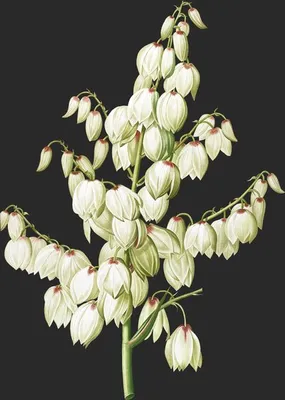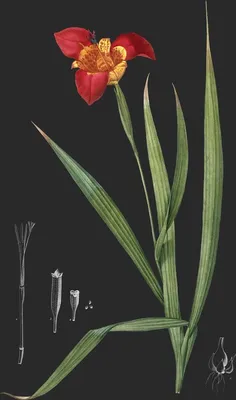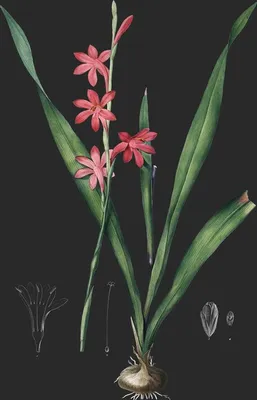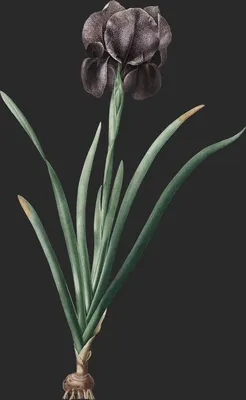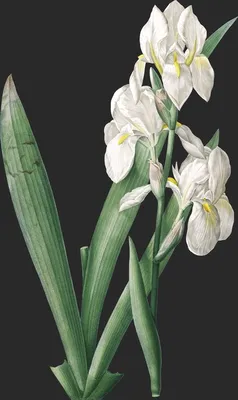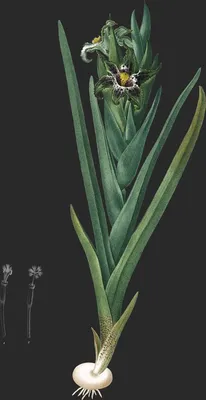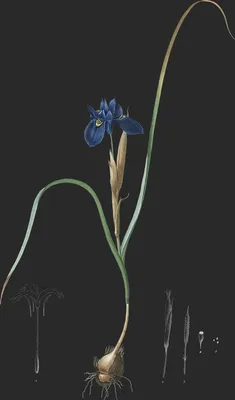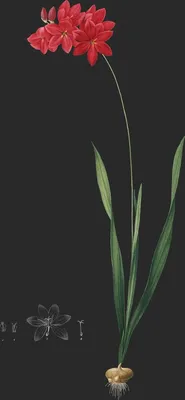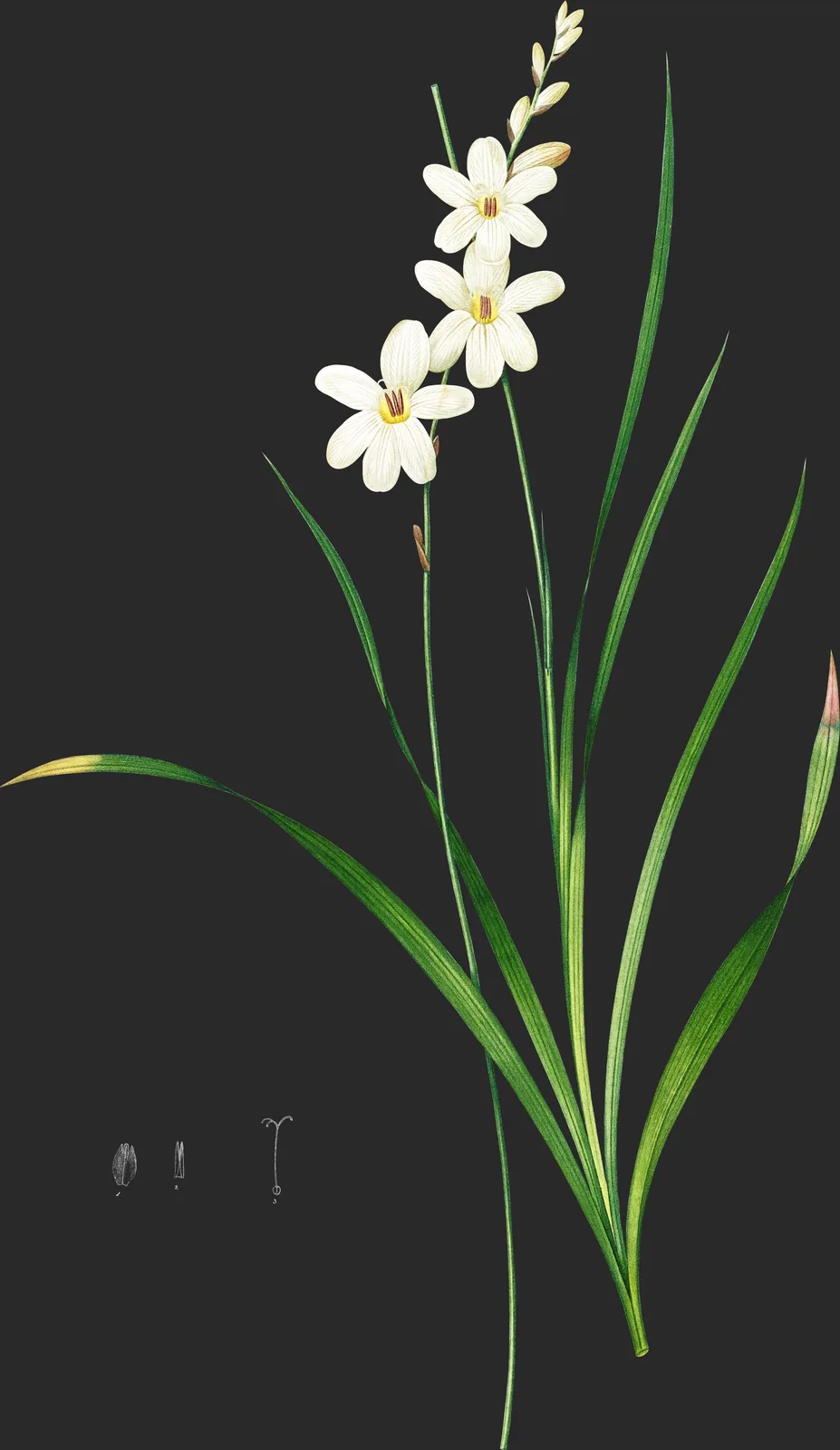
Gladiolus Lineatus
Glayeul Rayé
Glayeul Rayé
About this plate
Observations
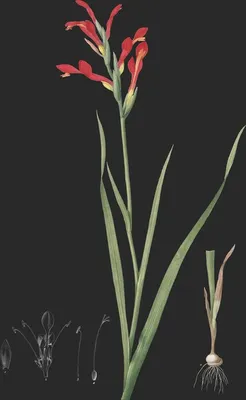
Quoique ce Glayeul ne se ditingue par aucun caractère important de celui que nous avons figuré sous le même nom dans une de nos premières livraisons, comme il en diffère assez par le port pour qu’on puisse le regarder, au premier aspect, comme une espèce bien distinete, nous avons cru devoir en donner ici la figure; mais nous n’en ferons point la description détaillée, dans laquelle nous serions forcés de répéter tout ce que nous avons dit de notre première variété, et nous nous bornerons aux remarques suivantes.
Les feuilles sont nombreuses, longues de trois ou quatre décimètres. La hampe rélève à un mètre environ. La grappe de fleurs qui la termine est composée de dix ou douze fleurs au moins, Les bractées sont simplement dentées, et non divisées en lobes. Les segments du périgone sont tous oblongs, obtus, légèrement échancrés, d’une coulear jaunâtre, pile, avec des lignes violettes tres-distinctes. Les trois inférieures ont à leur base une tache jaune. Les étamines sont proportionnellement plus courtes que dans la variété A. Dans cette dernière variété, les anthères sont d’une conleur grise pale. Dans celle dont nous donnons ici la ligure, elles sont d’un violet noirätre sur les bords, et d’une couleur plas pale dans le milieu.
C’est dans le Jardin impérial de Sevres que nous avons vu cette belle va-riété. Elle fleurit en même temps que l’autre, cestadire à la fin d’avril et au commencement de mai. M. Lelieur de Villesur-Arce, à qui nous en devons la connaissance, a remarqué que l’épi de fleurs sineline fortement dans la muit, et qu’il se redresse le matin.
Explication de la planche
La Plante de grandeur naturelle.
- Une des bractées extérieures.
- Une des bractées intérieures.
- L’ovaire, le style et les stigmates.
Fam. des Iris. Juss.—Triandrie monogynie. Lin.
- Gladiolas lineatus, G. corolle limbo tabo quadruplò longiore incurvo patente, laciniis ellipticis extus lincis tribus parallelis, suprema majore, exterioribus retusis.
- A minor paucillorus floribus Mlavo-robescentibus. Liliac. 55.
- B maior multiflorus floribus ochroleucis.
Ten ways of seeing
- measured cast yellow-green
- upright 1.73 : 1
- published 1812
- Plate 400
Not a catalogue entry but a way of looking: how to stand, what to notice, how the line was cut — then, halfway, a line of Chinese poetry: how the ancients saw this same flower. After it, the flower's language, its season and homeland, its book; and at the end one line of classical prose — and a pair of eyes to take away.
-
First Look
六法者何?一、气韵生动是也;二、骨法用笔是也;三、应物象形是也;四、随类赋彩是也;五、经营位置是也;六、传移模写是也。
—— 南齐·谢赫《古画品录》
The six laws: spirit resonance alive; bone-method in the brush; matching form; colour by kind; planning the placing; copying the masters.
The sheet is vertical: the eye climbs and settles in the upper half. Let the plant stand before you look for detail. Then step in close: watch where colour meets line, and whether the line ever breaks. Third, find where the green is deepest: the whole tonal order is measured from that patch.
-
Name and Thing
The binomial is Gladiolus lineatus: the first word is the genus it belongs among, the second the epithet that sets it apart. Two words carry a whole provenance. The older system filed it under Iridaceæ by overall affinity; Linnaeus, counting stamens only, placed it in Triandria — two ways of asking what a plant is. No established Chinese name exists, so it is cited by its binomial alone.
-
Form and Colour
Measured on this plate: flower colour is sparing, 0.5% of the sheet against 5.4% of foliage, the cast tending yellow-green — as with pale or white blooms, outline and tone do the talking. Bulbous plants store the year underground — bulb, corm or tuber — then send up a few thick leaves and a single scape, with six tepals in cup, funnel or star. Filed under green — a moss green, a colour that comes mostly from leaf and stem. Three things fix the habit: leaf arrangement, tepal count, and how the flower is borne.
-
Composition
Tall and narrow, the plant rising in one movement with generous margins — the upright format of most floras. (about 1.73 : 1) No details are appended: a plate for looking, not for keying out. The plant covers only 9% of the sheet, centred a little right of centre; the emptiness is where the eye rests. Old plates set the plant slightly off centre, with unequal margins — that small imbalance is what keeps it alive.
-
Line and Colour
The first half of the nineteenth century moved from copper to steel to lithography; stipple could render the softest transition. Take a loupe to three places: petal edge, leaf vein, caption. An unbroken line means engraving; colour crossing the outline means a hand. If you mean to copy it: take its skeleton, its margins and the order of its colours; the burin's hatching is the language of copper — suggest it with pencil density, do not imitate it stroke for stroke.
-
Poetic Resonance
郁金垂嫩柳,罯画委高笼。
—— 唐·元稹《春六十韻》
The poem gives the mood first and the picture supplies the form; set the line beside the plate and the green the corolla becomes its resting point.
-
Symbolism
The tulip was an imperial emblem in Istanbul and a speculative bubble in Amsterdam; the hyacinth sprang from a boy's blood in Greek myth. What bulbs share is concealment: next year kept underground. Meanings change their tune: the same flower can say opposite things within a century.
-
Season and Place
Early spring to early summer, genus by genus: tulips and hyacinths first, gladiolus and amaryllis later. Three homelands: the Mediterranean, Central Asia and South Africa. The tulip came from Ottoman gardens and became a Dutch mania. The year 1812 on the plate is that of publication, not of flowering — the gathering came a year or two earlier. Read the locality and the flowering season both with a discount: one is hearsay, the other a ten-day peak.
-
The Book and the Hand
“The Liliaceae” was drawn by Pierre-Joseph Redouté and published 1802-1816. This plate is Plate 400, book page 400. The image is public domain; the hand-colouring is still one person's hand.
-
The Written Tradition
写气图貌,既随物以宛转;属采附声,亦与心而徘徊。
—— 南朝梁·刘勰《文心雕龙·物色》
In tracing the spirit and drawing the shape one follows the object; in choosing colour and sound one lingers with the heart.
Li Bai's 'orchid wine, fragrant with yujin' is often misread as tulips; the Tang yujin was a turmeric-like root used to scent wine — same name, different plant. The difference is not of quality but of question: Europe asks what it is, China asks whom it resembles.
What to Take Away
If you keep one line, keep Guo Xi's: from afar its momentum, up close its texture. Two centuries on, the plant may still flower in some garden; the one on this sheet stopped in the season of 1812.