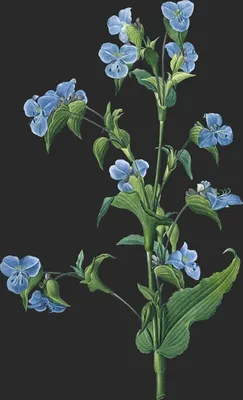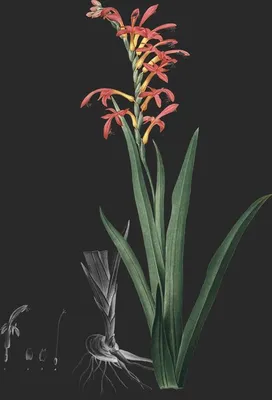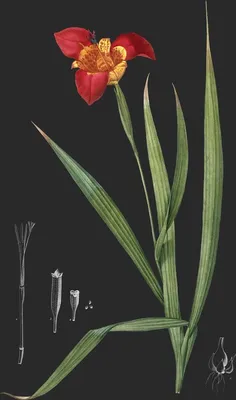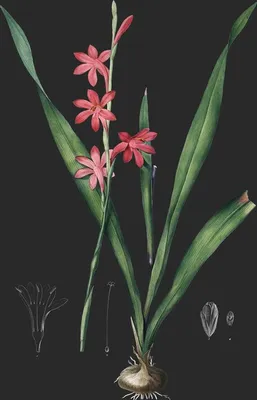
Ixia Liliago
食蚜蝇科
Ixia Fleur de Lis
Ten ways of seeing
- measured cast yellow-green
- upright 2.30 : 1
First Look
论画以形似,见与儿童邻。
—— 宋·苏轼《书鄢陵王主簿所画折枝》
To judge painting by likeness alone is the view of a child.
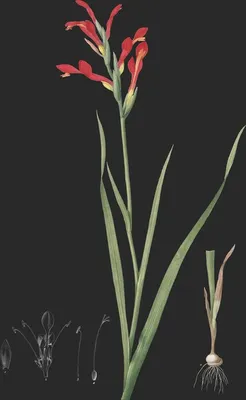
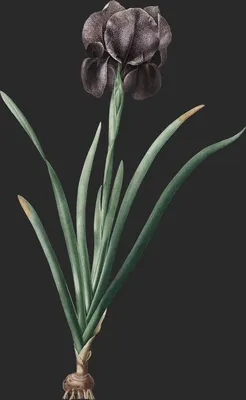
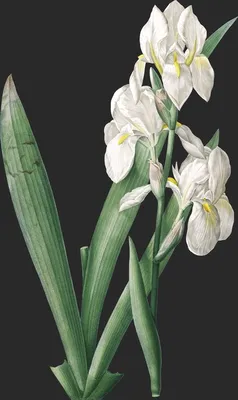
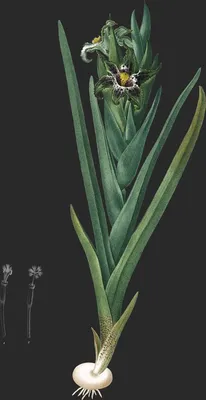
The sheet is vertical: the eye climbs and settles in the upper half. Let the plant stand before you look for detail. Then step in close: watch where colour meets line, and whether the line ever breaks. Third, find where the green is deepest: the whole tonal order is measured from that patch. The pose leans right: the upper half carries 14 points further right than the lower — a living thing, not a diagram.
Name and Thing
The binomial is Ixia liliago: the first word is the genus it belongs among, the second the epithet that sets it apart. Two words carry a whole provenance. The older system filed it under Iridaceæ by overall affinity; Linnaeus, counting stamens only, placed it in Triandria — two ways of asking what a plant is. The Chinese name 食蚜蝇科 is a modern rendering of the Latin, not an old garden name.
Form and Colour
Measured on this plate: flower colour is sparing, 0.8% of the sheet against 7.3% of foliage, the cast tending yellow-green — as with pale or white blooms, outline and tone do the talking. Bulbous plants store the year underground — bulb, corm or tuber — then send up a few thick leaves and a single scape, with six tepals in cup, funnel or star. a moss green. A single plant, laid out with nothing hidden.
Composition
The sheet is tall. No details are appended: a plate for looking, not for keying out. The plant covers only 20% of the sheet, centred a little right of centre; the emptiness is where the eye rests.
Line and Colour
The first half of the nineteenth century moved from copper to steel to lithography; stipple could render the softest transition. There is evidence on the back too: the plate mark pressed into the paper, the slight relief of the pigment, lines worn shallow in a later printing. If you mean to copy it: take its skeleton, its margins and the order of its colours; the burin's hatching is the language of copper — suggest it with pencil density, do not imitate it stroke for stroke.
Poetic Resonance
兰陵美酒郁金香,玉碗盛来琥珀光。
—— 唐·李白《客中行》
Fine wine of Lanling, fragrant with turmeric; poured in a jade bowl, it glows like amber.
The poem gives the mood first and the picture supplies the form; set the line beside the plate and the green the corolla becomes its resting point.
Symbolism
The tulip was an imperial emblem in Istanbul and a speculative bubble in Amsterdam; the hyacinth sprang from a boy's blood in Greek myth. What bulbs share is concealment: next year kept underground. Flower language was added later; the flower knows nothing of it, and that innocence is part of its power.
Season and Place
Early spring to early summer, genus by genus: tulips and hyacinths first, gladiolus and amaryllis later. Three homelands: the Mediterranean, Central Asia and South Africa. The tulip came from Ottoman gardens and became a Dutch mania. The year 1804 on the plate is that of publication, not of flowering — the gathering came a year or two earlier. Read the locality and the flowering season both with a discount: one is hearsay, the other a ten-day peak.
The Book and the Hand
“The Liliaceae” carries only Pierre-Joseph Redouté's name. The image is public domain; the hand-colouring is still one person's hand.
What to Take Away
Appreciation is not knowledge but habit — one more look each time. A flora exists to be consulted; look long enough and you forget to consult — someone in 1804 gave a whole day to a single flower.
About this plate
Description
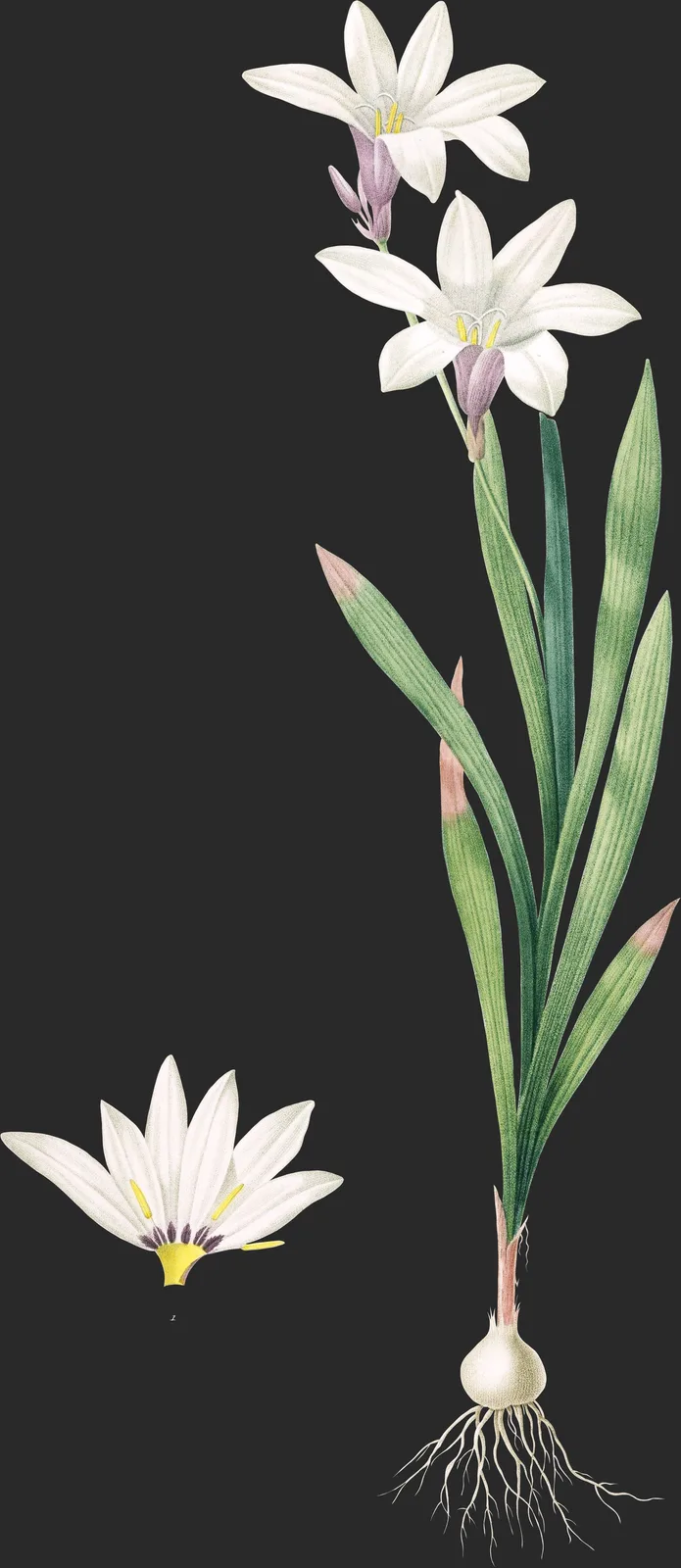
Cette belle espèce d’Ixia se distingue, dès le premier coup-d’œil, de toutes les plantes du même genre, par la grandeur de ses fleurs qui ressemblent à celles du Lis blanc ou de l’Antherie à fleur de Lis.
Une bulbe sphérique, de la grosseur d’une cerise, donne naissance, par sa partie inférieure, à plusieurs fibres greles et blanchätres; de son sommet sort une tige droite, simple, hante de 3 décimètres, cylindrique, feuillée et plus longue que les feuilles; celles-ci sont droites, glabres, ainsi que le reste de la plante, oblongues-linéaires, pointues, engainées par un de leurs bords à la manière des feuilles d’Iris; les inférieures sont plus courtes que les supérieures.
Les fleurs sont au nombre de deux ou trois, disposées en épi simple, droit, terminal, un peu éeartées les unes des autres: elles sont entourées à leur base de deux bractées, dont l’inférieure est laneéolée, acérée, alongée, membra-neuse, divisée sur les bords en lanières semblables à des cils.
La corolle est grande, d’un blanc tirant un peu sur le rouge en dehors, et sur le jaune en dedans, au moins à la fin de la fleuraison; son tube est court, minces son limbe est à six divisions ovales-oblongues, un peu obtuses, quatre ou cinq fois plus longues que le tube: à la base interne de chaque division est une tache ovale, d’un violet foncé; l’entrée du tube est elle-même tachée de jaune.
Les étamines sont au nombre de trois, attachées sur le bord du tube devant les divisions externes de la corolle; les filets sont blancs, droits, fili-formes, et ne dépassent pas le quart de la longueur des divisions; les anthères sont droites, blanches, aussi longues que les filets, a deux loges qui s’ouvrent par deux fentes longitudinales placées du côté extérieur.
L’ovaire est adhérent avec la base do tube, triangulaire, vert, court, caché par les bractées; le style est blane, filiforme, de la longueur des étamines, terminé par trois stigmates profondément séparés, souvent inégaux, ouverts, blanes, grêles, un peu épaissis au sommet.
Le fruit n’est pas parvenu à maturité.
Histoire
Il est probable que cette plante est indigène du Cap-de-Bonne-Espérance, mais je n’en ai d’autres preuves que celles qu’on peut tirer par analogie de sa culture, de sa végétation, etc. Elle est cultivée dans le jardin de M. Cels, où elle a fleuri l’année passée à l’entrée du printemps.
Explication de la planche
La Plante de grandeur naturelle.
- La corolle ouverte pour montrer les étamines et les taches qui sont à la base des divisions.
Fam. des Iridées. Juss.—Triandrie monogynie. Lin.
- Isia liliago. I. glabra, folis ensiformi-linearibus planis scapo brevioribus, floribus magais compamulatis, tubo brevissimo, laciniis oblongis basi maculatis.
- Isia liliago. Desf. cat. hort. Par. 31.