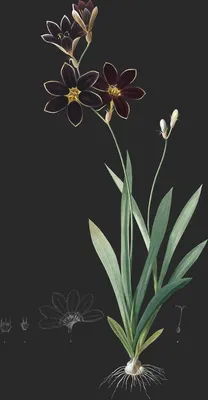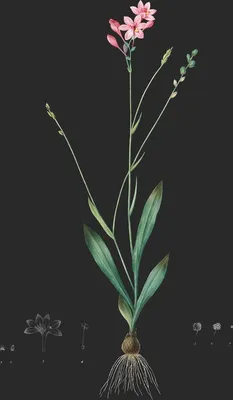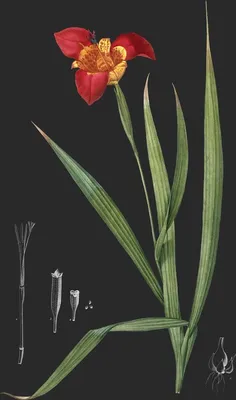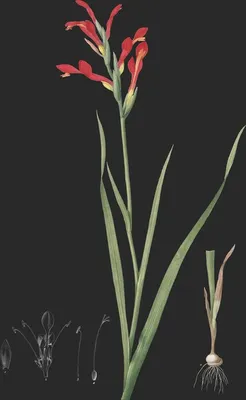
Ixia Patens
Ixia Ouvert
About this plate
Description
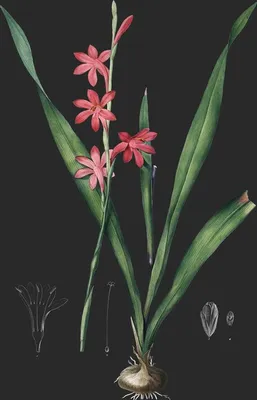
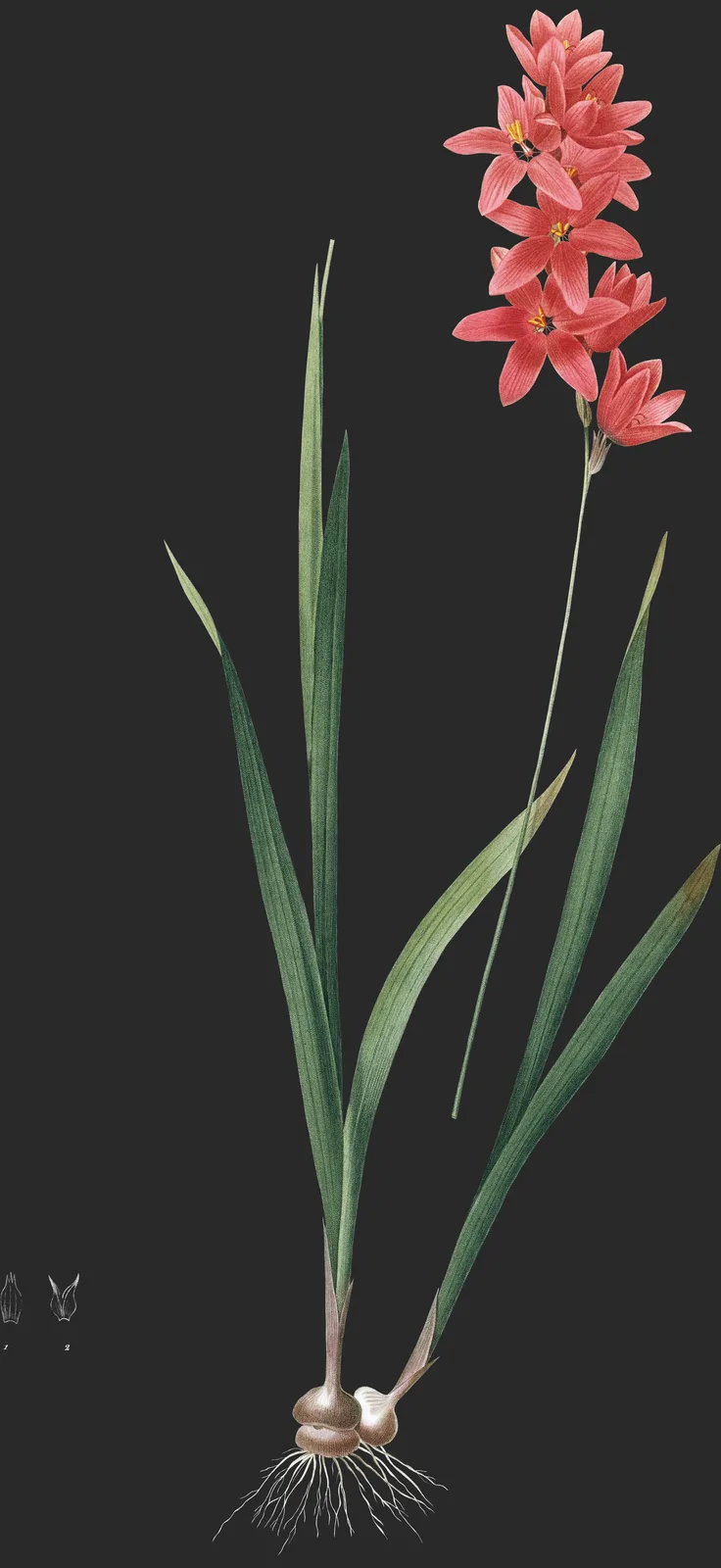
Cette espèce, longtemps cultivée par les jardiniers hollandais, sous le nom vulgaire d’Ixia Kermès, est en effet remarquable par la belle couleur rouge-carmin de ses fleurs.
Sa tige est droite, ferme, grèle, nue vers le sommet, lisse, glabre, simple, deux fois plus longue que les feuilles et atteignant de 6–8 décimètres de hauteur; elle porte vers sa base 4 à 5 feuilles droites, engainantes par le côté, linéaires, en forme de glaive, pointues, larges de 12 millimètres; les supérieures et celles qui naissent près de la racine sont courtes et demi-avortées.
Les fleurs sont au nombre de 6–7, disposées en un épi serré, terminal, simple dans les individus que j’ai sous les yeux, quelquefois rameux, selon Gawler; chacune d’elles sort d’entre deux bractées scarieuses qui embrassent et couvrent l’ovaire: la bractée inférieure est oblongue, divisée en trois pointes droites et grêles; la supérieure est plus courte, divisée seulement en deux pointes.
La corolle a un tube grele, long de 8 millimètres, un peu verdatre; son limbe est en forme de cloche trésouverte, divisé en six lanières oblongues, alternativement un peu inégales, obtuses, longues de a centimètres, sur 8 millimètres de largeur; blanchâtres à leur base, et d’un rouge-carmin dans le reste de leur étendue.
Les trois étamines qui naissent du sommet du tube sont droites et tellement rapprochées, qu’au premier coup d’ceil elles semblent monadelphes. Leurs filaments sont blancs à leur base, roses au sommet, longs de 6–7 millimètres; leurs anthères sont droites, linéaires, égales à la longueurdes filets, de couleur jaune.
L’ovaire est adhérent avec la base de la corolle, ovoïde, presque triangulaire, de couleur verte, caché sous les bractées: le style est filiforme, et atteint la base des anthères, oir il se divise en trois stigmates étalés, comprimés, garnis de papilles, du côté supérieur.
Le fruit n’est pas parvenu à maurité.
Histoire
L’Ixia ouvert est indigène du Cap-de-Bonne-Espérance, d’oi il a d’abord été apporté en Hollande; il y a été longtemps cultivé sous le nom d’Ixia Kermesina, et a ensuite passé dans les jardins botaniques des autres nations, où il est encore peu répandu. ♃.
Il fleurit au milieu du printemps.
Fam. des Iridées. Juss.—Triandrie monogynie. Lin.
- Ixia patens. I. tubo filiformi, limbo campanulato patente, laciniis oblongis, filamentis coaretatis erectis, stigmatis lacioris antheras subæquantibus. Gawler in Cart. mag. t. 522.
- Ixia patens. I. foliis subensiformibus glabris, racemo terminali, corollis campamulatis patalis, laciniis alternis angustioribus, filamentis erectis. Ait. Kew. 1. p. 59. Willd. Spec. 1. p. 201. Pers. Ench. 1. p. 47.
- Isia aristata. Schneev. icon. t. 32.
- Ixia flaccida. Salisb. prod. 36.
Twelve ways of seeing
- measured cast red
- upright 2.17 : 1
- published 1805
- Plate 140
Not a catalogue entry but a way of looking: how to stand, what to notice, how the line was cut, when it flowers, where it came from, who made it — and then the poems and the classics that taught China to see the same flower. Read the twelve in order and the plate opens.
-
First Look
真山水之川谷,远望之以取其势,近看之以取其质。
—— 宋·郭熙《林泉高致·山水训》
Mountains and valleys: from afar take their momentum, up close take their texture — the two distances from which any picture is read.
The sheet is vertical: the eye climbs and settles in the upper half. Let the plant stand before you look for detail. Then step in close: watch where colour meets line, and whether the line ever breaks. Third, find where the green is deepest: the whole tonal order is measured from that patch. The pose leans right: the upper half carries 13 points further right than the lower — a living thing, not a diagram.
-
Name and Thing
The binomial is Ixia ouvert: the first word is the genus it belongs among, the second the epithet that sets it apart. Two words carry a whole provenance. The older system filed it under Iridaceæ by overall affinity; Linnaeus, counting stamens only, placed it in Triandria — two ways of asking what a plant is. No established Chinese name exists, so it is cited by its binomial alone.
-
Form and Colour
Measured on this plate: flower colour covers 5.1% of the sheet, foliage 4.5%, the cast red. No other plate shares exactly this measure. Bulbous plants store the year underground — bulb, corm or tuber — then send up a few thick leaves and a single scape, with six tepals in cup, funnel or star. Filed under green — a moss green, a colour that comes mostly from leaf and stem. A single plant, laid out with nothing hidden.
-
Composition
Tall and narrow, the plant rising in one movement with generous margins — the upright format of most floras. (about 2.17 : 1) No details are appended: a plate for looking, not for keying out. The plant covers only 13% of the sheet, centred a little right of centre; the emptiness is where the eye rests. Old plates set the plant slightly off centre, with unequal margins — that small imbalance is what keeps it alive.
-
Line and Colour
The first half of the nineteenth century moved from copper to steel to lithography; stipple could render the softest transition. Take a loupe to three places: petal edge, leaf vein, caption. An unbroken line means engraving; colour crossing the outline means a hand.
-
Season
Early spring to early summer, genus by genus: tulips and hyacinths first, gladiolus and amaryllis later. The year 1805 on the plate is that of publication, not of flowering — the gathering came a year or two earlier. Note the season. Phenology is the most practical tool of appreciation.
-
Provenance
Three homelands: the Mediterranean, Central Asia and South Africa. The tulip came from Ottoman gardens and became a Dutch mania; South African bulbs filled European glasshouses after 1800. In the same volume the kin are shelved together; set several plates side by side.
-
The Book and the Hand
“The Liliaceae” was drawn by Pierre-Joseph Redouté and published 1802-1816. This plate is Plate 140, book page 140. The image is public domain; the hand-colouring is still one person's hand.
-
Poetic Resonance
不语亭亭俨薄妆,画裙双凤郁金香。
—— 唐·杜牧《偶呈鄭先輩》
The poem gives the mood first and the picture supplies the form; set the line beside the plate and the green the corolla becomes its resting point.
-
The Written Tradition
庭下如积水空明,水中藻荇交横,盖竹柏影也。
—— 宋·苏轼《记承天寺夜游》
The courtyard seemed flooded with clear water, weeds crossing in it — in fact the shadows of bamboo and cypress.
Li Bai's 'orchid wine, fragrant with yujin' is often misread as tulips; the Tang yujin was a turmeric-like root used to scent wine — same name, different plant. The difference is not of quality but of question: Europe asks what it is, China asks whom it resembles.
-
Symbolism
The tulip was an imperial emblem in Istanbul and a speculative bubble in Amsterdam; the hyacinth sprang from a boy's blood in Greek myth. What bulbs share is concealment: next year kept underground. Flower language was added later; the flower knows nothing of it, and that innocence is part of its power.
-
What to Take Away
If you keep one line, keep Guo Xi's: from afar its momentum, up close its texture. The flower of that year is dust, yet its image on paper has outlived every living cousin.