Sisyrinchium Collinum
Sisyrinche des Collines
About this plate
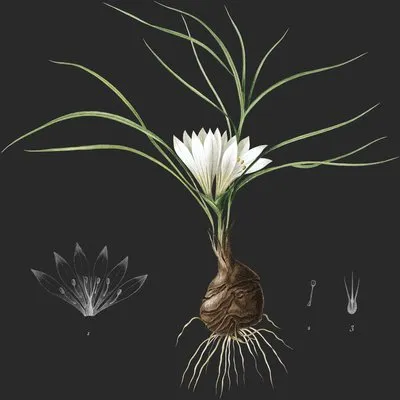
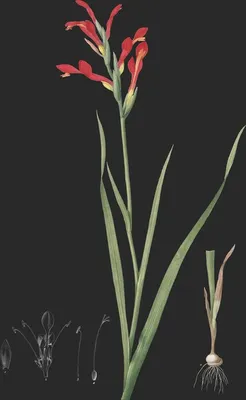
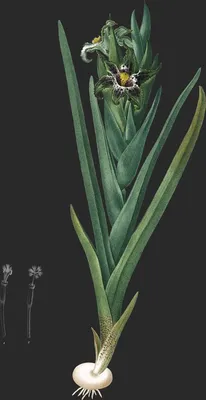
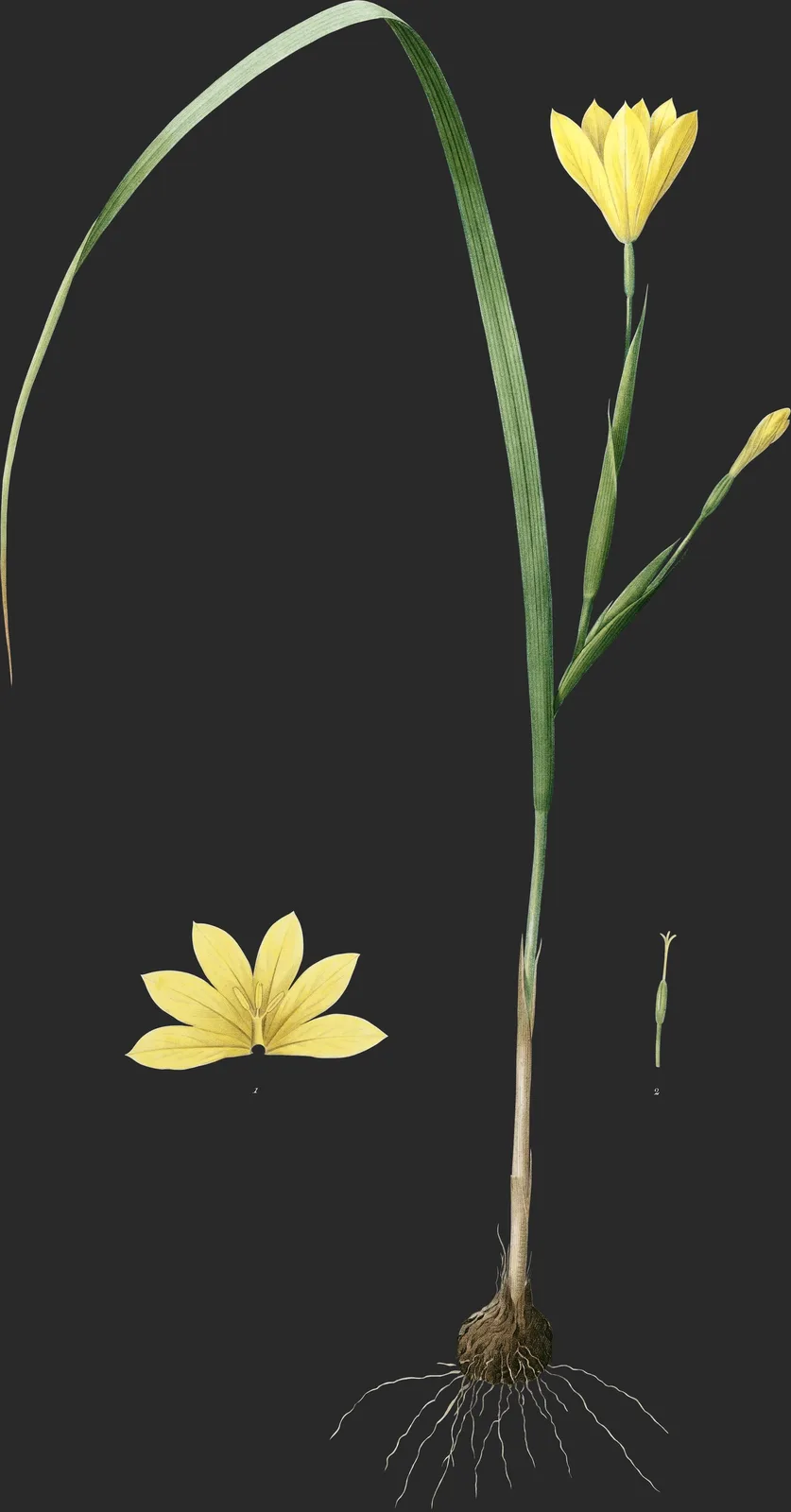
La racine de cette plante est une sorte de bulbe arrondie, noiritre, dont les écailles sont dures, épaisses, demi-ligneuses, soudées ensemble par leurs bords, disposées sur deux ou trois plans, percées d’un grand nombre d’ouvertures allongées, au travers desquelles sortent les fibres radicales. Celles-ci naissent du lieu de jonction de la tige avec un tubercule sphérique, qui a quelque analogie avec ceux des Orchis, et qui est situé au milieu des écailles. Cette singulière racine émet par son sommet une tige haute de trois ou quatre déci-mètres, cylindrique, striée, droite dans le bas, un peu coudée dans sa partie moyenne, simple, ou un peu rameuse, parfaitement glabre, ainsi que tout le reste de la plante, couverte inférieurement par des gaines membraneuses. Elle n’est accompagnée d’aucune feuille radicale. Vers sa partie moyenne, elle porte une feuille linéaire, pointue, longue de quatre à cinq décimètres, creusée en gouttière et engainée à sa base, mais nullement comprimée en forme de glaive. Elle donne ensuite naissance à trois ou quatre feuilles beaucoup plus courtes, situées à l’origine des rameaux, qu’elles embrassent en manière de spathe. Ceux-ci sont simples, peu nombreux, et portent à leur extrémité une fleur solitaire, dont le pédoncule est enveloppé par une spathe à deux valves, lancéolées, foliacées, pointues et presque égales entre elles.
Le périgone, dont la couleur est tantôt jaune, tantôt rositre, est divisé jusqu’à sa base en six segments étalés, ovales-oblongs, longs de quatre centimètres environ, rétrécis à la base, obtus au sommet, marqués dans toute leur longueur d’une nervure moyenne noirâtre.
Les étamines, au nombre de trois, n’atteignent pas la moitié de la longueur des segments du périgone. Leurs filaments sont soudés ensemble dans presque toute leur longueur, de manière à former un tube qui enveloppe le style. Les anthères sont oblongues, redressées, assez volumineuses.
L’ovaire est soudé au périgone. Il est allongé, presque cylindrique, relevé dans sa longueur de six arètes un peu proéminentes. Le style est égal en lon-queur aux étamines. Les stigmates, que nous n’avons pas bien pu examiner, à cause de l’état de dessiccation des échantillons qui ont servi à notre description, sont, suivant Thunberg, un peu renflés au sommet, triangulaires, partagés en deux lèvres, dont l’extérieure est obtuse, échancrée, et l’intérieure est divisée, en deux lanières, courtes, aiguis et recourbées.
Histoire
Le Sisyrinche des collines est originaire du Cap de Bonne-Espérance. Il a été cultivé dans quelques jardins de l’Europe, mais ne parait pas avoir encore été introduit dans ceux de France.
Explication de la planche
La Plante entière de grandeur naturelle.
- Une fleur ouverte.
- L’ovaire et le style.
Fam. des Iris. Juss.—Monadelphie triandrie. Lin.
- Sisyrinchium collinum. S. scapo tereti subramoso folio caulino lineari-acuminato breviore, petalis oblongis acutis. Willd. 3. 578.
- Sisyrinchium collinum. S. scapo tereti, folio dependente, laciniis corollæ subæqualibus. Cavan. diss. 6. p. 346.
- Moræa collina. Thunb. diss. de Moræâ, p. 11. n. 13.
- Moræa collina. M. scapo tereti ramoso, folio unico lineari-ensiformi scapum superante, stigmatibus bilabiatis. Jacq. ic. rar. 2. t. 226.
Twelve ways of seeing
One plate, read twelve times over: its name, its colour, the burin and the brush, the shape of the sheet, the season, the soil it came from, the book it belongs to, its language of flowers, the poem it answers to, the lore behind it, how to look, and what remains.
-
The Name
The plate is titled “Sisyrinchium Collinum”, numbered Plate 250 (book page 250). No reliable binomial survives on the plate, so it must be cited by its original title. Neither a Chinese name nor a reliable binomial survives: the plate can only be cited by its printed title, and left to speak for itself.
-
Form and Colour
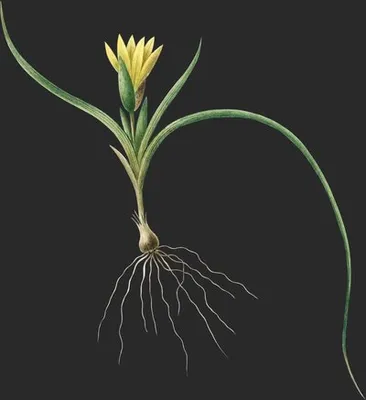
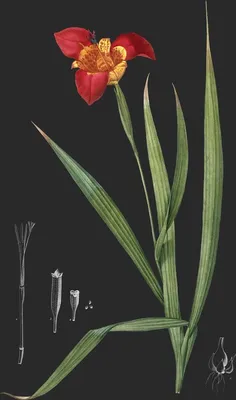
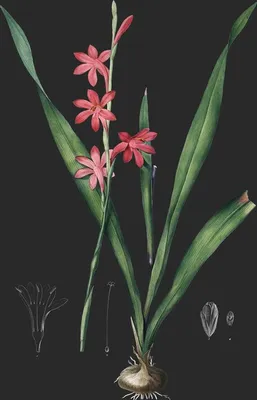
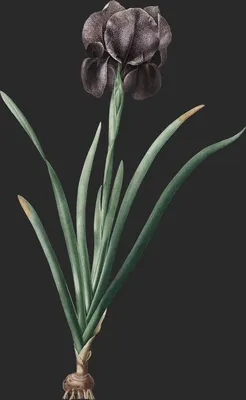
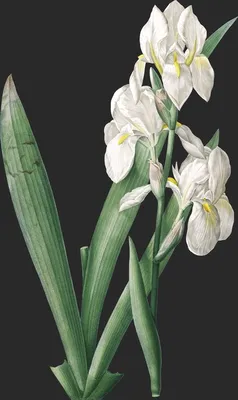
Irises carry rhizomes or bulbs, sword-shaped leaves in two ranks, and six tepals — three falls drooping, often bearded or speckled, three standards erect. Filed under yellow — a honey-yellow. The colour is built in washes: a pale ground first, then deepening at the petal base and in shadow. Three things fix the habit: leaf arrangement, tepal count, and how the flower is borne.
-
Line and Colour
The first half of the nineteenth century moved from copper to steel to lithography. Stipple could render the softest transition — Redouté's roses depend on it — while lithography suited broad, gentle washes. Look closely at the line and the colour: an unbroken line means engraving, colour crossing the outline by half a millimetre means hand-colouring. Craft leaves franker evidence than inscriptions.
-
Composition
Tall and narrow, the plant rising in one movement with generous margins above and below — the upright format of most floras. (about 1.91 : 1). No details are appended: this is a plate for looking, not for keying out.
-
Season
Late spring to early summer, peaking in April and May, before the summer rains. The year 1809 on the plate is the year of publication, not of flowering — the gathering came a year or two earlier.
-
Provenance
Temperate north. In China iris and sweet flag belong to the Dragon Boat festival; in Europe Iris germanica gave the perfume trade its orris root. The volume was made in 1802-1816, when most of this knowledge came from living plants under glass rather than from the wild.
-
The Book
“The Liliaceae” was drawn by Pierre-Joseph Redouté and published 1802-1816. This plate is Plate 250, book page 250. The image is in the public domain; the hand-colouring on the paper is still one person's hand, two centuries ago.
-
Symbolism
In China sweet flag hung at the door wards off evil at midsummer; in Europe the iris is the messenger, since Iris was the rainbow goddess who carried divine words. This plate leans yellow, which in flower language adds one more degree of feeling. Meanings change their tune: the same flower can say opposite things within a century.
-
Poetic Resonance
蓝田日暖玉生烟。
—— 唐·李商隐《锦瑟》
In warm sun over Lantian, the jade gives off smoke.
The poem gives the mood first and the picture supplies the form; set the line beside the plate and the yellow the corolla becomes its resting point.
-
Classical Lore
The Bencao Gangmu lists iris and sweet flag among herbs; the Jingchu seasonal records describe hanging mugwort and flag at the door at midsummer — a custom unbroken for a thousand years. Chinese flower books ranked plants by character; European floras described them by form and name. This plate belongs to the second tradition, yet bears reading by the first. A flora asks what it is; a flower book asks what it means. Read both or half-read the plate.
-
How to Look
Look for a beard or a signal patch on the falls — a beard points to the bearded irises, a patch to the beardless. The fan-shaped leaf arrangement confirms the family. Stand back for the habit, step close for the meeting of line and colour.
-
Afterword
The flower of 1809 is dust, yet its image on paper has outlived every living cousin.