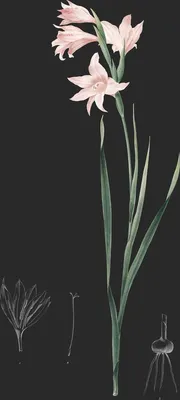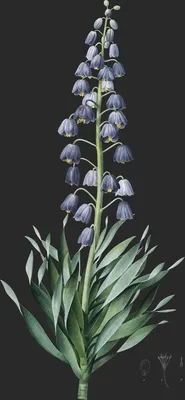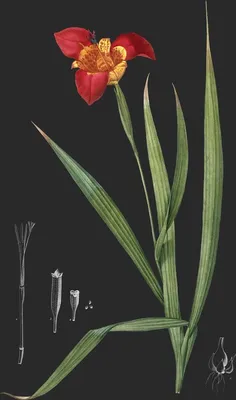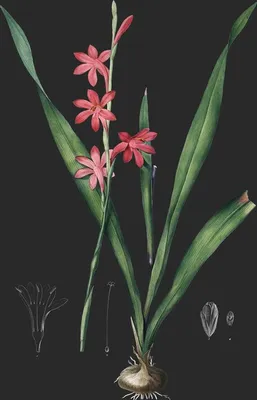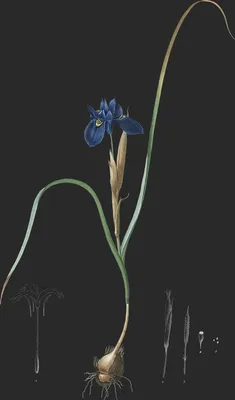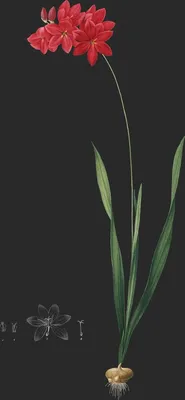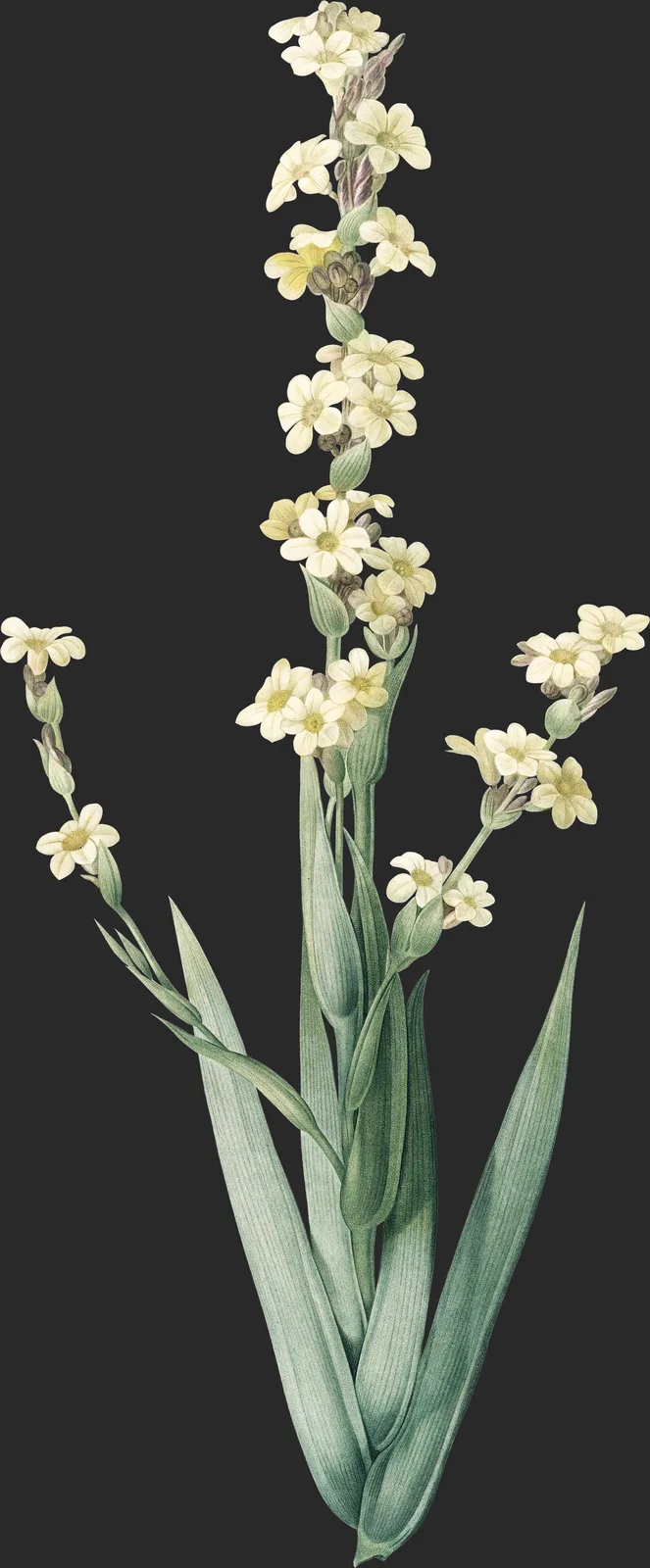
Sisyrinchium Striatum
Bermudienne Striée
Bermudienne Striée
About this plate
Description
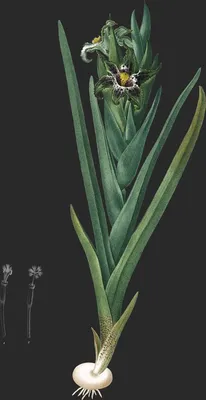
Quoique la connaissance de cette Liliacée ne remonte pas à un temps éloigné, elle se trouve cependant si bien décrite et représentée si fidèlement dans les ouvrages des naturalistes modernes, que je crois inutile d’en donner une description détaillée.
Une racine branchue et fibreuse donne naissance à une ou plusieurs tiges, simples ou rameuses, hautes de 5–8 décimètres, qui sont réellement cylindriques, mais qui paraissent comprimées et tranchantes sur le dos comme celles des Iris; ces feuilles sont alternes, presque disposées sur deux rangs, droites, pointues, et marquées de nervures longitudinales peu sensibles.
Le sommet de la tige présente un thyrse ou un épi droit, alongé, composé de spathes alternes, d’où sortent successivement plusieurs fleurs (douze et au delà) pédicellées, légèrement odorantes, jaunâtres, marquées surtout en dehors de nervures anastomosées, brunes ou purpurines: on trouve dans la spathe, entremélées avec les pédicelles, des bractées linéaires qui semblent naitre à la base de chaque fleur.
La corolle est posée sur l’ovaire, dépourvue de tube, en forme de cloche, divisée presque jusqu’à la base en six lamières oblongues, obtuses, surmontées d’une petite pointe; les trois filaments des étamines sont réunis presque jusqu’à leur sommet en une colonne droite, égale à la longueur de la corolle; sous la fleur est un ovaire globuleux, légèrement triangulaire, d’où s’élève un style capillaire, égal aux étamines, divisé en trois stigmates.
Le fruit est une capsule globuleuse, un peu triangulaire, marquée au sommet par un disque orbiculaire dû à la chute de la corolle, divisée en trois loges, formée par trois valves, remplie de graines nombreuses, ovoïdes, chagrinées, attachées à l’angle interne des loges.
Histoire
Cette plante est originaire du Mexique. ♃.
Elle est introduite depuis environ quinze ans dans nos jardins de botanique, où elle fleurit chaque été: elle se multiplie, soit par ses graines, qui mürissent ordinairement dans nos jardins, soit par la division de ses racines.
Fam. des Iridées. Juss.—Monadelphie triandrie. Lin.
- Siavrinchium striatum. S. foliis ensiformibus, caule ancipiti ramosissimo multifloro, floribus spatham excedentibus. Smith. ic. pict. 1. p. 9. 1. 9.
- Sisyrinchium striatum. S. scapo ancipiti folioso, floribus spicatis, petalis subrotundo-ovatis acutis, foliis lineari-ensiformibus. Willd. Spec. 3. p. 580.
- Sisyrinchium spicatum. S. caule compresso, spathis multifloris alternis in spicam adproximatis. Cav. ic. 2. p. 2. 1. 104.
- Morcea sertata. M. scapo tereti, foliis ensiformibus, racemo erecto, floribus aggregatis. Jacq. Hort. Schenbr. 1. p. 6. t. 11.
Twelve ways of seeing
- measured cast yellow-green
- upright 2.41 : 1
- published 1804
- Plate 66
Not a catalogue entry but a way of looking: how to stand, what to notice, how the line was cut, when it flowers, where it came from, who made it — and then the poems and the classics that taught China to see the same flower. Read the twelve in order and the plate opens.
-
First Look
江馆清秋,晨起看竹,烟光日影露气,皆浮动于疏枝密叶之间。
—— 清·郑板桥《题画竹》
On an autumn morning at the river lodge I looked at the bamboo: mist, sunlight, dew, all drifting among the sparse and dense leaves.
The sheet is vertical: the eye climbs and settles in the upper half. Let the plant stand before you look for detail. Then step in close: watch where colour meets line, and whether the line ever breaks. Third, find where the yellow is deepest: the whole tonal order is measured from that patch.
-
Name and Thing
The binomial is Sisyrinchium striatum: the first word is the genus it belongs among, the second the epithet that sets it apart. Two words carry a whole provenance. The older system filed it under Iridaceæ by overall affinity; Linnaeus, counting stamens only, placed it in Monandria — two ways of asking what a plant is. No established Chinese name exists, so it is cited by its binomial alone.
-
Form and Colour
Measured on this plate: flower colour covers 3.3% of the sheet, foliage 4.0%, the cast yellow-green. No other plate shares exactly this measure. Irises carry rhizomes or bulbs, sword-shaped leaves in two ranks, and six tepals — three falls drooping, often bearded or speckled, three standards erect. Filed under yellow — a honey-yellow, built in washes from a pale ground. Three things fix the habit: leaf arrangement, tepal count, and how the flower is borne.
-
Composition
Tall and narrow, the plant rising in one movement with generous margins — the upright format of most floras. (about 2.41 : 1) No details are appended: a plate for looking, not for keying out. The plant covers only 23% of the sheet, centred below centre; the emptiness is where the eye rests. Blank paper is not unfinished work: it is where the eye rests.
-
Line and Colour
The first half of the nineteenth century moved from copper to steel to lithography; stipple could render the softest transition. There is evidence on the back too: the plate mark pressed into the paper, the slight relief of the pigment, lines worn shallow in a later printing.
-
Season
Late spring to early summer, peaking in April and May, before the summer rains. The year 1804 on the plate is that of publication, not of flowering — the gathering came a year or two earlier. The best time to read such a plate is its flowering season: three minutes under the tree explains what no text can.
-
Provenance
Temperate north. In China iris and sweet flag belong to the Dragon Boat festival; in Europe Iris germanica gave the perfume trade its orris root. The localities on the plate are those of a century ago; plants travel and places change their names.
-
The Book and the Hand
“The Liliaceae” was drawn by Pierre-Joseph Redouté and published 1802-1816. This plate is Plate 66, book page 66. The image is public domain; the hand-colouring is still one person's hand.
-
Poetic Resonance
但恨今无遏云曲,送我菖蒲一杯绿。
—— 宋·范成大《子文大丞重午日走貺煮酒清甚殆與遠水一色何其妙哉數語奉謝》
The poem gives the mood first and the picture supplies the form; set the line beside the plate and the yellow the corolla becomes its resting point.
-
The Written Tradition
论画以形似,见与儿童邻。
—— 宋·苏轼《书鄢陵王主簿所画折枝》
To judge a painting by likeness alone is the view of a child.
The Bencao Gangmu lists iris and sweet flag among herbs; the Jingchu seasonal records describe hanging mugwort and flag at the door at midsummer — a custom unbroken for a thousand years. Keep the line; it will surface the next time you meet the same plant.
-
Symbolism
In China sweet flag hung at the door wards off evil at midsummer; in Europe the iris is the messenger, since Iris was the rainbow goddess who carried divine words. This plate leans yellow, which in flower language adds one more degree of feeling. Meanings change their tune: the same flower can say opposite things within a century.
-
What to Take Away
Next time you stand before a flowering plant, give it three minutes: leaf arrangement, direction of the flower, the darkest patch. A flora exists to be consulted; look long enough and you forget to consult — someone in 1804 gave a whole day to a single flower.